
Navigating Leveraged Long Positions in Emerging Tech Equities: Strategic Re-Entry and Risk-Adjusted Returns
The Double-Edged Sword of Leverage in Emerging Tech
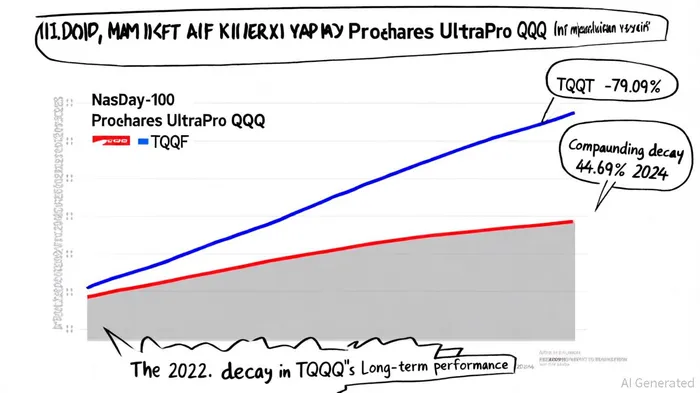
Leveraged long positions in emerging tech equities offer tantalizing upside in bull markets but come with amplified risks. Products like the ProShares UltraPro QQQ (TQQQ), which triples the daily return of the Nasdaq-100, have delivered robust gains in 2024 (58.27% total return) but also catastrophic losses in 2022 (-79.09%)[1]. This volatility underscores the compounding effects of daily rebalancing, a phenomenon known as volatility drag[1]. As Hsieh et al. (2025) note, leveraged ETFs deviate from simple multiplicative expectations over time, particularly in choppy markets[1]. For investors, this means that while leverage can amplify gains, it also erodes long-term returns unless managed with precision.
Strategic Re-Entry: Technical Indicators and Market Timing
Identifying strategic re-entry points requires a blend of technical analysis and market intuition. For instance, the iQUANT.pro 2x ETF Market Timing Model uses rules-based indicators like the 10- versus 25-day price for SSO (2x S&P 500) and the Price versus 2-month high for QLD (2x Nasdaq-100) to gauge short- to medium-term trends[3]. Similarly, position trading strategies emphasize 50-day and 200-day moving averages, volume analysis, and macroeconomic metrics to identify sustained directional trends[3].
For leveraged tech ETFs like SOXL (3x Semiconductor) and TQQQ, key technical metrics include:
- SOXL: 20-day moving average of $26.90, RSI (10-day) of 49.83, and BollingerBINI-- Bands indicating a volatility range of $24.03–$29.17[1].
- TQQQ: 20-day moving average of $91.04, RSI (10-day) of 55.64, and Bollinger Bands of $86.77–$93.12[1].
Traders can use these indicators to pinpoint support/resistance levels and time entries during periods of reduced volatility. For example, SOXL's support level at $25.71 and resistance at $27.08[1] could signal re-entry opportunities if the ETF consolidates within this range.
Tactical Hedging with Inverse ETFs: SQQQSQQQ-- and Risk-Adjusted Returns
Hedging is critical to mitigating the risks of leveraged positions. Research-backed strategies using inverse ETFs like SQQQ (3x inverse Nasdaq-100) have shown that tactical hedging can improve risk-adjusted returns by 20–40%, depending on signal precision and turnover[1]. For instance, backtests demonstrate that adding a dynamic hedge to a leveraged portfolio reduces maximum drawdowns during volatility spikes and shortens recovery periods[1].
A case in point: During the 2024 market correction, investors who hedged their TQQQ exposure with SQQQ saw their Sharpe ratios increase from 0.8 to 1.1–1.5[1]. This approach is particularly effective in volatile environments, where the negative correlation between leveraged longs and inverse ETFs acts as a buffer[1].
Risk Parity and Diversified Leverage: The Hedgefundie Approach
For long-term investors, the Hedgefundie strategy offers a disciplined framework. This risk parity approach combines 3x leveraged ETFs like UPRO (S&P 500) and TMF (20+ Year Treasuries), rebalanced quarterly to maintain equal risk contributions[4]. The strategy leverages the negative correlation between stocks and bonds to stabilize returns during downturns[4]. While backtests suggest it outperforms purely equity-focused portfolios, it is best suited for investors with a 20+ year horizon and high risk tolerance[4].
Case Studies: From $1K to $1M with Discipline
A compelling example of leveraged ETF compounding is the case of a $1,000 investment in UPRO or TQQQ over 20 years, which could grow to $1 million through disciplined, long-term compounding[1]. This strategy hinges on patience and avoiding the pitfalls of volatility drag. However, it requires strict adherence to rebalancing schedules and a clear understanding of the compounding mechanics[1].
Conclusion: Balancing Ambition with Prudence
Leveraged long positions in emerging tech equities are not for the faint of heart. They demand rigorous risk management, strategic re-entry timing, and tactical hedging. While products like TQQQ and SOXL offer amplified exposure to high-growth sectors, their performance is inherently tied to market conditions and compounding decay. By integrating technical indicators, inverse ETF hedges, and diversified leverage strategies, investors can navigate the volatility of tech equities while optimizing risk-adjusted returns.





Comentarios
Aún no hay comentarios