
Navigating the Labor Market Slowdown: Strategic Sectors for Resilience Amid Rising US Unemployment Claims
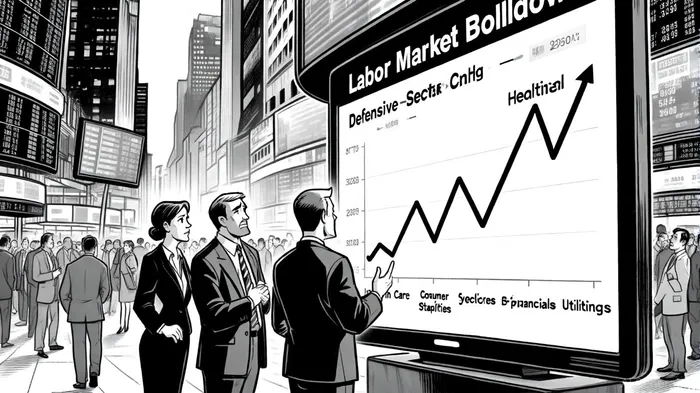
The U.S. labor market, once a bastion of resilience, is showing signs of strain. According to a Reuters report, initial unemployment claims rose to 224,269 in the week ending September 27, 2025, marking a marginal but telling uptick in jobless filings. Meanwhile, the Monthly Labor Review underscores a broader trend: employment gains between April 2024 and March 2025 were overestimated by 911,000 jobs, and hiring has since stagnated. This slowdown, compounded by President Trump's trade policies and the disruptive ascent of artificial intelligence, has left businesses hesitant to hire or fire, creating a limbo that investors must navigate with precision.
The Case for Defensive Investing
In such an environment, defensive investing becomes a necessity. The Schwab Center for Financial Research highlights, in its Monthly Stock Sector Outlook, that the Health Care sector remains a cornerstone of stability, as demand for essential services persists regardless of economic cycles. Similarly, Consumer Staples-a sector built on the unshakable need for food, household goods, and personal care-continues to draw capital from risk-averse investors. These sectors are not immune to challenges, however; inflationary pressures and rising input costs threaten profit margins if not managed adeptly.
Yet the playbook for resilience extends beyond these traditional safe havens. The labor market's uneven performance-where younger workers face a 10.5% unemployment rate while prime-age workers hover near 3.6%-suggests a fragmented landscape. Sectors like Leisure and Hospitality, which have added jobs in arts, entertainment, and food services, offer unexpected resilience, according to a SHRM review. This aligns with broader consumer behavior: even in downturns, people prioritize experiences and basic services, making these industries less volatile than trade-dependent counterparts like manufacturing.
Sector Rotation: Balancing Risk and Opportunity
For investors seeking to capitalize on shifting dynamics, sector rotation is key. A momentum-based approach, as outlined by AI Signals, prioritizes sectors with sustained price strength, using tools like the Relative Strength Index (RSI) to identify overperformers. Thematic investing, meanwhile, targets long-term trends such as renewable energy and cybersecurity-industries poised to benefit from policy shifts and technological adoption.
The Energy sector, for instance, remains a wildcard. While oil prices have been volatile, geopolitical tensions and potential regulatory changes could spark a rebound, making it a high-risk, high-reward bet. Conversely, Utilities-a sector often overlooked-offers the stability of regulated pricing and inelastic demand, making it a natural hedge against economic uncertainty, as noted by TraderHQ.
A risk-on/risk-off strategy further sharpens the toolkit. When market sentiment improves, cyclical sectors like Industrials and Financials may outperform, but as volatility resurges, defensive sectors like Health Care and Utilities provide a buffer. This duality requires constant recalibration, particularly in a labor market where wage growth remains modest and job openings outpace available workers, according to the Monthly Labor Review.
The Road Ahead
The labor market's current state-a mix of stagnation and selective resilience-demands a nuanced approach. While the unemployment rate clings to 4.2%, the underlying data tells a more complex story: a declining labor force participation rate, downward revisions to past job gains, and a growing divide between sectors. For investors, this means avoiding a one-size-fits-all strategy.
As Alpha Picks by Seeking Alpha notes, defensive portfolios should prioritize companies with strong fundamentals, such as high Alpha Scores and reliable dividend histories. This is particularly critical in Health Care and Utilities, where innovation and demographic trends (e.g., aging populations) create long-term tailwinds.
In the end, the labor market slowdown is not a harbinger of collapse but a call to adapt. By rotating into defensive sectors, leveraging thematic opportunities, and staying attuned to macroeconomic signals, investors can weather the storm-and position themselves for the next upturn.







Comentarios
Aún no hay comentarios