
Navigating Key Buy Points Amid Upcoming Economic Data Releases
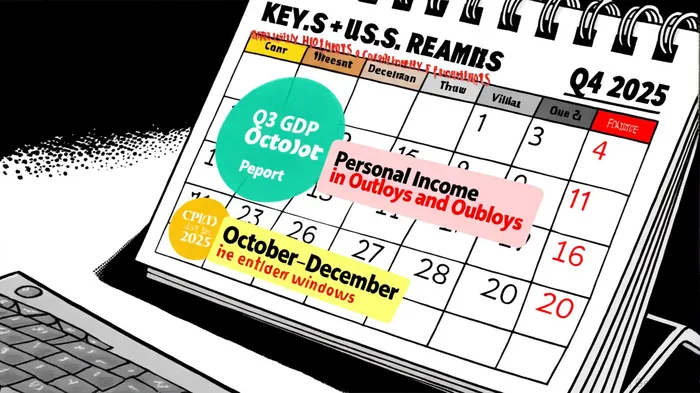
The fourth quarter of 2025 presents a critical juncture for investors seeking to capitalize on market volatility driven by key economic data releases. With the U.S. economy navigating a "higher-for-longer" interest rate environment[1], strategic entry timing hinges on understanding how macroeconomic signals—such as GDP, inflation metrics, and trade data—will shape asset valuations. By leveraging historical volatility patterns and advanced forecasting tools, investors can identify low-risk entry points amid the anticipated turbulence.
Key Data Releases and Volatility Drivers
The Bureau of Economic Analysis (BEA) has scheduled the Q3 2025 U.S. GDP report for October 30, 2025[2], a date likely to trigger significant market reactions. This advance estimate will provide the first glimpse into whether the U.S. economy is maintaining its resilience against tightening monetary policy. Concurrently, the Personal Income and Outlays data, released monthly through October, November, and December, will offer granular insights into consumer spending and inflation trends[2]. These metrics are particularly critical as they directly influence Federal Reserve policy decisions and bond yields.
Meanwhile, the Consumer Price Index (CPI) and Producer Price Index (PPI), slated for late 2025 releases[2], will remain pivotal for gauging inflationary pressures. Historical data reveals that CPI announcements have suppressed volatility 70% of the time[3], but exceptions like the Services ISM report suggest that the comprehensiveness of data can amplify market swings. Investors must prepare for asymmetric outcomes, especially if actual figures deviate sharply from forecasts.
Historical Volatility Patterns and Strategic Implications
Contrary to popular assumptions, major economic data releases often suppress volatility rather than exacerbate it. For instance, the VIX index has historically closed lower on 70% of Non-Farm Payrolls (NFP) announcement days[3], reflecting a "price-in" effect where markets discount expectations ahead of official releases. However, this pattern is notNOT-- universal: the Services ISM and PCE deflator have shown greater volatility spikes[3], underscoring the need for nuanced timing strategies.
Machine learning models now outperform traditional GARCH and HAR volatility forecasts by integrating macroeconomic variables, investor sentiment, and global market dynamics[4]. These tools enable investors to construct volatility-timing portfolios that adjust exposure based on predicted market turbulence. For example, reducing equity allocations ahead of high-impact data releases (e.g., Q3 GDP) and reallocating to defensive assets like gold or inflation-linked bonds[1] can mitigate downside risks.
Tactical Entry Strategies for Q4 2025
- Pre-Release Positioning:
- Reduce exposure to high-beta equities in the days leading up to major releases (e.g., October 29–30 for Q3 GDP). Historical data suggests that volatility spikes are more common when outcomes surprise to the downside[3].
Increase cash or fixed-income allocations to capitalize on potential "buy-the-dip" opportunities post-release. Vanguard's 2025 outlook emphasizes global bonds and inflation-linked securities as hedges against policy uncertainty[1].
Post-Release Rebalancing:
- Enter equities selectively if data aligns with or exceeds expectations, particularly in sectors sensitive to rate cuts (e.g., utilities, real estate).
Use volatility spikes to add to undervalued positions. For example, a sharp rise in the VIX following a weak GDP report could signal oversold conditions in growth stocks[4].
Dynamic Asset Allocation:
- Leverage low-volatility portfolios during data-heavy periods. Studies show these portfolios outperform during high-volatility environments by reducing drawdowns[5].
- Monitor the Put/Call ratio and VIX as real-time sentiment indicators. A rising Put/Call ratio ahead of a release may signal impending volatility, prompting defensive adjustments[4].
Conclusion
The Q4 2025 economic calendar offers both risks and opportunities for strategic investors. By combining historical volatility insights with cutting-edge forecasting models, market participants can navigate data-driven turbulence with precision. Key entry points will emerge around the Q3 GDP release on October 30 and subsequent CPI/PPI reports, provided investors remain agile in adjusting their asset allocations. As Vanguard notes, maintaining a long-term perspective while exploiting short-term volatility is the hallmark of resilient portfolios in uncertain times[1].







Comentarios
Aún no hay comentarios