
Navigating the Impact of AI on Higher Education and Future Workforce Demand: Investing in STEM and Vocational Programs as a Hedge Against Automation Disruption
AI's Transformation of Higher Education and Workforce Pathways
The traditional model of higher education-static curricula, four-year degrees, and linear career paths-is increasingly obsolete in an era where AI tools evolve faster than textbooks. According to a Forbes report, institutions are now prioritizing "AI fluency" as a foundational skill, integrating it across disciplines rather than confining it to computer science departments. This shift is driven by real-time labor market data, which reveals that AI is not just replacing jobs but augmenting them. For instance, in high-paying roles involving data analysis, AI adoption has led to productivity gains that sustain or expand employment, provided workers develop complementary skills like critical thinking and ethical judgment.
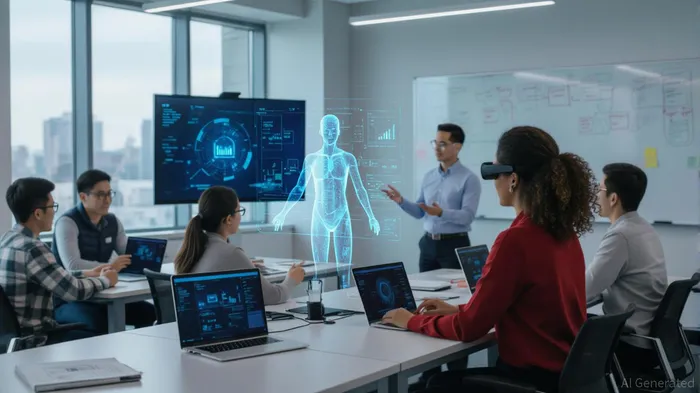
Vocational and STEM programs are emerging as essential investments in this landscape. A 2025 study by the U.S. Bureau of Labor Statistics projects substantial growth in roles such as software developers and data architects, underscoring the need for training programs that align with AI-driven demand. Moreover, industries like healthcare and construction-where human expertise remains irreplaceable-are retooling their curricula to include AI literacy, ensuring workers can leverage technology to enhance, rather than be displaced by, automation.
Economic Returns on STEM and Vocational Investments
The economic case for investing in STEM and vocational education is compelling. A 2025 OECD report highlights that AI investment in education and training has a statistically significant positive effect on GDP growth, with the AI in education market alone projected to surge from $7.05 billion in 2025 to $112.30 billion by 2034. This growth is fueled by both public and private sectors: the U.S. Department of Labor recently allocated $30 million in grants to address workforce shortages in AI and skilled trades, while the EdTech market-valued at $277.2 billion in 2025 is expected to reach $907.7 billion by 2034.
Institutions that align their programs with industry needs are already seeing returns. MIT's Schwarzman College of Computing and platforms like OpenClassrooms, which offer apprenticeship-based degrees, have demonstrated scalable ROI through improved student outcomes and employment rates. Similarly, vocational programs emphasizing AI literacy and data analysis are closing skills gaps in sectors like semiconductor manufacturing, where the U.S. faces a critical shortage of engineers and technicians.
Funding Trends and Policy Challenges
Federal and state funding trends reflect a growing recognition of the urgency to invest in AI-aligned education. The National Science Foundation (NSF) has launched initiatives to build a national infrastructure for AI education, including K-12 expansions and support for two-year institutions. However, challenges persist. Recent federal funding cuts have forced states to collaborate with ed-tech vendors and private stakeholders to fill gaps, while restrictive immigration policies threaten to undermine the U.S.'s reliance on foreign-born STEM talent. A report by the Center for American Progress estimates that declining international STEM enrollment could cost the U.S. economy $240–$480 billion annually by 2025.
Investment Opportunities and Risks
For investors, the opportunities in STEM and vocational education are vast but not without risks. The EdTech sector, driven by AI-driven innovations like personalized learning and VR/AR tools, offers high-growth potential. However, success depends on addressing systemic challenges: workforce displacement, equitable access to education, and policy uncertainties. Institutions that integrate AI comprehensively-both in academic programs and operational functions-are well-positioned to thrive. Conversely, programs that fail to adapt risk obsolescence as automation accelerates.
Conclusion
The AI revolution is not a distant threat but an ongoing transformation. For higher education and vocational training, the path forward lies in agility-rethinking curricula, embracing lifelong learning, and aligning with labor market needs. For investors, the stakes are equally high. STEM and vocational programs are not just educational tools but strategic assets in a world where automation is both a disruptor and an enabler. The question is no longer if to invest but how to invest wisely, ensuring that education remains a ladder to opportunity in an AI-driven future.







Comentarios
Aún no hay comentarios