
Navigating Holiday Market Closures and Volatility: Strategic Positioning for Reduced-Liquidity Periods
The end-of-year holiday season, marked by closures for Christmas, New Year's, and regional banking holidays, consistently triggers a sharp decline in market liquidity and a corresponding rise in volatility. From 2020 to 2025, , while fixed-income and foreign exchange (FX) markets experience even steeper declines, with
on Christmas Eve and Boxing Day. These liquidity constraints, driven by reduced trading activity and overlapping holidays, amplify execution costs and price fluctuations, particularly in thinly traded assets. For investors, understanding and proactively managing these seasonal dynamics is critical to mitigating risk and optimizing returns.
Historical Patterns of Liquidity and Volatility
The holiday-driven liquidity crunch is a well-documented phenomenon. U.S. fixed-income markets, for instance, , , respectively
according to Russell Research. FX markets, which rely heavily on continuous global participation, face a steady erosion of liquidity through year-end, with bid-ask spreads widening significantly. Similarly, derivatives and credit markets exhibit prolonged execution times and higher trading costs during this period.
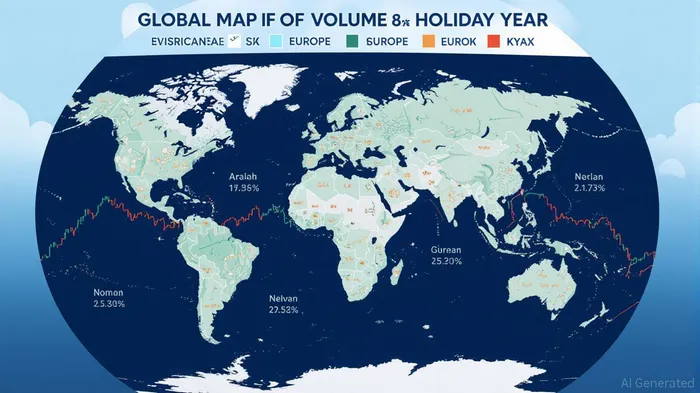
This seasonal pattern is exacerbated by the psychological impact of holidays on investor behavior.
Studies show that holidays initially elevate investor sentiment-a "therapeutic effect"-but this fades into a "hygienic effect," where sentiment stabilizes without significant improvement. While this may reduce short-term trading activity, it does not eliminate the structural risks posed by liquidity gaps.
Strategic Positioning: Execution Timing and Liquidity Management
To navigate these challenges, investors must adjust their execution timelines.
Data from 2020–2025 underscores . For example,
the MSCI semi-annual rebalance on November 25, 2025 temporarily boosted liquidity, offering a window for strategic positioning before the broader holiday-driven slowdown.
Institutional investors also leverage securities-based loans to maintain liquidity without disrupting long-term portfolios. These tools allow access to capital for opportunities like business expansions or market rebalancing while preserving core holdings
according to JPMorgan Private Bank. A case study from 2025 highlights how a high-net-worth individual used a variable prepaid forward (VPF) to monetize company stock,
securing liquidity for diversification while retaining upside potential.
Hedging and Asset Allocation Adjustments
Hedging strategies during reduced-liquidity periods require careful calibration. Dynamic hedging mechanisms, such as option replication, can backfire in volatile environments,
as seen during the 1987 crash and the 1998 LTCM crisis. Instead, experts recommend non-linear hedging components and stress-testing risk appetite against potential shocks
according to . For fixed-income and FX exposures, this might involve layered hedges or adjusting position sizes to align with narrower liquidity windows.
Asset allocation shifts also play a pivotal role. Liquid diversifiers-such as high-yield bonds, REITs, and inflation-linked assets-offer uncorrelated returns and reduce portfolio risk during volatile periods
according to Cambridge Associates. Additionally, securities-based loans enable investors to access liquidity without selling assets, preserving strategic allocations while addressing short-term needs
according to JPMorgan Private Bank.
Institutional Practices and Innovations
Institutional investors have increasingly adopted semiliquid fund structures to balance growth-oriented private market allocations with liquidity needs . These hybrid vehicles provide partial liquidity, addressing the "liquidity crunch" observed in private markets in 2025, where European firms struggled with capital returns and fundraising . Such innovations reflect a broader trend toward tailored risk management frameworks that prioritize flexibility and resilience.
Conclusion
The holiday-driven liquidity crunch is a predictable yet complex challenge for investors. By aligning execution timelines with seasonal liquidity cycles, deploying hedging strategies calibrated to market stress, and leveraging liquid diversifiers and structured financing tools, investors can mitigate risks and capitalize on opportunities. As markets continue to evolve, proactive positioning-rooted in historical insights and institutional best practices-remains essential for navigating the end-of-year volatility with confidence.





Comentarios
Aún no hay comentarios