
Navigating Holiday Market Closures: Strategic Insights for Optimizing Portfolio Performance
The stock market's seasonal rhythms, shaped by major holidays and liquidity shifts, present both challenges and opportunities for investors. From the pre-holiday rally to the summer doldrums, historical patterns reveal how market behavior evolves around key calendar events. By understanding these dynamics, investors can refine their timing and asset allocation strategies to mitigate risk and enhance returns.
Seasonal Patterns and the Pre-Holiday Effect
One of the most well-documented phenomena is the pre-holiday effect, where stock returns tend to rise on the final trading day before a major holiday. This pattern has been observed globally, including in the U.S., U.K., and Hong Kong markets according to research. For instance, the S&P 500 has historically closed higher on the day before Thanksgiving and Christmas, driven by a combination of investor optimism and reduced trading activity. However, this effect has weakened in recent years as market efficiency and algorithmic trading have arbitraged away some of these anomalies.
The January Effect-a seasonal rally in small-cap stocks-also underscores the influence of calendar-driven behavior. This phenomenon is often attributed to year-end tax-loss harvesting and portfolio rebalancing. While its magnitude has diminished, it remains a relevant consideration for investors seeking to position portfolios ahead of the new year.
Liquidity Shifts and the Holiday Trading Effect
Liquidity, a critical factor in execution costs and portfolio performance, undergoes pronounced seasonal shifts around holidays. From late November to early January, trading volumes across asset classes decline sharply. For example:
- U.S. equity volumes fall to 80% of normal levels the day before Thanksgiving and drop to 45% the day after, which is a half-day session.
- Global equity volumes in mid-December often trade at 45–70% of normal levels, with similar declines in fixed income and foreign exchange markets.
These liquidity reductions create wider bid-ask spreads and higher transaction costs, particularly for large trades. 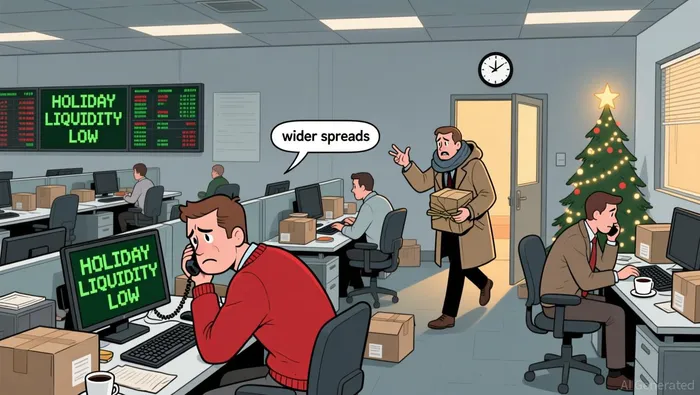 The August-September slump, another seasonal trend, sees the S&P 500 underperform due to reduced volume, portfolio rebalancing, and heightened volatility according to market analysis. Cyclical sectors and high-beta stocks are especially vulnerable during these periods.
Strategic Adjustments for Holiday Periods
To navigate these challenges, investors can adopt several strategies:
1. Timing Execution: Completing major trades before mid-December or waiting until early January-when liquidity typically rebounds-can reduce implementation risk.
2. Position Sizing: Reducing exposure during low-liquidity periods minimizes slippage and price volatility.
3. Order Types: Limit orders are preferable to market orders during holidays, as they allow investors to control entry and exit points.
4. Asset Selection: Focusing on major currency pairs (e.g., EUR/USD, USD/JPY) and defensive assets like gold (GLD) can provide stability during thin markets.
5. Liquidity Tools: Utilizing liquidity heatmaps and volume indicators enhances execution efficiency.
For example, a strategy of buying Amazon five days before Thanksgiving and holding through three days after has historically delivered an average annual return of 5.18%. Similarly, a Christmas-focused gold strategy (buying GLD two days before the holiday) has yielded 2.48% annually.
Academic Insights and Portfolio Resilience
Academic research further underscores the value of holiday-driven strategies. A study on cultural calendars and gold prices found that gold ETFs like GLD exhibit abnormal returns around major holidays, including Christmas, due to socio-cultural demand for wealth transfer. Another study highlighted seasonal shifts in investor risk preferences, with a tendency to favor safer assets in autumn and riskier ones in spring according to quantitative analysis.
To build resilient portfolios, investors should diversify across uncorrelated assets, as recommended by J.P. Morgan. Structured notes and bonds can also provide downside protection, while regular stress testing ensures alignment with long-term goals.
Conclusion
Holiday market closures and liquidity shifts are not mere disruptions but predictable forces that shape portfolio performance. By aligning execution timelines with seasonal liquidity patterns, adjusting asset allocation toward defensive or holiday-sensitive sectors, and leveraging quantitative insights, investors can turn these challenges into opportunities. As markets evolve, staying attuned to these rhythms will remain a cornerstone of strategic investing.







Comentarios
Aún no hay comentarios