
Navigating Holiday Market Closures: Liquidity Shifts and Behavioral Insights for Strategic Investing
The interplay between market closures and investor behavior during major holidays has long been a focal point for strategists seeking to balance risk and reward. As global markets brace for seasonal disruptions, understanding the dual forces of liquidity compression and psychological shifts becomes critical.
Recent studies from 2023 to 2025 reveal how these dynamics create both short-term opportunities and risks, offering actionable insights for investors navigating holiday-driven market cycles.
Liquidity Dynamics: A Double-Edged Sword
Market liquidity typically deteriorates during major holidays, with trading volumes, execution speeds, and cost structures all showing measurable strain. For instance, the period from late November to early January-spanning Thanksgiving, Christmas, and New Year's Day-has consistently seen wider bid-ask spreads and reduced order book depth across asset classes
according to research. This phenomenon was starkly evident in 2025, where
the MSCI semi-annual index rebalance on November 25 temporarily inflated trading volumes, only for liquidity to contract sharply afterward due to Thanksgiving-related inactivity.
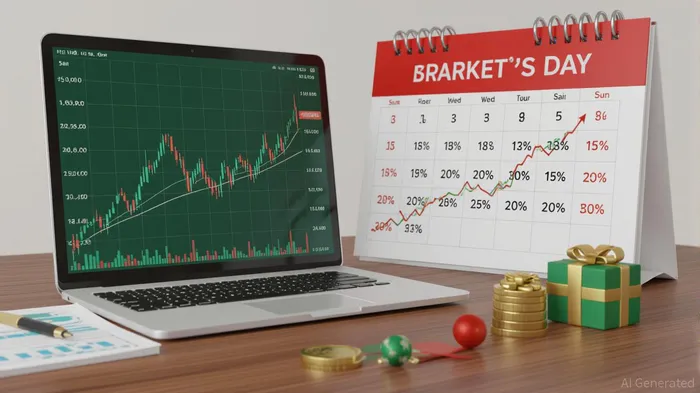 Fixed income, foreign exchange, and derivatives markets are particularly vulnerable. By mid-December 2025, participation in these sectors had declined to levels
that historically correlate with heightened price volatility and execution risk. Such patterns underscore the importance of timing:
investors who adjust their strategies to align with liquidity cycles-such as front-loading trades before mid-December or deferring activity until post-holiday-can mitigate implementation risks.
Investor Psychology: Sentiment Swings and Sector Volatility
Behavioral finance research highlights a nuanced relationship between holidays and investor sentiment. Initially, holidays act as a "therapeutic" reset, lifting mood and reducing risk aversion
according to studies. However, this optimism wanes as the holiday period extends, leading to a "hygienic effect" where sentiment stabilizes but fails to surge
according to research. This dynamic is particularly pronounced in sectors tied to holiday demand, such as retail and travel, which
often exhibit abnormal return volatility during festive seasons.
For example, U.S. stocks in consumer discretionary and cyclical sectors showed heightened sensitivity to holiday-driven sentiment shifts in 2025, with price movements diverging from broader market trends
according to research. Conversely, defensive assets like utilities and healthcare demonstrated relative stability, offering a counterbalance to sector-specific risks.
Case Study: Treasury Market Liquidity in 2025
The Treasury market provides a compelling case study of how external shocks can amplify holiday-related liquidity challenges. In April 2025, tariff announcements triggered a sharp deterioration in liquidity, marked by
inflated bid-ask spreads and reduced market depth. While these disruptions were exacerbated by pre-holiday inactivity, liquidity normalized by late summer, illustrating the market's resilience to short-term stressors
according to analysis. This pattern aligns with historical trends, where
Treasury liquidity has shown a strong inverse correlation with volatility during geopolitical or economic shocks.
Strategic Implications for Investors
The evidence points to a clear imperative: investors must proactively adapt to seasonal liquidity cycles and psychological shifts. For instance,
executing large trades before mid-December-when liquidity providers are still active-can reduce slippage costs. Conversely, avoiding high-risk trades in the final days of the year, when market participation plummets, is prudent.
Moreover, sector rotation strategies can capitalize on holiday-driven sentiment.
Overweighting cyclicals during early December while hedging with defensive assets may balance the portfolio against post-holiday volatility. Similarly,
leveraging Treasury market rebounds in late January could offer a low-risk entry point for fixed-income allocations.
Conclusion
Market closures around major holidays are not mere pauses in trading but pivotal moments that reshape liquidity and investor psychology. By dissecting these dynamics through empirical research, investors can transform potential risks into strategic advantages. As 2025's market behavior demonstrates, the key lies in anticipating seasonal patterns and aligning portfolio decisions with both quantitative data and behavioral insights.







Comentarios
Aún no hay comentarios