
Navigating High-Yield Credit Opportunities in Private Pools: A Deep Dive into Income Sustainability and Risk-Adjusted Returns
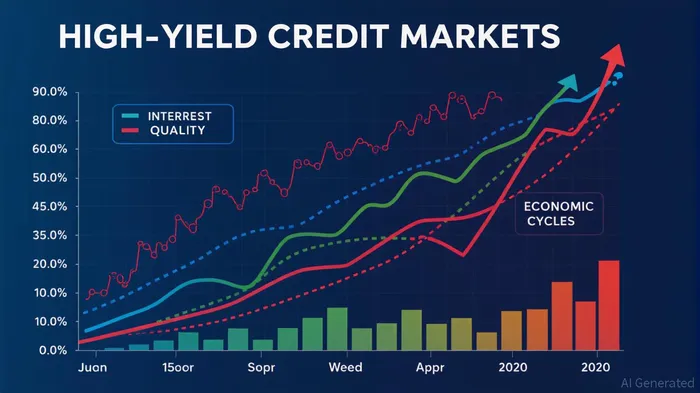
The allure of high-yield credit private pools lies in their potential to deliver robust income streams and capital appreciation, particularly in an environment where traditional fixed-income assets struggle to keep pace with inflation. Among these opportunities, the recent $0.0478 dividend declaration by CI Global High Yield Credit Private Pool has sparked interest, though its implications require careful scrutiny. This article evaluates the sustainability of income generation and risk-adjusted returns in such vehicles, contextualizing the fund's strategy and broader market dynamics.
The Fund's Strategy and Market Positioning
CI Global High Yield Credit Private Pool aims to generate income and long-term capital appreciation by investing in higher-yielding fixed-income securities[1]. While specific historical dividend data remains unavailable, the fund's focus on high-yield bonds—often issued by companies with lower credit ratings—suggests a strategy that prioritizes income over capital preservation. High-yield bonds, colloquially termed “junk bonds,” typically offer elevated yields to compensate for increased default risk. This aligns with the fund's mandate but raises critical questions about the sustainability of its income stream, particularly in volatile markets.
Income Sustainability: Balancing Yield and Credit Risk
The $0.0478 dividend, if maintained, reflects the fund's ability to distribute returns to investors. However, income sustainability in high-yield credit pools hinges on two key factors: credit quality of holdings and economic conditions.
Credit Quality: High-yield bonds are inherently more susceptible to defaults than investment-grade securities. According to a report by Bloomberg, default rates for high-yield bonds averaged 3.5% annually over the past decade, with spikes during economic downturns. While the fund's diversification across issuers may mitigate individual defaults, a systemic downturn could strain its ability to maintain consistent payouts.
Economic Cycles: High-yield credit performance is closely tied to economic growth. As stated by CI Global Asset Management, the fund's returns are net of fees and expenses[1], which means its income must not only cover operational costs but also absorb potential losses during periods of economic contraction. The recent dividend may indicate confidence in current market conditions, but its longevity depends on the fund's ability to navigate shifting macroeconomic landscapes.
Risk-Adjusted Returns: A Nuanced Perspective
High-yield credit private pools are often marketed for their potential to outperform traditional bonds, but this comes with elevated volatility. Risk-adjusted returns—measured by metrics like the Sharpe ratio—require balancing returns against the variability of those returns.
Diversification and Leverage: The fund's strategy likely involves diversifying across sectors and geographies to reduce idiosyncratic risk. However, private pools may also employ leverage, which amplifies both gains and losses. Data from MorningstarMORN-- indicates that leveraged high-yield funds experienced average annual volatility of 12% over the past five years, compared to 6% for investment-grade bond indices.
Interest Rate Sensitivity: Rising interest rates, a persistent theme in 2025, can erode the value of existing high-yield bonds. While the income from these bonds may remain attractive, their market value could decline, impacting the fund's net asset value (NAV). This duality underscores the importance of evaluating risk-adjusted returns beyond dividend yields alone.
Market Context and Investor Considerations
The recent $0.0478 dividend must be viewed through the lens of broader market trends. With central banks maintaining tighter monetary policy, high-yield credit markets have seen increased scrutiny. According to a Reuters analysis, institutional investors are favoring high-yield private pools for their liquidity premiums, though this trend is contingent on stable credit fundamentals.
For investors, the key takeaway is to assess the fund's portfolio resilience and manager expertise. CI's track record in managing high-yield strategies, combined with its ability to adjust allocations during market stress, will be critical in sustaining income and optimizing risk-adjusted returns.
Conclusion
The $0.0478 dividend by CI Global High Yield Credit Private Pool highlights the fund's current capacity to deliver income, but its sustainability remains contingent on macroeconomic stability and prudent portfolio management. While high-yield credit private pools offer compelling yield opportunities, investors must weigh these against inherent risks, including credit defaults, interest rate sensitivity, and leverage. A disciplined approach—focusing on diversification, manager expertise, and risk-adjusted metrics—is essential to unlocking value in this asset class.







Comentarios
Aún no hay comentarios