
Navigating Grocery Inflation and Income Disparity: Strategic Investment Opportunities in Consumer Discretionary and Essential Retail Sectors
The U.S. grocery market is undergoing a seismic shift as rising inflation and deepening income inequality reshape consumer behavior and retail dynamics. From 2023 to 2025, food-at-home prices have surged by 23.6% compared to 2020 levels, outpacing the 21.2% increase in the all-items CPI during the same period according to USDA data. This divergence has disproportionately impacted lower-income households, with 75% of low-income Americans citing food costs as "extremely or very important" in purchasing decisions as Forbes reports. As these trends converge, the consumer discretionary and essential retail sectors present both challenges and opportunities for investors.
The Grocery Inflation-Disparity Nexus
The link between grocery inflation and income disparity is stark. By August 2025, food prices had risen 3.2% year-over-year, with food-at-home prices up 2.7% according to USDA data. While these rates are lower than the 11.4% peak in 2022, they remain volatile and outpace wage growth for many households. Lower-income families, which allocate a larger share of their budgets to groceries, face heightened financial strain. For instance, 13.5% of U.S. households experienced food insecurity in 2023, with Black and Hispanic households disproportionately affected as Forbes reports. This creates a self-reinforcing cycle: as prices rise, households reduce spending on non-essentials, further concentrating economic activity in essential retail.
Investment Opportunities in Essential Retail
The essential retail sector, particularly grocery-anchored retail centers, has emerged as a resilient asset class. These centers accounted for 31% of total retail transaction volume in Q1 2025, with institutional investment quadrupling year-over-year according to JLL data. Discount grocers like Aldi and AlbertsonsACI-- are capitalizing on this trend. Aldi, for example, opened 105 new U.S. stores in 2024 and plans to add 225 more in 2025, leveraging its low-price model to attract inflation-weary consumers according to JLL analysis.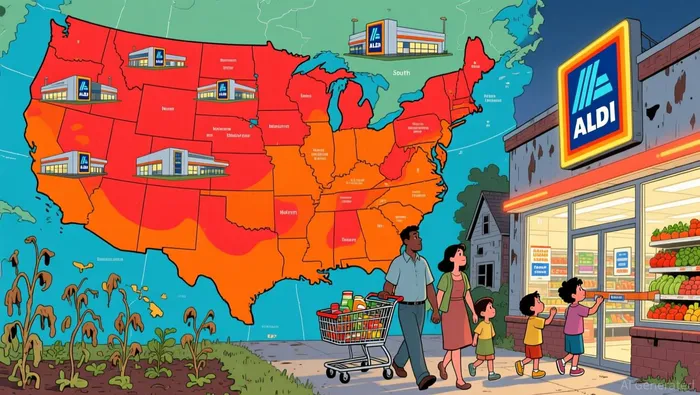 Its 2024 foot traffic surged 51.2% to 900 million visits, demonstrating strong cross-income demand as Grocery Gazette reports.
Traditional grocers are also adapting. KrogerKR-- reported 3.2% identical sales growth in Q1 2025 and plans to invest $400 million in 2026 to improve e-commerce profitability after $2.6 billion in impairment charges for automated fulfillment systems according to Kroger's investor announcement. Analysts project Kroger's adjusted EPS to reach $4.75–$4.80 in 2025, supported by digital transformation and share repurchases as Investing.com reports. Albertsons, meanwhile, trades at a forward P/E of 8.1x, making it an attractive value play according to Investing.com analysis.
The Rise of Value-Focused Retailers
The discount retail market, valued at $35.9 billion in 2025, is projected to grow at a 10.5% CAGR through 2033 according to Data Insights Market. This growth is driven by private-label brands and multi-channel strategies. Aldi's expansion of private-label offerings and Albertsons' 2024 private-label sales surge highlight this trend according to JLL analysis. Similarly, value-focused retailers like TJX and Ross Stores are benefiting from shifting consumer preferences toward cost-conscious shopping as Fidelity reports.
For investors, ETFs like the SPDR S&P Retail ETF (XRT) and ProShares Online Retail ETF (ONLN) offer diversified exposure to these dynamics. XRT returned 5.63% in the past year, while ONLN and IBUY captured the e-commerce boom with 5.89% and 3.37% returns, respectively according to ETF Database. These funds align with the growing reliance on digital platforms, including SNAP-enabled on-demand grocery delivery, which serves 41 million participants according to JLL analysis.
Strategic Considerations for Investors
While the sector offers compelling opportunities, risks persist. Traditional retailers face margin pressures from automation costs and shifting consumer habits. Kroger's Q4 2025 operating loss of $1.54 billion, driven by fulfillment network impairments, underscores these challenges according to Inspire ETF analysis. However, its adjusted EPS guidance of $4.75–$4.80 and $5 billion share repurchase program signal long-term confidence according to Inspire ETF analysis.
Investors should also consider macroeconomic factors. The Federal Reserve's potential interest rate cuts in 2026 could revive housing-related discretionary spending, indirectly benefiting the sector as Fidelity reports. Meanwhile, income disparity trends suggest sustained demand for affordable essentials, reinforcing the case for discount grocers and value ETFs.
Conclusion
The interplay of grocery inflation and income disparity is reshaping the retail landscape, creating both headwinds and tailwinds for investors. Discount grocers and value-focused retailers are well-positioned to capitalize on the shift toward essentials, while ETFs offer diversified access to this evolving market. As the sector navigates these dynamics, strategic investments in resilient, adaptive players will be critical for long-term growth.







Comentarios
Aún no hay comentarios