
Navigating Global Trade Tensions: Strategic Investment in Resilient Sectors for Emerging Markets
In 2025, the global economic landscape remains fraught with uncertainty. The IMF's July 2025 World Economic Outlook Update underscores a fragile recovery, with trade tensions lingering as a persistent drag on growth. For emerging markets, the stakes are high: while the global economy is projected to grow at 3.0%, many nations remain vulnerable to policy shifts, tariff hikes, and geopolitical shocks. Mexico, for instance, faces a revised 0.2% GDP growth forecast for 2025—a stark contrast to its pre-pandemic performance. This article examines how investors can strategically position themselves in sectors insulated from trade volatility, while aligning with IMF warnings about systemic risks.
Trade Tensions and the Emerging Market Dilemma
The IMF's latest reports highlight a paradox: while trade tensions have eased slightly (with U.S. tariffs averaging 17% as of July 2025), the threat of renewed escalation looms large. Mexico, a key example, has seen its growth forecast revised upward from a projected -0.3% contraction, yet it remains near stagnation. The country's reliance on U.S. trade—exacerbated by uncertainty over the U.S.-Mexico-Canada Agreement (USMCA) review—has left it exposed to policy shocks. Weak domestic demand and inflation above the Bank of Mexico's 3% target further complicate recovery efforts.
The broader picture is no less dire. Global trade as a share of output is expected to decline from 57% in 2024 to 53% by 2030, according to the IMF. For emerging markets, this means reduced export momentum and heightened vulnerability to capital flight. The Fund warns that a return to higher tariffs could trigger a 0.5% global growth contraction—a risk investors must not ignore.
Resilient Sectors: Technology, Renewables, and Domestic Consumption
Amid this uncertainty, three sectors stand out for their insulation from trade volatility and alignment with long-term trends: technology, renewable energy, and domestic consumption.
1. Technology: Digital Infrastructure as a Hedge
Emerging markets are leapfrogging traditional development stages through digital innovation. Southeast Asia's fintech boom, India's AI-driven manufacturing, and Latin America's mobile banking platforms are reshaping economies. These sectors are less exposed to trade wars, as they rely on domestic demand and local capital. For example, India's Nifty Green Energy Index has surged 22% in 2025, driven by solar and wind projects funded by domestic banks and international green bonds.
Investors should prioritize tech firms with strong regulatory backing and scalable models. Companies like Mexico's Fintotta (digital lending) and Nigeria's Flutterwave (cross-border payments) exemplify the potential in this space.
2. Renewable Energy: Policy-Driven Growth
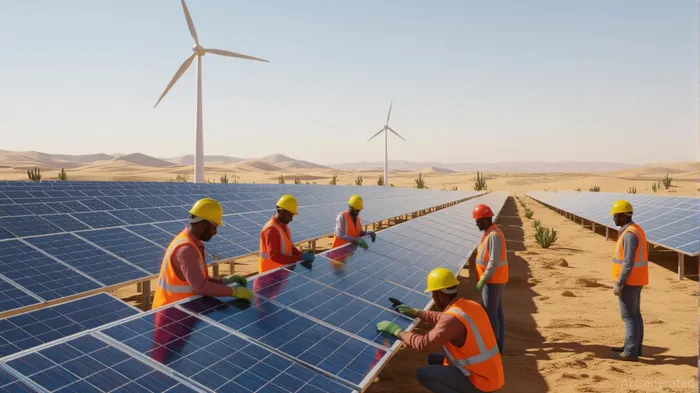
The global push for decarbonization has made renewable energy a cornerstone of emerging market growth. In 2025, renewables account for 92.5% of new power capacity additions globally, with emerging Asia leading the charge. India's 500 GW renewable energy target by 2030 and Brazil's ethanol-to-electricity transition are creating fertile ground for investment.
Renewables are also less susceptible to trade tensions, as local manufacturing and grid infrastructure dominate the value chain. For instance, Mexico's $12 billion solar project in Baja California is funded by a mix of state-owned banks and private equity, bypassing U.S. tariff risks.
3. Domestic Consumption: The Inflation-Proof Pillar
As trade volatility disrupts global supply chains, domestic consumption has emerged as a stabilizer. In 2025, India's middle class is projected to reach 500 million, driving demand for affordable housing, e-commerce, and healthcare. Similarly, Brazil's recent tax reforms have boosted retail sales, with consumer goods companies outperforming trade-dependent sectors.
Investors should target sectors with inelastic demand, such as food processing, pharmaceuticals, and education. Mexico's CEMEXCX--, for example, has pivoted to low-income housing construction, capitalizing on pent-up demand and government subsidies.
Actionable Insights for Investors
- Diversify Across Resilient Sectors: Allocate capital to tech, renewables, and consumer goods in emerging markets with strong policy frameworks. Avoid overexposure to trade-dependent industries like automotive or agriculture.
- Prioritize Policy Stability: Focus on countries with credible fiscal plans and regulatory clarity. India's production-linked incentive (PLI) scheme and Vietnam's digital economy roadmap are positive signals.
- Monitor Trade Policy Timelines: The expiration of U.S. tariff suspensions on August 1, 2025, and the USMCA review in 2026 are critical inflection points. Position portfolios to hedge against sudden policy shifts.
- Leverage Green Bonds and ESG Funds: Renewable energy projects in emerging markets are increasingly financed through green bonds, offering yields of 6–8% with lower volatility.
Conclusion
The IMF's warnings about trade instability are clear: investors must prepare for a world of persistent uncertainty. Yet, within this challenge lies opportunity. By targeting sectors like technology, renewable energy, and domestic consumption, investors can build portfolios that thrive amid volatility. For emerging markets, these industries are not just resilient—they are the engines of a new economic era. As the global economy recalibrates, strategic positioning will separate the winners from the casualties.







Comentarios
Aún no hay comentarios