
Navigating Global Trade Tensions: Defensive Sectors and Portfolio Resilience in Canadian Equities
Global trade tensions have intensified in 2025, with U.S.-Canada tariff disputes reshaping Canada's economic landscape. Canada's trade deficit widened to $6.32 billion in August 2025, driven by declining exports in metals, machinery, and forestry sectors, which face eroded competitiveness due to U.S. tariffs, according to BNN Bloomberg. These disruptions have forced Canadian businesses to seek alternative markets and adjust supply chains, with over half of surveyed firms anticipating reduced profitability, according to a Morningstar report. Amid this volatility, defensive sectors and strategic portfolio adjustments are emerging as critical tools for resilience.
The Vulnerability of Trade-Exposed Sectors
Industries reliant on cross-border trade, such as automotive and energy, have borne the brunt of recent tariffs. For example, General MotorsGM-- scaled back operations at its Oshawa Assembly plant in 2025, citing trade-related supply chain disruptions, as reported by BNN Bloomberg. Similarly, the imposition of a 25% U.S. tariff on Canadian steel and aluminum in March 2025 created significant uncertainty, straining industrial producers, according to Business Standard. These developments underscore the fragility of sectors dependent on U.S. demand, which accounts for over 70% of Canada's total trade, per a ResearchGate analysis.
Defensive Sectors: Pillars of Stability
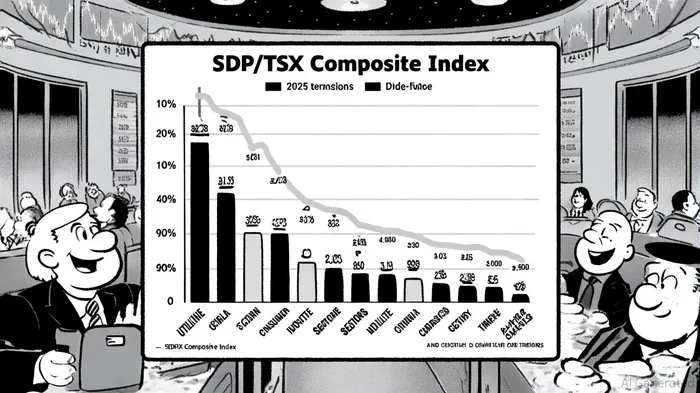
In contrast, defensive sectors such as utilities, consumer staples, and gold mining have demonstrated resilience. The S&P/TSX Composite Index, weighted 50% toward defensive assets like financials, pipelines, and utilities, has outperformed its U.S. counterpart in 2025, according to Morningstar. For instance, gold-related stocks-led by Barrick Gold and Wheaton Precious Metals-contributed to a 23% sectoral return, fueled by safe-haven demand amid geopolitical uncertainty, as noted by BNN Bloomberg. This performance aligns with historical trends: during the 2018-2025 trade wars, utilities and consumer staples consistently outperformed, buffering the index against broader market declines, per Morningstar.
The Canadian market's limited exposure to high-beta sectors like technology (10% of the S&P/TSX Composite) further enhances its stability compared to the U.S. market's 30% tech weighting, as observed by Morningstar. Additionally, the Bank of Canada's rate-cutting cycle since June 2024 has bolstered defensive equities by redirecting capital from low-yield bonds to higher-yielding assets, per Morningstar.
Strategic Portfolio Adjustments for Resilience
To navigate trade tensions, investors should prioritize sectors insulated from cross-border disruptions. For example, nearshoring trends and domestic supply chains-such as Canada's critical minerals initiatives (e.g., Frontier Lithium, Saskatchewan rare earth projects)-offer growth opportunities while reducing reliance on U.S. markets, according to the ResearchGate analysis. Similarly, utilities and consumer staples provide consistent dividends and low volatility, making them ideal for capital preservation, as Morningstar highlights.
Diversification into alternative income streams, such as private credit, can also enhance resilience in a low-interest-rate environment, a point BNN Bloomberg underscores. Conversely, reducing exposure to trade-sensitive sectors like industrial and energy equities is prudent, given their susceptibility to tariff-driven cost inflation and supply chain fragility, per Morningstar.
Conclusion: Balancing Risk and Opportunity
While trade tensions pose significant challenges, they also create opportunities for strategic positioning. Defensive sectors and domestic-focused industries offer a counterbalance to global volatility, supported by historical performance and current monetary policy. As Canada diversifies its trade relationships and invests in critical minerals, investors must remain agile, leveraging sector-specific insights to build resilient portfolios. In this evolving landscape, a disciplined focus on defensive assets and nearshoring trends will be key to navigating the uncertainties of 2025 and beyond.





Comentarios
Aún no hay comentarios