
Navigating Geopolitical Storms: South Korea's Battery Industry Balances Growth and Supply Chain Resilience
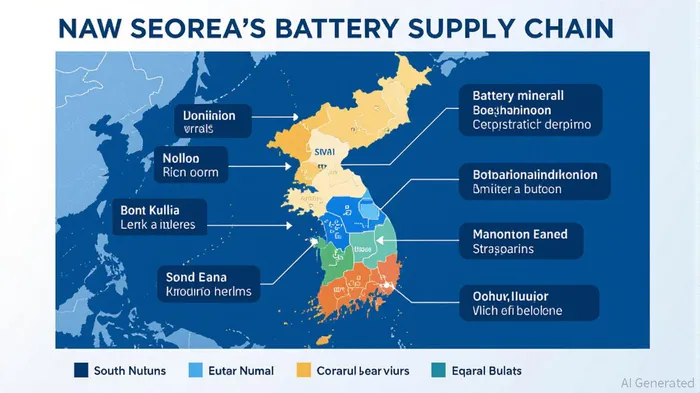
South Korea's battery industry is at a pivotal crossroads, balancing explosive growth with mounting geopolitical risks. As the world's second-largest battery producer after China, the country's dominance in cathode material exports and EV battery innovation is underpinned by a market projected to grow from USD 8.84 billion in 2024 to USD 35.37 billion by 2035, driven by a 13.43% compound annual growth rate (CAGR) [1]. Yet this trajectory is shadowed by vulnerabilities in its supply chain, particularly its reliance on China for over 90% of precursor cathode materials, synthetic graphite, and lithium hydroxide [2].
Geopolitical Risks: A Tenuous Raw Material Lifeline
South Korea's battery sector is acutely exposed to geopolitical tensions, particularly U.S.-China trade dynamics. China's near-monopoly on critical minerals—controlling 96% of gallium and 87% of germanium production—creates a chokepoint for South Korean firms [2]. The U.S. Inflation Reduction Act (IRA), which mandates local sourcing for EV tax credits, has further complicated matters. South Korean companies like LG Energy Solution and SK On have already delayed or canceled joint ventures with Chinese partners, including a battery recycling project with Huayou Cobalt and a venture with GEM Korea New Energy Materials, to comply with IRA restrictions [3].
Compounding these challenges, the EU's battery passport regulations and sustainability mandates are forcing Korean producers to adapt to stringent environmental standards [2]. These pressures highlight a critical question: Can South Korea maintain its competitive edge while reshaping its supply chains?
Diversification and Recycling: A Strategic Pivot
To mitigate risks, South Korea has launched the Special Act on National Resource Security, a 2025 policy aimed at reducing import dependency on critical minerals to 50% by 2030 [2]. Key strategies include:
1. International Partnerships: Collaborations with Canada, Indonesia, and African nations are central to this effort. For instance, POSCOPKX-- International's $40 million investment in Tanzania's Mahenge graphite mine and a 2023 Memorandum of Understanding (MOU) with Canada to secure critical minerals and recycling technologies underscore this pivot [4].
2. Recycling Infrastructure: While only 25% of waste batteries are currently recovered through formal channels, the government is offering low-interest loans to scale recycling initiatives [1]. However, technological gaps and systemic inefficiencies remain hurdles.
3. Domestic Innovation: Investments in solid-state battery R&D and cobalt-free technologies aim to reduce reliance on volatile raw material markets [1].
The Road Ahead: Balancing Ambition and Realism
South Korea's $15 billion investment in battery manufacturing by 2030 and its leadership in the Minerals Security Partnership (MSP) signal a long-term vision to counter China's dominance [2]. Yet challenges persist. The precursor cathode materials segment remains a weak link, with China controlling 97% of South Korea's imports [5]. Meanwhile, the U.S. IRA's emphasis on local production could force Korean firms to choose between global market access and compliance with U.S. green energy incentives.
Conclusion: A High-Stakes Bet on Resilience
South Korea's battery industry is a testament to the interplay between innovation and geopolitical fragility. While its market is poised for explosive growth, the path forward hinges on the success of its diversification and recycling strategies. Investors must weigh the sector's potential against the risks of supply chain disruptions and regulatory shifts. For now, the country's proactive policies and strategic alliances offer a glimmer of hope—but the road to true resilience is long and fraught.







Comentarios
Aún no hay comentarios