
Navigating Geopolitical Storms: Positioning Crypto Portfolios for Resilience in a Volatile Macro Landscape
In an era where geopolitical tensions and trade policy shifts dominate global headlines, cryptocurrency markets have emerged as both a barometer and a battleground for macroeconomic uncertainty. From the Russia-Ukraine war to Trump-era tariffs and regulatory crackdowns, the crypto asset class has demonstrated a unique, yet fragile, relationship with geopolitical risk. For investors, understanding these dynamics is no longer optional-it's a prerequisite for survival in a high-volatility environment.
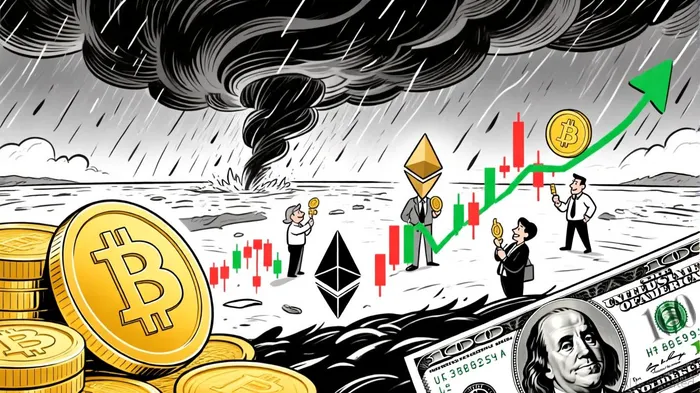
Geopolitical Events as Catalysts for Volatility
Geopolitical crises have historically triggered sharp selloffs in cryptocurrency markets, often outpacing their impact on traditional assets. During the Israel-Iran conflict in 2025, BitcoinBTC-- plummeted below $103,000, erasing $140 billion in market capitalization as investors flocked to safer assets like gold and U.S. Treasuries, according to a MarketNavigator analysis. This mirrors the 2022 Russia-Ukraine war, where actual conflict escalation had a more pronounced negative effect on crypto liquidity and prices than the mere threat of escalation-a pattern distinct from stock markets, as shown in a ScienceDirect study.
However, not all geopolitical events spell doom for crypto. In politically unstable economies like Venezuela and Argentina, Bitcoin adoption has surged as a hedge against hyperinflation and currency devaluation, according to a CoinMetro article. This duality-crypto as both a victim and a refuge of geopolitical chaos-underscores its evolving role in global finance.
Trade Policy Shifts and Tariff Turmoil
The Trump administration's 2025 "Liberation Day" tariffs, which imposed a 50% tax on Chinese imports, sent shockwaves through cryptocurrency markets. Bitcoin and EthereumETH-- dropped nearly 9% and 8%, respectively, within 48 hours, triggering $16 billion in leveraged long liquidations, according to a Forbes analysis. Tariffs, by design, amplify economic uncertainty, prompting investors to flee high-risk assets like crypto. The ripple effects extended to mining operations, where tariffs on imported equipment squeezed profit margins, and stablecoin redemptions spiked as liquidity drained from decentralized exchanges, according to a CoinPedia report.
This event reignited debates about crypto's safe-haven status. While Bitcoin has shown resilience in localized crises, it failed to act as a hedge during a globally synchronized panic-a stark reminder of its entanglement with traditional financial systems, the CoinPedia report argued.
Regulatory Dynamics and Compliance Pressures
Regulatory actions have proven equally disruptive. The U.S. SEC's 2023 legal battles with crypto firms temporarily depressed market sentiment, while El Salvador's adoption of Bitcoin as legal tender spurred global interest, CoinMetro reported. Yet, regulatory clarity remains fragmented: 26% of countries lack clear crypto asset classifications, creating legal gray areas that deter institutional adoption, the MarketNavigator analysis found.
Compliance costs have also surged, with small to mid-sized firms spending an average of $620,000 annually on AML and KYC protocols-a 28% increase in 2025, MarketNavigator reported. These costs, coupled with uneven global enforcement, force investors to balance innovation with risk.
Positioning for Resilience: Strategies for Investors
To thrive in this volatile landscape, investors must adopt a multi-pronged approach:
- Diversification and Hedging: Allocate a portion of crypto portfolios to stablecoins like TetherUSDT--, which have shown hedge-like characteristics during crises, as identified in the ScienceDirect study. Pair this with traditional safe-haven assets to mitigate downside risk.
- Real-Time Monitoring: Track geopolitical developments and regulatory updates using AI-driven analytics tools. Early detection of policy shifts can prevent liquidity traps.
- Regulatory Preparedness: Prioritize jurisdictions with clear crypto frameworks (e.g., Singapore, Switzerland) to reduce legal exposure.
- Leverage Utility Tokens: During trade wars, utility-based tokens tied to real-world applications (e.g., DeFi, NFTs) may outperform speculative assets, the CoinPedia report suggested.
Conclusion
Cryptocurrency markets are no longer insulated from the forces shaping global geopolitics and trade. While volatility remains a double-edged sword, strategic positioning-rooted in diversification, regulatory agility, and real-time risk management-can transform uncertainty into opportunity. For investors, the key lies not in avoiding storms but in building a portfolio resilient enough to weather them.






Comentarios
Aún no hay comentarios