
Navigating Geopolitical Storms: The Future of Taiwan's Semiconductor Industry and Global Supply Chain Resilience
The global semiconductor industry stands at a crossroads in 2025, with Taiwan's critical role in advanced chip manufacturing increasingly entangled in geopolitical tensions and policy-driven supply chain shifts. As the world's leading producer of cutting-edge logic chips-accounting for over 90% of global output-Taiwan Semiconductor Manufacturing Company (TSMC) remains a linchpin for industries ranging from consumer electronics to artificial intelligence (AI). However, the confluence of U.S. trade policies, regionalization trends, and strategic diversification efforts is reshaping the landscape, creating both risks and opportunities for investors.
Geopolitical Risks and the Fragility of Concentration
Taiwan's dominance in semiconductor manufacturing has long been a double-edged sword. While its advanced fabrication capabilities and R&D expertise make it indispensable, this geographic concentration also exposes the global supply chain to disruptions from natural disasters, trade wars, or regional conflicts according to recent analysis. Recent U.S. policy changes, including the proposed 1:1 chip production rule and 100% tariffs on non-domestic semiconductors, underscore a deliberate effort to reduce reliance on foreign manufacturing hubs like Taiwan and South Korea as reported by industry sources. These measures, part of the broader CHIPS and Science Act 2025, aim to incentivize domestic production through tax credits and subsidies but risk inflating costs for companies already grappling with high U.S. labor and infrastructure expenses.
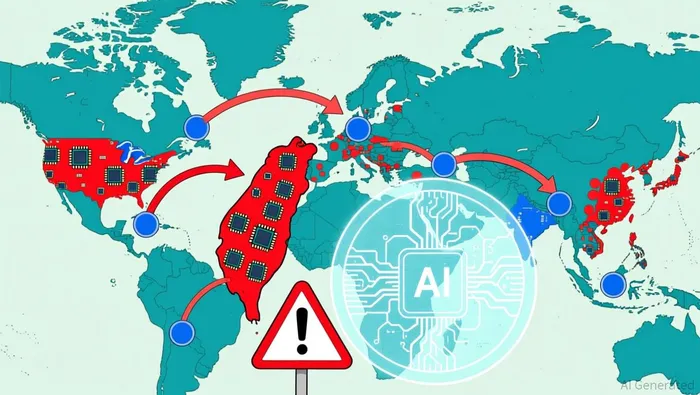 The Trump administration's push for 100% tariffs on imported semiconductors has further intensified these dynamics, particularly for sectors like medical devices, where supply chain disruptions could delay innovation and raise healthcare costs according to industry experts. For Taiwan, the implications are stark: while TSMCTSM-- has begun investing $165 billion in U.S. facilities to hedge against these risks, the island's share of global chip production may face downward pressure as governments and corporations prioritize regionalization according to market analysis.
Diversification Strategies: From Multi-Sourcing to Regionalization
In response to these pressures, the industry is pivoting toward diversification. Multi-sourcing-spreading production across multiple regions-has become a cornerstone of supply chain resilience. Intel, for instance, has formed partnerships across the U.S., Europe, and Asia to reduce dependency on single suppliers, while TSMC and Samsung are expanding in Vietnam and India, where lower costs and government incentives make them attractive alternatives according to industry reports.
Regionalization, or the localization of supply chains within specific geographic blocs, is another key trend. The European CHIPS Act and Japan's $5.5 billion investment in domestic manufacturing reflect a global shift toward "economic security" over pure cost efficiency as detailed in recent studies. This fragmentation, however, comes at a cost: capital expenditures are surging, with global semiconductor investments projected to hit $192 billion by 2028 as companies build advanced fabs in multiple regions according to market forecasts.
The AI Imperative and Talent Challenges
The rise of AI is amplifying these dynamics. By 2025, AI applications are expected to account for 30% of semiconductor industry revenue, driving demand for specialized chips and accelerating R&D spending according to industry analysis. Yet, this growth is constrained by a critical talent shortage, with unfilled positions in semiconductor engineering and manufacturing rising annually. Workforce development initiatives, particularly in the U.S. and Europe, will be pivotal in sustaining innovation amid geopolitical fragmentation according to expert commentary.
Investment Implications: Balancing Risk and Opportunity
For investors, the semiconductor sector presents a paradox: while geopolitical risks threaten short-term stability, they also catalyze long-term innovation and diversification. Companies that successfully navigate this transition-such as TSMC, Intel, and regional players in Vietnam or India-stand to benefit from sustained demand and policy tailwinds. Conversely, firms overly reliant on single regions or outdated manufacturing models may face margin compression and operational bottlenecks.
The key lies in identifying players with robust diversification strategies, strong R&D pipelines, and strategic partnerships. For example, TSMC's global expansion and Intel's multi-regional fab network position them to capitalize on the reshaped supply chain. Meanwhile, emerging markets with government-backed incentives could offer high-growth opportunities for investors willing to navigate regulatory and geopolitical uncertainties.
Conclusion
The semiconductor industry's evolution in 2025 is a microcosm of broader global trends: the clash between economic interdependence and national security, the tension between cost efficiency and resilience, and the accelerating role of technology in reshaping industries. For Taiwan, the challenge is to maintain its technological edge while adapting to a world increasingly defined by fragmentation. For investors, the path forward lies in supporting companies that embrace diversification, innovation, and strategic foresight in an era of geopolitical volatility.







Comentarios
Aún no hay comentarios