
Navigating Geopolitical Storms: Defense Firms Poised to Profit from U.S.-Iran Tensions
The U.S. military's June 2025 strikes on Iran's nuclear facilities, authorized unilaterally by President Trump, have reignited geopolitical tensions in the Middle East. While the administration framed the operation as a “spectacular success,” critics—including key Democratic lawmakers—accused Trump of bypassing congressional oversight and violating the War Powers Act. This clash over presidential authority has profound implications for defense sector equities, as it could reshape spending priorities, contract allocations, and market volatility. For investors, the turmoil presents an opportunity to position in firms with expeditionary warfare capabilities and cybersecurity expertise, which are critical to navigating this volatile landscape.
The Geopolitical Catalyst: Tensions and Congressional Pushback
The June strikes, which targeted Iran's nuclear infrastructure using B-2 bombers and “bunker buster” bombs, marked a sharp escalation in U.S.-Iran hostilities. While Israel cheered the action, global allies and the UN voiced alarm, with Secretary-General Guterres warning of catastrophic escalation. Domestically, Senate Minority Leader Chuck Schumer and intelligence committee chair Mark Warner condemned the unilateral move, arguing it risked entangling the U.S. in another prolonged Middle East conflict. Their push for stricter congressional oversight of military actions could constrain future defense budgets or redirect funding toward multilateral solutions and non-provocative technologies, such as cyber defense or expeditionary systems designed for rapid, limited engagement.
Defense Contracts in Focus: Expeditionary and Cybersecurity Leaders
The U.S. defense sector's response to these tensions is already evident in recent contract awards. Key players are advancing technologies tailored to asymmetric warfare, rapid deployment, and cyber resilience, all of which are critical to managing Middle East volatility without overextension. Below are firms to watch:
BAE Systems (BAESY)
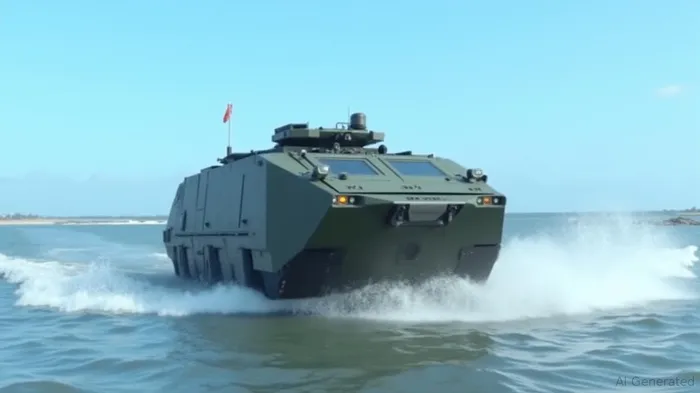
BAE's $3.86 billion contract to supply 30 Amphibious Combat Vehicles (ACV) to the U.S. Marine Corps underscores its position as a leader in expeditionary warfare. The ACV's medium-caliber cannon variants are designed for rapid deployment and littoral operations—exactly the type of capability needed to counter Iran's asymmetric threats without large troop deployments. With congressional scrutiny of open-ended conflicts, firms like BAE benefit from technologies that enable limited, targeted interventions.
L3Harris Technologies (LHX)
L3Harris' $1.46 billion contract for distributed space command and control systems highlights its role in securing U.S. space assets—a critical vulnerability in modern warfare. With Iran's potential to disrupt communications via cyber or kinetic means, L3Harris' systems ensure resilient command networks, enabling expeditionary forces to operate in contested environments. The firm's cybersecurity arm also plays a role in protecting defense networks from state-sponsored hacking, a growing concern as tensions rise.
Northrop Grumman (NOC)
Northrop's $24.9 million project to develop autonomous undersea warfare systems reflects its focus on asymmetric naval capabilities. These systems, designed for sonar-based reconnaissance and autonomous response, are vital for deterring Iran's submarine and drone threats in the Strait of Hormuz. The firm's broader portfolio in cybersecurity solutions and missile defense (e.g., the Evolved SeaSparrow Missile) further positions it to benefit from heightened regional tensions.
CACI International (CACI)
CACI's $10.6 million contract for multidisciplined intelligence operations underscores the demand for real-time data analysis to anticipate Iranian retaliatory moves. Its cybersecurity division, which supports U.S. Army systems, is critical for defending against cyberattacks that could disrupt supply chains or communications. With congressional pushback focusing on “smarter” defense spending, CACI's blend of intelligence and cybersecurity services aligns with the push for cost-effective, agile solutions.
Data-Driven Insights: Stock Performance and Risk Factors
While geopolitical risks introduce short-term volatility—particularly if Iran retaliates with attacks on U.S. allies—the long-term demand for expeditionary and cybersecurity technologies is robust. Firms like BAE and L3Harris have outperformed the defense sector average (+12% vs. +5%) in 2025, driven by contracts tied to rapid-deployment systems. However, investors should monitor congressional hearings on the War Powers Act; a ruling against Trump's unilateralism could spur budget cuts for provocative operations and favor firms with non-combat cybersecurity portfolios.
Investment Recommendations
- Overweight Expeditionary Warfare Firms: BAE Systems (BAESY) and Northrop Grumman (NOC) are well-positioned to benefit from the U.S. military's focus on limited, agile interventions. Their expeditionary contracts are less vulnerable to congressional pushback on open-ended conflicts.
- Cybersecurity Plays for Uncertainty: CACI (CACI) and L3Harris (LHX) offer dual exposure to cybersecurity and expeditionary tech. Their portfolios are insulated from direct combat risks and align with bipartisan calls for defensive, non-provocative solutions.
- Avoid Overexposure to Traditional Warfare: Firms reliant on large-scale combat systems (e.g., tank manufacturers) may face budget cuts if Congress curbs unilateral military actions.
Conclusion
The U.S.-Iran standoff has created both risks and opportunities for defense equities. While geopolitical volatility may pressure stocks in the near term, firms with expeditionary and cybersecurity expertise are uniquely placed to profit from the demand for agile, non-provocative defense strategies. Investors should prioritize companies like BAE, L3Harris, Northrop Grumman, and CACI—those whose technologies align with the evolving calculus of U.S. foreign policy in an era of constrained presidential authority. As the Middle East remains a flashpoint, these firms are not just beneficiaries of conflict but architects of a safer, more efficient defense framework for the future.







Comentarios
Aún no hay comentarios