
Navigating Geopolitical Shifts: Investment Risks and Opportunities in Japan's Energy Sector
Japan's energy sector in 2025 stands at a crossroads, shaped by a volatile geopolitical landscape and an urgent push for decarbonization. As the world grapples with shifting supplier dynamics-from Middle East tensions to the rise of hydrogen economies-Japanese energy firms face both existential risks and transformative opportunities. This analysis examines how geopolitical realignments are reshaping investment strategies, with a focus on hydrogen, renewables, and supply chain diversification, while underscoring the critical role of public-private partnerships in navigating this complex terrain.
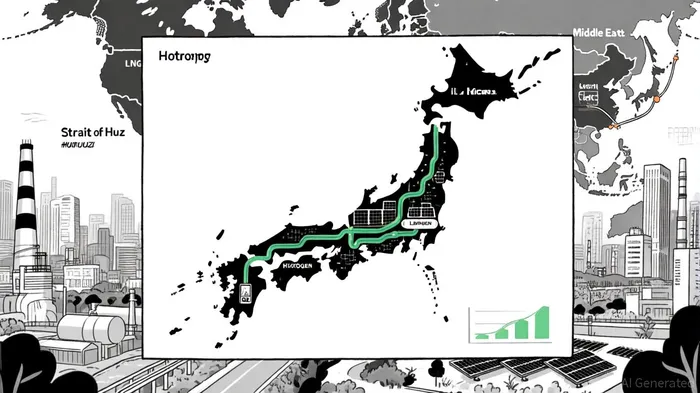
Geopolitical Risks: The Fragility of Fossil Fuel Dependence
Japan's energy security remains precarious due to its reliance on imported fossil fuels. According to an Invezz report, 93% of Japan's crude oil imports still originate from the Middle East in 2025, despite efforts to diversify. This dependency is compounded by the country's exposure to the Strait of Hormuz, a critical chokepoint through which 75% of its crude oil shipments pass, as noted by the Japan Times. Rising tensions between Iran and Israel have already prompted maritime companies to reroute vessels and increase insurance costs, with analysts warning that a full-scale closure of the Strait could push Brent crude prices above $100 per barrel, according to a Maritime Hub analysis.
The economic implications are stark. Japan's energy import bill remains vulnerable to price shocks, as seen during the Russia-Ukraine war, which disrupted LNG markets and exposed the fragility of its fossil fuel-centric model in a Japan NRG deep dive. While the government has accelerated diversification efforts-such as a 19-fold surge in US crude imports in July 2025-these measures have yet to offset the structural risks of over-reliance on a single region, according to S&P Global.
Opportunities in Hydrogen and Renewables: A Strategic Pivot
Amid these risks, Japan has doubled down on hydrogen as a cornerstone of its energy transition. The government's 15-trillion-yen ($100 billion) investment plan over 15 years aims to reduce hydrogen production costs to 20 yen/Nm³ by 2050, with a target of 20 million tons of annual production, according to a JETRO insight. This ambition is underpinned by public-private partnerships, such as Chiyoda Corporation's collaboration with NEDO to develop a hydrogen supply chain using methylcyclohexane (MCH) carriers, outlined by Business Insider. Similarly, JERA Co., Japan's largest power generator, has partnered with BP on a $5.8 billion offshore wind initiative targeting 13 GW of capacity, signaling a shift toward low-carbon energy (an IT Business Today feature).
Renewables, though underutilized, are gaining traction. The Renewable Energy Institute highlights that a 90% renewable energy mix could reduce Japan's energy costs and enhance self-sufficiency through technologies like agrivoltaics and floating offshore wind in a Renewable Energy Institute report. Companies like Eurus Energy are leading the charge, with projects such as the Dohoku Wind Power Plant demonstrating the viability of community-driven renewable development in land-scarce Japan (IT Business Today).
Supply Chain Diversification: A Balancing Act
Japanese firms are also recalibrating their supply chains to mitigate geopolitical risks. Tokyo Electric Power Company (TEPCO), for instance, has pivoted from geothermal-to-hydrogen projects in Southeast Asia to urban-focused hydrogen initiatives, such as its green hydrogen facility in Tokyo's Central Breakwater Outer Landfill Site, detailed in a TEPCO hydrogen initiatives overview. Meanwhile, JERA's partnerships with Indonesia's Pertamina NRE and Singapore's ESR aim to secure alternative energy corridors, reducing exposure to Middle East volatility (IT Business Today).
However, diversification efforts face headwinds. Domestic solar production remains limited, and Japan's reliance on China for critical green technology components-such as photovoltaic panels-has prompted collaborations with India to co-develop solar infrastructure, as reported by Asia Times. These strategic alliances reflect a broader trend of "friend-shoring" in energy, where geopolitical alignment with like-minded nations is prioritized over cost efficiency.
Investment Implications: Navigating the New Energy Paradigm
For investors, Japan's energy transition presents a dual-edged sword. On one hand, the government's 150-trillion-yen GX Plan and the Green Innovation Fund's 20-trillion-yen allocation to hydrogen and renewables offer fertile ground for long-term gains, according to Robeco. Firms like Mitsubishi Corporation, which is developing carbon-neutral LNG and green hydrogen ecosystems, and TEPCO, with its urban hydrogen projects, are prime candidates for capital deployment (IT Business Today).
On the other hand, the slow pace of renewable adoption and continued reliance on coal and gas-despite climate pledges-pose regulatory and reputational risks, as highlighted by The Diplomat. The 7th Strategic Energy Plan's inclusion of LNG-fired plants as a transitional measure underscores the tension between economic stability and decarbonization goals, as laid out in the 7th Strategic Energy Plan. Investors must weigh these trade-offs carefully, particularly as youth movements and civil society push for more aggressive climate action (The Diplomat).
Conclusion: A Path Forward
Japan's energy firms are navigating a high-stakes landscape where geopolitical fragility and climate imperatives collide. While the risks of fossil fuel dependence and slow renewable adoption persist, the strategic pivot to hydrogen and international partnerships offers a viable pathway to energy security and decarbonization. For investors, the key lies in supporting firms that balance innovation with resilience-those that can harness Japan's technological prowess to build a diversified, low-carbon energy future.







Comentarios
Aún no hay comentarios