
Navigating Geopolitical Risks: ExxonMobil's Strategic Caution and Trump's Policy Push in Unstable Markets
The global energy sector remains a high-stakes arena where corporate governance and geopolitical risk intersect. For U.S. energy companies operating in politically unstable markets, the alignment-or misalignment-between corporate strategies and political agendas can determine financial outcomes and long-term viability. ExxonMobil's approach to managing geopolitical risks, particularly in regions like Venezuela, offers a compelling case study of how corporate governance frameworks interact with political pressures. This analysis examines ExxonMobil's cautious stance in volatile markets and contrasts it with the Trump administration's aggressive push for U.S. energy dominance, highlighting the implications for investors.
Corporate Governance as a Risk Mitigation Tool
ExxonMobil's governance structure in 2025 reflects a deliberate effort to institutionalize geopolitical risk management. The company's Board of Directors, bolstered by independent directors with expertise in energy transition and climate risk, oversees a multilayered Enterprise Risk Management (ERM) framework. This system ensures that risks-financial, operational, and geopolitical-are systematically identified, prioritized, and addressed. For instance, the ERM framework includes dedicated task forces and regular engagement with external experts to assess evolving threats in unstable regions. Such structures are critical for a company like ExxonMobilXOM--, which operates in areas prone to political upheaval, regulatory shifts, and expropriation risks.
The board's emphasis on long-term sustainability goals further underscores its strategic alignment with risk mitigation. By embedding climate-related and geopolitical considerations into capital allocation and strategic planning, ExxonMobil aims to balance short-term profitability with resilience against global volatility according to its governance reports. This approach is evident in its 2025 Global Outlook, which stresses the importance of technological advancements and energy demand forecasting in shaping business decisions. However, the company's financial stability remains under scrutiny, as high global volatility and shifting regulatory landscapes challenge its growth trajectory according to recent research.
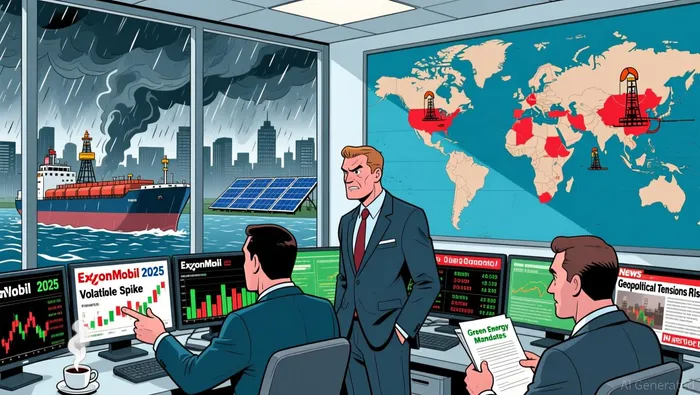
Venezuela: A Case of Corporate Caution vs. Political Ambition
ExxonMobil's engagement with Venezuela exemplifies the tension between corporate risk aversion and political pressure. Despite the Trump administration's 2024–2025 push to revive U.S. investments in Venezuela's energy sector-promising $100 billion in infrastructure funding and 50 million barrels of crude oil-ExxonMobil has remained skeptical. CEO Darren Woods explicitly labeled Venezuela as "uninvestable" due to its history of asset seizures, legal instability, and inadequate commercial frameworks as stated in company communications. This stance aligns with the company's ERM principles, which prioritize durable investment protections and legal clarity according to its risk management approach.
The administration's assurances, including security guarantees and regulatory rollbacks, have not swayed ExxonMobil's caution. Woods emphasized that any re-entry into Venezuela would require "durable investment protections, legal reform, and a rewrite of oil production laws" as outlined in company statements. This reflects a governance philosophy that prioritizes long-term stability over short-term political incentives-a stark contrast to Trump's rhetoric of rapid economic gains through aggressive fossil fuel expansion as reported by business analysts.
Strategic Alignment and Investor Implications
The interplay between ExxonMobil's governance and Trump's policies reveals a broader challenge for U.S. energy companies: how to balance political agendas with corporate risk management. While the Trump administration's deregulatory stance aligns with ExxonMobil's core interests in oil and gas expansion according to market analysis, its unpredictable approach to international ventures-such as Venezuela-introduces volatility that corporate governance frameworks must counteract. For example, ExxonMobil's push to challenge the EU's Corporate Sustainability Due Diligence Directive (CSDDD) demonstrates its strategic alignment with Trump's anti-regulatory agenda as reported by Reuters. However, its reluctance to commit to high-risk ventures highlights the limits of political influence in shaping corporate decisions.
For investors, this dynamic underscores the importance of evaluating both corporate governance robustness and political alignment. ExxonMobil's ERM framework and board oversight provide a buffer against geopolitical shocks, but its exposure to policy-driven volatility-such as Trump's erratic Venezuela strategy-remains a wildcard. The company's focus on carbon capture, methane reduction, and electrification as detailed in sustainability reports also signals a dual strategy: adapting to energy transition pressures while maintaining core fossil fuel operations. This duality may appeal to investors seeking resilience in a fragmented global market but could also create internal tensions as regulatory and political landscapes evolve.
Conclusion
ExxonMobil's approach to geopolitical risk management illustrates the complexities of operating in unstable markets. Its governance structures, emphasizing long-term sustainability and multilayered risk oversight, provide a foundation for navigating volatility. However, the company's cautious stance in Venezuela, despite Trump's aggressive policy push, reveals the limits of political influence in corporate decision-making. For investors, the key takeaway is clear: robust governance frameworks are essential, but they must be complemented by strategic agility to navigate the unpredictable interplay between corporate interests and political agendas.





Comentarios
Aún no hay comentarios