
Navigating Geopolitical Risk and Biofuel Policy Shifts in the ICE Canola Market
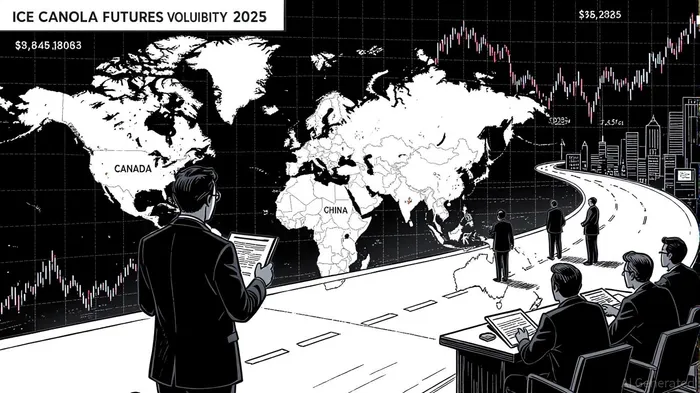
The ICEICE-- Canola market in 2025 is at a crossroads, shaped by a confluence of geopolitical tensions, biofuel policy shifts, and supply-demand imbalances. For long-term investors, understanding these dynamics is critical to identifying opportunities amid uncertainty. This analysis examines how trade disputes, regulatory changes, and market fundamentals are reshaping the sector—and how strategic positioning can mitigate risks while capitalizing on emerging trends.
Geopolitical Tensions: A Double-Edged Sword
China’s imposition of a 75.8% anti-dumping duty on Canadian canola seed in August 2025 has been a seismic shock to the market. According to a report by TimeTrex, this move effectively closed a C$4.9 billion market, triggering a liquidity crisis for Canadian producers and a 4% month-over-month decline in ICE Canola futures in July 2025 [5]. The trade war, sparked by Canada’s tariffs on Chinese electric vehicles and metals, has created a feedback loop of retaliatory measures, with U.S.-Canada trade negotiations under CUSMA adding further uncertainty [3].
While these tensions have destabilized short-term pricing, they also highlight the fragility of over-reliance on a single market. For investors, this underscores the importance of diversification. Canada’s pivot to new markets—such as South Korea, Mexico, and Belgium—has shown promise, with crude canola oil exports rising despite refined oil shipments to the U.S. declining by 22% [1]. However, the success of this strategy hinges on resolving trade disputes through mechanisms like the World Trade Organization, which Canada is now pursuing [2].
Biofuel Policy Shifts: A New Energy Paradigm
The U.S. biofuel sector’s evolving policies have introduced both headwinds and tailwinds for Canadian canola. The U.S. Environmental Protection Agency’s (EPA) proposal to reduce renewable fuel credits for imported biofuels has made Canadian canola less competitive, with U.S. biofuel plants earning 12 cents less per pound from Canadian feedstock compared to domestic soybean oil [2]. This has prompted Canada to launch the Biofuels Production Incentive, a $370 million initiative to bolster domestic biofuel capacity and reduce reliance on U.S. imports [4].
Conversely, the U.S. Budget Bill’s exclusion of imported used cooking oil and tallow from subsidies has created a niche for Canadian canola oil as a preferred feedstock [1]. While this policy shift initially boosted demand, it also exposed vulnerabilities in the face of Trump-era tariff fluctuations [1]. For investors, the key takeaway is the need to balance exposure to U.S. biofuel demand with hedging against policy volatility.
Supply-Demand Imbalances: A Tug-of-War
The canola market’s fundamentals are being tested by a mismatch between supply and demand. China’s tariffs have erased a critical export channel, but U.S. demand remains robust, with canola processing reaching 11.3 million tonnes in MY 2024/25 [2]. Meanwhile, production challenges—such as drought stress in western Canada—threaten to tighten supply, exacerbating price volatility [5].
This imbalance creates a unique opportunity for investors to target companies with strong domestic processing capabilities or diversified export networks. Saskatchewan’s Premier Scott Moe has already signaled a focus on federal support to counteract trade barriers [3], while Canada’s expanded Advance Payments Program offers financial flexibility to producers [4]. These measures aim to stabilize the sector but require time to materialize.
Strategic Positioning for Long-Term Investors
For investors seeking to navigate this complex landscape, three strategies emerge:
Diversify Market Exposure: Reducing reliance on China and the U.S. by targeting emerging markets in Asia, Europe, and Latin America can mitigate geopolitical risks. Saskatchewan’s planned diplomatic efforts to resolve China’s tariffs [3] and Canada’s pivot to crude oil exports [1] illustrate this approach.
Leverage Policy Support: Canada’s Biofuels Production Incentive and Advance Payments Program [4] provide a safety net for producers. Investors should prioritize companies aligned with these initiatives, particularly those with vertical integration in biofuel production.
Hedge Against Volatility: Given the market’s sensitivity to trade disputes and weather, hedging through futures contracts or partnerships with processors can stabilize returns. The 4% decline in ICE Canola futures in July 2025 [5] underscores the need for proactive risk management.
Conclusion
The ICE Canola market in 2025 is a microcosm of global trade tensions and energy transition challenges. While short-term volatility is inevitable, long-term investors can thrive by adopting a diversified, policy-aware, and supply-chain-focused strategy. As Canada navigates trade disputes and biofuel policy shifts, the sector’s resilience will depend on its ability to adapt—and investors who anticipate these changes will be well-positioned to capitalize.
Source:
[1] U.S. Budget Bill Opens Biofuel Door for Canadian Canola [https://www.producer.com/markets/u-s-budget-bill-expected-to-open-biofuel-market-to-canola/]
[2] Why US Clean Fuels Policy May Mean Even Higher ... [https://www.dtnpf.com/agriculture/web/ag/news/article/2025/01/13/us-clean-fuels-policy-may-mean-even-2]
[3] AM Market Report – August 25, 2025 – FoodIndustryNetwork [https://foodindustrynetwork.com/am-market-report-august-25-2025/]
[4] Ottawa Announces Canola Sector Supports [https://www.syngenta.ca/market-news/ottawa-announces-canola-sector-supports]
[5] Canada's canola market sees 4% decline in July 2025 [https://www.linkedin.com/posts/cropgpt-oil_canola-canada-agricultureindustry-activity-7357036302438912000-HV84]





Comentarios
Aún no hay comentarios