
Navigating Geopolitical Crosscurrents: Strategic Energy Plays Amid Russian Sanctions and Volatility
The sanctions regime targeting Russian energy exports has evolved into a high-stakes game of geopolitical chess, with supply disruptions, price swings, and shifting trade routes creating both risks and opportunities for investors. As Russia's oil revenues plunge to EUR 565 million/day—the lowest since its invasion of Ukraine began—the sanctions' bite is undeniable. Yet the Kremlin's resilience, aided by shadow fleets and Asian buyers, ensures the oil market remains a powder keg. For investors, this volatility is not just a challenge but a catalyst to reallocate capital toward energy sectors poised to thrive in this fractured landscape.
The Sanctions Tightrope: Supply Risks and Volatility Drivers
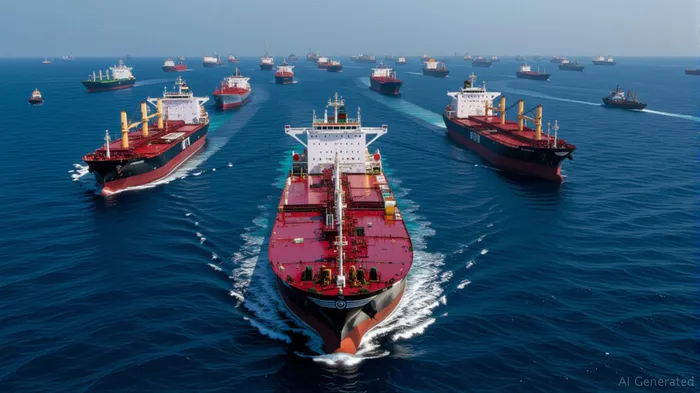
The EU's proposed oil price cap of USD 45/barrel—down from USD 60—threatens to further squeeze Russian revenues, but its implementation faces hurdles. Hungary's potential veto and U.S. reluctance to lower its cap below USD 60 risk fragmenting the G7 coalition, leaving enforcement gaps. Meanwhile, Russia's tactics—ship-to-ship transfers in EU waters rising 55% month-on-month and reliance on “shadow” tankers (now 46% of exports)—highlight its ability to evade restrictions.
The result? Persistent supply uncertainty. Brent crude has hovered near USD 85/barrel this year, up 15% year-to-date, as investors price in risks from drone attacks on Kyiv to U.S. pauses in Patriot missile shipments. Even a partial disruption in Russia's 10.2 million b/d output—a mere 2% dip—could send prices soaring.
Investment Plays: Capitalizing on Chaos
1. North American Energy Majors: The Baseline Hedge
Companies like ExxonMobil (XOM) and Chevron (CVX) remain bedrock holdings. Their diversified portfolios—spanning U.S. shale, Gulf of Mexico projects, and global LNG—insulate them from single-market risks. Chevron's 2025 production guidance of 3.2 million b/d and Exxon's $30 billion annual capital budget, focused on high-return projects, offer stability.
For leveraged gains, shale-focused firms like EOG Resources (EOG) benefit from Brent's proximity to USD 85. EOG's low break-even costs (USD 45/barrel) and 2025 production growth of 7%–9% make it a prime play on sustained prices.
2. Energy Infrastructure: The Quiet Winners
The rerouting of Russian oil and LNGLNG-- is a boon for midstream firms handling U.S. and Middle Eastern exports. Enterprise Products Partners (EPD), with its Gulf Coast export terminals and 19,000-mile pipeline network, stands to gain as U.S. crude and NGL exports surge. Its 6% yield and 95% coverage ratio by cash flow offer downside protection.
Similarly, Magellan Midstream Partners (MMP), which handles refined products and crude in shale hubs, benefits from U.S. production resilience.
3. Renewables: The Geopolitical Hedge
Energy security demands are accelerating renewables adoption. NextEra Energy (NEE), the world's largest renewable generator, is positioned to capitalize on corporate and government green mandates. Its 8.5% annual earnings growth and 3.2% dividend yield make it a “buy-and-hold” staple.
For solar plays, First Solar (FSLR), with its advanced thin-film technology and 2025 project backlog of 24 GW, offers exposure to the 34% annual growth in global solar capacity.
4. ETFs with Downside Armor
For traders, United States Oil Fund (USO) remains a liquid proxy for Brent, but its exposure to contango (when near-month contracts cost more than later ones) can erode returns. Pair it with ProShares UltraShort Oil & Gas (DNO) to hedge against geopolitical shocks. Alternatively, iShares Global Energy ETF (IXC) offers diversified exposure to majors like ShellSHEL-- and TotalEnergie, with a 2.8% dividend yield.
The Geopolitical Wildcards
- EU Price Cap Split: If the U.S. refuses to lower its cap below USD 60, the resulting regulatory chaos could boost Russia's shadow fleet trade—and briefly spike prices.
- China's LNG Appetite: Beijing's 2025 LNG imports are projected to rise 10%, driven by coal-to-gas switching. This supports Cheniere Energy (LNG), which operates 40% of U.S. LNG export capacity.
- Dollar Dynamics: A Fed rate cut by year-end could weaken the dollar, making U.S. crude cheaper for importers and lifting prices.
Immediate Action: Allocate Now
The calculus is clear: geopolitical instability will persist until sanctions are either enforced with G7 unity or Russia finds a diplomatic off-ramp. In this environment, portfolios must balance:
- 20%–25% in oil majors (XOM, CVX) for stability.
- 15%–20% in shale plays (EOG) to amplify upside.
- 10%–15% in renewables (NEE, FSLR) to future-proof against energy transition tailwinds.
- 5%–10% in infrastructure (EPD) to capture trade rerouting.
Avoid pure-play Russian energy stocks; even Gazprom's USD 1.50/barrel discount to Brent is unsustainable if sanctions tighten.
Final Word: Volatility Is the New Normal
The oil market's fragility—driven by sanctions, shadow fleets, and geopolitical brinkmanship—is here to stay. Investors who treat this volatility as a feature, not a bug, will find abundant opportunities in energy's crosscurrents. Act now to position portfolios for a world where every tanker's voyage is a geopolitical referendum.





Comentarios
Aún no hay comentarios