
Navigating the New Frontier: Strategic Hedging in 2025's Crypto Markets Amid Regulatory Clarity and Liquidity Shifts
The 2025 Crypto Regulatory Landscape: A Double-Edged Sword
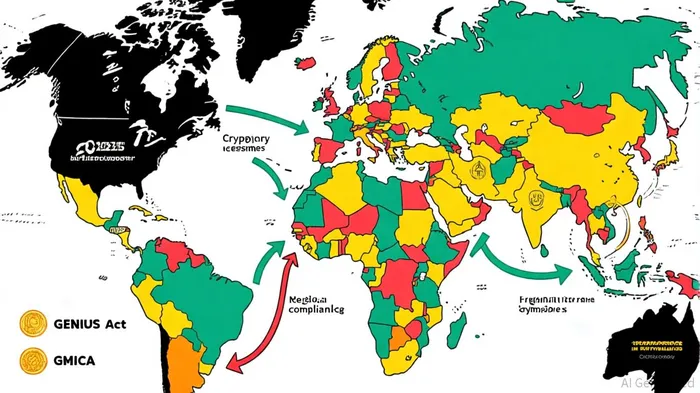
The crypto markets of 2025 are no longer operating in the shadows. Regulatory frameworks have matured significantly, with the U.S. GENIUS Act[1], the EU's Markets in Crypto-Assets (MiCA) regulation[4], and Asia's licensing regimes[2] creating a patchwork of rules aimed at balancing innovation with stability. These developments have reduced systemic risks—particularly in stablecoin markets—by mandating 1:1 reserve backing, AML/KYC compliance, and custodial safeguards[1]. However, they have also introduced new challenges, including cross-jurisdictional fragmentation and the need for updated tax policies[3].
For instance, the U.S. GENIUS Act's focus on stablecoin transparency has boosted consumer confidence but also increased operational costs for smaller exchanges[1]. Meanwhile, the EU's MiCA framework, while fostering standardization, has faced pushback from member states like France and Italy, which advocate for stricter oversight[4]. This regulatory duality—clarity and complexity—has reshaped liquidity dynamics, with tokenized securities and staked ETFs now contributing to deeper markets[2]. Yet, as of mid-2025, liquidity risks persist in less-regulated regions, where enforcement gaps remain[3].
Strategic Hedging: The Institutional Playbook
Institutional investors have responded to this evolving landscape by adopting sophisticated hedging strategies. Derivatives—particularly perpetual futures and options—have become central to risk management. According to a report by CoinLaw[2], 82% of institutions now use derivatives to hedge price volatility, up from 38% in 2023. Platforms like dYdXDYDX-- and GMX[3] offer on-chain execution, enabling real-time adjustments to leverage and exposure while reducing reliance on centralized exchanges.
A key innovation is the use of Bitcoin futures to mitigate regulatory and market risks without holding the underlying asset[2]. These contracts, which range from perpetual to physical delivery, allow institutions to lock in prices amid regulatory uncertainty. However, liquidity constraints and market inefficiencies remain hurdles[2]. To address this, 62% of institutions have adopted multi-signature wallets and cold storage solutions[2], while 59% demand proof-of-reserves from custodians[2].
Case Studies: Hedging in Action
The U.S. SEC's evolving stance on digital assets has forced institutions to adopt conservative collateral strategies[3]. For example, hedge funds in Singapore and Switzerland—jurisdictions with clearer frameworks—now allocate 33% of their portfolios to tokenized assets and synthetic products[4]. This trend is supported by layer 2 solutions like zero-knowledge rollups, which reduce transaction costs and latency for large-scale trading[1].
Meanwhile, the EU's MiCA framework has enabled the creation of compliant investment vehicles, with 72% of institutions reporting enhanced risk management systems tailored for crypto[1]. These frameworks allow for dynamic hedging against counterparty risks, particularly in cross-border transactions.
The Road Ahead: Balancing Innovation and Stability
While 2025's regulatory environment has reduced macroeconomic vulnerabilities, it has also necessitated a shift in investor behavior. The rise of AI-driven analytics and tokenized assets[2] suggests that the market is moving toward a more resilient structure. However, challenges like U.S. tax policy gaps and EU regulatory divergences[3] could delay full institutional adoption.
For investors, the key takeaway is clear: strategic hedging is no longer optional. As markets mature, those who leverage derivatives, custody innovations, and jurisdictional advantages will outperform peers. The future of crypto investing lies in navigating regulatory complexity while capitalizing on liquidity opportunities—a balance that defines the 2025 landscape.







Comentarios
Aún no hay comentarios