
Navigating the New Frontier: Regulatory and Operational Risks in Crypto Exchanges
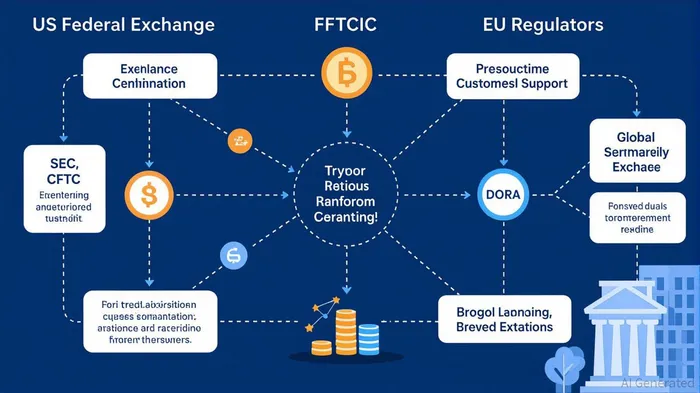
The crypto landscape in 2025 is no longer a Wild West. With the U.S. passing the and , and the EU fully implementing MiCA and , the industry is now under a microscope. For investors, this means one thing: compliance is no longer optional—it's existential. But how do these regulatory shifts impact the operational risks tied to outsourced customer support? Let's break it down.
The New Regulatory Tightrope
The U.S. has finally unified its crypto oversight under the , which mandates that stablecoins be 1:1 backed by high-quality assets like U.S. Treasuries and FDIC-insured deposits [1]. Simultaneously, the forces centralized exchanges to register with both the SEC and CFTC, creating a dual compliance burden [2]. For outsourced customer support teams, this means every interaction with a user could trigger a regulatory obligation—from verifying stablecoin reserves to ensuring AML checks are embedded in customer service workflows.
In the EU, has created a single-market passport for crypto service providers, but at the cost of stricter licensing and transparency rules. For example, under , crypto firms must now prove their outsourced partners can withstand cyberattacks and operational disruptions [3]. This isn't just paperwork—it's a capital-intensive requirement for smaller exchanges.
Case Studies: When Compliance Fails
Let's talk about the handed to OKX for . The DOJ found that OKX allowed users to trade anonymously and even encouraged employees to falsify KYC checks [4]. Similarly, . These aren't just bad PR—they're existential threats for any firm outsourcing customer support without rigorous oversight.
Why do these failures happen? Outsourced teams often lack the training or tools to flag red flags. For instance, . That's a staggering statistic, and it underscores a critical risk: if your outsourced support can't detect money laundering, your exchange becomes a liability.
Best Practices for Survival
So, how do you future-proof your crypto business? Start with . Automated KYC onboarding and real-time transaction monitoring are no longer luxuries—they're necessities [7]. For example, .
Second, vet your third-party providers like they're your own employees. The OCC now allows banks to outsource crypto custody and trading services, but only if they maintain “robust risk management practices” [9]. That means conducting of your outsourced teams and ensuring they're aligned with both U.S. and international standards.
Third, embrace dual registration. The CLARITY Act's dual SEC/CFTC registration requirement isn't just a checkbox—it's a strategic move. By proactively engaging with both regulators, exchanges can avoid the chaos of conflicting rules and build a .
Investment Implications
For investors, the message is clear: avoid exchanges that treat compliance as an afterthought. Look for firms that:
1. Publicly disclose their compliance frameworks (e.g., under the GENIUS Act).
2. Invest in for .
3. Have a track record of (e.g., early adopters of ).
Conversely, red flags include exchanges that:
- Outsource customer support to jurisdictions with lax AML laws.
- Ignore .
- Have a history of enforcement actions (see OKX and Binance).
Conclusion
The crypto industry is at a crossroads. Regulatory clarity is a double-edged sword: it creates opportunities for compliant players but crushes those who lag. For outsourced customer support, the stakes are higher than ever. As an investor, your due diligence must now include scrutinizing a firm's compliance infrastructure as rigorously as its product roadmap. Because in 2025, the next crypto crash won't be caused by a bear market—it'll be triggered by a compliance failure.







Comentarios
Aún no hay comentarios