
Navigating the New Frontier: Institutional Crypto Strategies in a Regulated Era
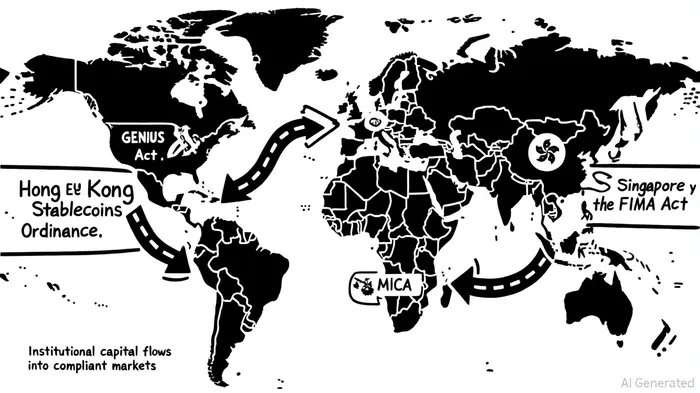
The crypto sector in 2025 stands at a pivotal inflection point, marked by a global shift from fragmented experimentation to structured regulation. For institutional investors, this transition is not merely a compliance exercise but a strategic imperative. Regulatory preparedness-embracing frameworks like the U.S. GENIUS Act, the EU's MiCA, and Asia's licensing regimes-has become central to mitigating risk and unlocking value in a maturing market.
U.S. Regulatory Clarity: A Catalyst for Institutional Adoption
The United States has emerged as a leader in crypto regulation, with the GENIUS Act and CLARITY Act reshaping the landscape. The GENIUS Act mandates 1:1 reserve backing for stablecoins, requiring monthly disclosures and annual audits to ensure transparency, according to a Crypto.com analysis. This has directly addressed institutional concerns about liquidity and counterparty risk, enabling firms like BlackRockBLK-- and Fidelity to launch spot BitcoinBTC-- ETFs and custody solutions, as noted in the Crypto.com analysis. Meanwhile, the CLARITY Act clarifies jurisdictional divides between the SEC and CFTC, assigning the CFTC oversight of commodities like Bitcoin and EthereumETH-- while the SEC governs securities-like offerings, a distinction the Crypto.com analysis highlights. This delineation has reduced regulatory ambiguity, encouraging institutional capital to flow into crypto markets with greater confidence.
EU's MiCA Framework: Harmonization and Centralization
The European Union's Markets in Crypto-Assets (MiCA) regulation, fully implemented by mid-2025, has harmonized crypto rules across member states, creating a unified market for crypto-asset service providers (CASPs). By classifying stablecoins as either e-money tokens (EMTs) or asset-referenced tokens (ARTs), MiCA enforces strict reserve requirements and prohibits algorithmic stablecoins, according to a Stablecoin Insider report. This has spurred a €150 billion migration to compliant tokens like EURC and EURS, displacing non-compliant alternatives such as USDTUSDT-- in EU exchanges, a trend the Stablecoin Insider report also documents.
However, MiCA's success hinges on centralized oversight. The European Securities and Markets Authority (ESMA) is now centralizing cross-border supervision, addressing inconsistencies in national licensing processes. For example, Malta's partial compliance with MiCA standards during an ESMA review highlighted the need for uniform enforcement, as discussed in the Crypto.com analysis. Institutions operating in the EU must now prioritize MiCA-compliant operations, leveraging passporting rights to scale across member states while adhering to ESMA's evolving guidelines, a point also raised by the Crypto.com analysis.
Asia's Diverse Regulatory Ecosystem
Asia's approach to crypto regulation in 2025 reflects a blend of caution and innovation. India's 30% capital gains tax and mandatory cybersecurity audits for exchanges, according to a Crystal Intelligence report, have tempered speculative activity but reinforced institutional trust in long-term holdings. Meanwhile, Hong Kong's Stablecoins Ordinance and Singapore's FIMA Act have positioned both as global crypto hubs. Hong Kong's requirement for full asset-backed reserves and anti-money laundering (AML) compliance has attracted institutional stablecoin issuers, while Singapore's expanded regulatory reach under MAS now covers crypto-derivatives and on-site inspections-observations echoed by the Stablecoin Insider report. These frameworks enable institutions to diversify geographically, balancing risk with growth opportunities.
Proactive Strategies: Compliance, Diversification, and Innovation
Institutional investors are adopting three core strategies to navigate this evolving landscape:
Regulatory Compliance as a Competitive Advantage
Firms are investing heavily in compliance infrastructure, such as Qualified Digital Asset Custodians (QDACs) mandated by the CLARITY Act. This not only ensures adherence to U.S. regulations but also positions institutions to capitalize on emerging products like commodity-based exchange-traded products (ETPs) and continuous futures for Bitcoin and EtherETH--, according to an Edge Forex analysis.Geographic Diversification
The UK's 2026 "gateway regime" for crypto service providers and the UAE's unified licensing system in Dubai and Abu Dhabi, as outlined in the Crystal Intelligence report, are creating new corridors for institutional capital. By securing licenses in these jurisdictions, firms can access markets with robust regulatory frameworks while mitigating exposure to less mature regimes.Risk Mitigation Through Tokenized Assets
With stablecoins now subject to stringent reserve requirements, institutions are reallocating portfolios toward tokenized assets that align with regulatory expectations. For example, EURC and EURS-MiCA-compliant stablecoins-have become preferred liquidity instruments in EU markets, a shift the Stablecoin Insider report highlights.
The Road Ahead: 2026 and Beyond
As 2026 approaches, the focus will shift to enforcing existing frameworks and addressing gaps. The U.S. SEC's anticipated finalization of comprehensive crypto regulations, discussed in the Crypto.com analysis, and the UK's stablecoin caps (noted in the Edge Forex analysis) will further refine institutional strategies. Meanwhile, global harmonization-led by the EU's MiCA model-will likely reduce jurisdictional arbitrage, compelling firms to adopt a "regulatory-first" mindset.
For institutions, the lesson is clear: regulatory preparedness is no longer optional. It is the foundation for sustainable growth in a sector where compliance and innovation are increasingly intertwined.





Comentarios
Aún no hay comentarios