
Navigating the New Frontier: Crypto Wallet Security and Recovery in 2025
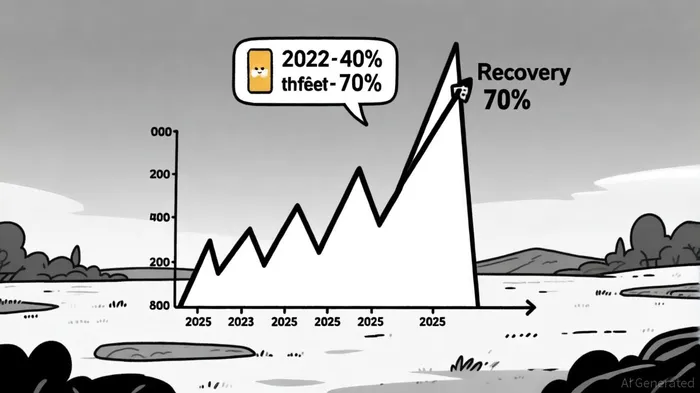
The cryptocurrency ecosystem has entered a critical juncture. By mid-2025, over $2.17 billion had already been stolen from crypto services, with the DPRK's $1.5 billion hack of ByBit marking the largest single incident in history[1]. This represents a stark escalation from 2024, where losses totaled $3.01 billion, and 2023's $1.8 billion. The data paints a grim picture: as the industry matures, so too do the sophistication and scale of attacks. For investors, the imperative to prioritize wallet security and recovery strategies has never been more urgent.
The Escalating Threat Landscape
The shift in attacker focus from centralized exchanges to individual wallets is particularly alarming. In 2025, $8.5 billion in stolen funds remains on-chain, as hackers increasingly target retail users[1]. This trend is driven by the proliferation of AI-enhanced phishing campaigns, deepfake interfaces, and wallet-draining dApps. For instance, attackers now exploit browser extensions and social engineering to compromise hot wallets like MetaMask, which, while convenient for daily transactions, expose users to higher risks[2].
DeFi platforms remain particularly vulnerable. The 2024 report from PeckShield noted a 15% year-over-year increase in losses, with $2.15 billion attributed to hacks and $834.5 million to scams[2]. These figures underscore the fragility of decentralized systems and the need for robust security infrastructure.
Building Investor Resilience: Best Practices for 2025
To mitigate risks, investors must adopt a layered security approach. Cold storage solutions, such as hardware wallets (e.g., Ledger Nano X, Trezor Model T), are now non-negotiable for long-term holdings. These devices store private keys offline, shielding them from remote exploits[1]. For active trading, hot wallets remain practical but should be used sparingly and compartmentalized—keeping only small balances for daily use[2].
Multisignature wallets, like GnosisGNO-- Safe, offer an additional safeguard by requiring multiple approvals for transactions, reducing the risk of single-point failures[2]. Meanwhile, two-factor authentication (2FA) has evolved beyond SMS-based solutions. Hardware-based 2FA and phishing-resistant methods like passkeys are now essential to combat SIM-swap attacks[1].
Recovery phrase management is equally critical. Storing these phrases digitally—via screenshots or cloud notes—remains a leading cause of preventable losses. Instead, investors should opt for encrypted backups or physical storage in secure locations[2]. For institutional investors, crypto inheritance planning is gaining traction, ensuring assets remain recoverable by heirs or business partners[2].
Recovery Strategies: Tracing and Reclaiming Stolen Assets
Despite best efforts, breaches are inevitable. Fortunately, recovery mechanisms have advanced. Blockchain forensic tools from firms like Chainalysis and Elliptic now enable tracing of stolen funds with increasing precision[3]. In 2024, PeckShield reported $488.5 million in successful recoveries, a testament to the growing efficacy of these tools[2].
Legal action is another avenue. The case of Atom Holdings, where provisional liquidators were appointed to recover misappropriated assets, highlights the role of courts in recognizing crypto as property[3]. Jurisdictions like the Cayman Islands and England are leading this shift, offering frameworks for asset recovery[3].
However, success rates vary. While firms like CRC claim 98% recovery rates in 2024, industry averages hover around 70%[4]. Large-scale hacks, such as the $1.4 billion theft from Bybit, often yield dismally low recovery rates—sometimes as low as 0.4%[4]. These disparities emphasize the importance of acting swiftly: engaging law enforcement, leveraging blockchain analysis, and collaborating with recovery experts[3].
The Path Forward: Vigilance and Adaptation
The crypto landscape in 2025 demands a mindset of vigilance. Investors must stay informed about emerging threats, such as wallet drainers and AI-generated phishing attacks[2]. Regularly revoking unnecessary token approvals, using burner wallets for airdrops, and adopting Multi-Party Computation (MPC) solutions are now table stakes[2].
For traders using automated tools, securing API keys with limited permissions, IP whitelisting, and regular rotation is critical[1]. Platforms like 3Commas offer encrypted API management, further reducing exposure[1].
Ultimately, resilience lies in preparation. As Chainalysis notes, “The key to surviving 2025's security challenges is not only adopting the right tools but also cultivating a mindset of verification and caution”[2].
Conclusion
The stakes for crypto investors have never been higher. With losses surpassing $2 billion in 2025 alone, the need for robust security and recovery strategies is undeniable. By embracing cold storage, multisignature wallets, and proactive recovery planning, investors can safeguard their assets against an increasingly sophisticated threat landscape. As the industry evolves, so too must our defenses—turning resilience into a competitive advantage.







Comentarios
Aún no hay comentarios