
Navigating the New Frontier: Crypto Developer Liability and Regulatory Risk in 2025
The U.S. Case: Criminal Liability and Investor Exposure
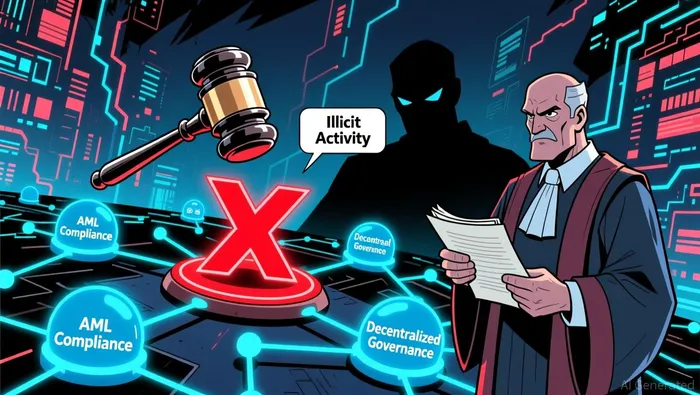
The U.S. Department of Justice's prosecution of Samourai Wallet developer Keonne Rodriguez underscores the heightened legal risks for developers of non-custodial platforms. Rodriguez, sentenced to five years in prison for his role in a crypto-mixing service that laundered $200 million in illicit funds, pleaded guilty to conspiracy charges tied to money transmission laws, as reported by CryptoNews. His case highlights a critical shift: regulators are increasingly holding developers accountable for the misuse of their platforms, even in decentralized systems where they lack direct control over user activity.
For investors, this signals a growing exposure to reputational and legal risks. Projects that fail to implement robust anti-money laundering (AML) safeguards or ignore red flags in user behavior may face not only criminal penalties but also civil litigation from defrauded parties. The $237 million forfeiture ordered in the Rodriguez case further illustrates the financial stakes, as reported by CryptoNews. Investors must now assess whether a project's governance model includes mechanisms to mitigate such risks, such as transparent audits or community-driven compliance protocols.
The EU's Regulatory Overhaul: Centralization and Compliance Burdens
In parallel, the European Union has expanded the authority of the European Securities and Markets Authority (ESMA) to oversee crypto exchanges, aiming to create a unified regulatory framework for the bloc, as reported by CityBuzz. This move, part of a broader capital markets union initiative, imposes stricter operational and reporting standards on non-custodial platforms. While centralized oversight may enhance investor protection, it also raises concerns about stifling innovation in decentralized systems.
For investors, the EU's approach introduces cross-jurisdictional compliance challenges. Non-custodial platforms operating in multiple EU member states must now navigate a more cohesive but complex regulatory environment. Projects lacking the resources to meet ESMA's requirements-such as real-time transaction monitoring or enhanced disclosure obligations-risk exclusion from key markets. This could fragment the user base of decentralized platforms, reducing liquidity and utility for tokens tied to these systems.
The CLARITY Act: A Framework for U.S. Innovation and Risk Mitigation
The 2025 U.S. CLARITY Act (Digital Asset Market Clarity Act) offers a contrasting approach, seeking to balance innovation with investor safeguards. By categorizing digital assets into "commodities," "restricted assets," and "permitted stablecoins," the Act clarifies jurisdictional boundaries between the SEC and CFTC, as reported by Skadden. For non-custodial infrastructure, the Act introduces a certification pathway for developers to obtain regulatory clarity, along with a "safe harbor" for pre-2025 projects that meet decentralization criteria, as reported by Skadden.
This legislative clarity is a double-edged sword for investors. On one hand, the Act reduces regulatory ambiguity, enabling projects to raise capital more efficiently through exempt offerings capped at $75 million annually, as reported by Skadden. On the other, the certification process imposes new compliance costs, particularly for smaller teams. Investors should prioritize projects that actively engage with the CLARITY Act's frameworks, as these are more likely to withstand future regulatory scrutiny.
Strategic Risk Assessment for Investors
To navigate this shifting landscape, investors must adopt a multi-layered risk assessment strategy:
1. Due Diligence on Governance Models: Evaluate whether a project's governance includes mechanisms to address misuse, such as community-driven AML protocols or transparent code audits.
2. Regulatory Alignment: Favor projects that proactively engage with emerging frameworks like the CLARITY Act or ESMA guidelines, as these demonstrate long-term viability.
3. Jurisdictional Diversification: Avoid overexposure to platforms operating in high-risk jurisdictions with unclear legal standards, particularly those lacking robust AML/KYC infrastructure.
The evolving liability landscape for crypto developers is no longer a peripheral concern-it is a central factor in assessing the sustainability of non-custodial infrastructure. As governments continue to refine their approaches, investors who integrate regulatory risk into their analysis will be better positioned to capitalize on the opportunities in this dynamic sector.







Comentarios
Aún no hay comentarios