
Navigating France's Resilient Economy: Undervalued Sectors in a Trade-Exhausted Landscape
France's economy in 2025 is a study in contradictions. While real GDP growth has slowed to 0.6%, and trade tensions have eroded export-driven industries, pockets of resilience persist. Investors navigating this environment must distinguish between sectors that are weathering the storm and those that are being reshaped by it. The key lies in identifying undervalued sectors that are adapting to a slow-growth environment—and avoiding those overly exposed to volatile trade dynamics.
The Resilience of Industrial and Services Sectors
Amid the gloom, France's industrial and services sectors have shown surprising tenacity. The chemicals industry, led by firms like Arkema (ARKP.PA) and Solvay (SOLB.PA), has adopted a defensive posture by stockpiling inventory to hedge against U.S.-China tariff risks. This strategy has allowed the sector to maintain low debt levels and avoid distress, despite a compressed valuation. Arkema, for instance, trades at a 12x P/E ratio, well below its 5-year average of 15x, suggesting potential for upside if trade tensions ease.
The information servicesIII-- sector, dominated by companies such as Orange (OR.PA) and Bouygues Telecom (ENGI.PA), is thriving on government mandates for digital transformation. With 5G infrastructure investments and cybersecurity demand surging, Bouygues' capital expenditure plans for 2024–2025 are unlocking new revenue streams. Orange's 18x P/E ratio reflects optimism about its role in France's digital future, even as valuations remain elevated.
Construction, though in an eight-quarter slump, offers contrarian value. Vinci (DGFP.PA) and Bouygues (ENGI.PA) are poised to benefit from high-speed rail expansions and renewable energy grid projects. Vinci's EV/EBITDA of 8.5x is below its 10-year average of 10.2x, signaling a potential rebound if policy execution improves.
The Sinking Ship: Trade-Exposed Industries
Nowhere is the toll of trade uncertainty more evident than in the wine industry. French exports to the U.S., once a $2.51 billion juggernaut in 2024, now face a perfect storm of tariffs, inventory overhang, and shifting consumer behavior. U.S. importers' last-minute stockpiling in December 2024 created a $10 billion inventory glut, suppressing new orders in 2025. Champagne and Bordeaux, long pillars of French wine exports, have seen sharp declines in both volume and value.
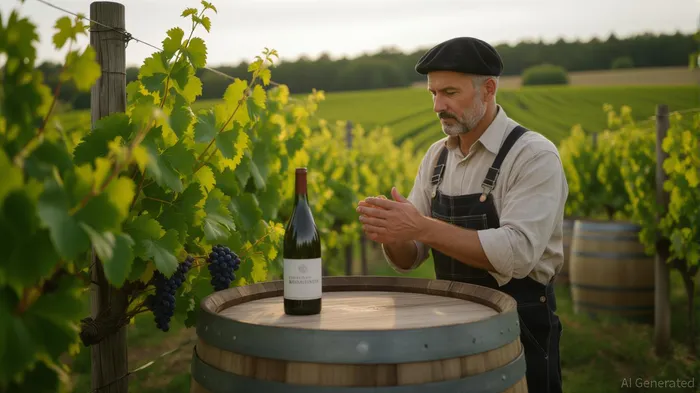
Burgundy producers, who rely on 80% of their exports to the U.S., are particularly vulnerable. With tariffs threatening to erode already thin margins, many are diversifying into northern Europe and Asia. However, these markets lack the scale of the U.S., and the transition will take years. For now, the sector remains a high-risk bet.
Strategic Investment Opportunities
The path forward for investors lies in sector rotation and tactical hedging. The iShares MSCIMSCI-- France ETF (EWQ) offers broad exposure, with 36% allocated to chemicals/industrials and 18% to communications services. Targeting individual stocks like Arkema and Orange can yield asymmetric returns, while short EUR/USD positions may offset currency risks from ECB rate cuts.
Avoiding export-heavy industries like automotive (Renault, RENA.PA) and luxury goods (LVMH, MC.PA) is prudent until trade policies stabilize. These sectors are too exposed to geopolitical shifts and currency volatility.
Conclusion: Building a Resilient Portfolio
France's economy is a mosaic of challenges and opportunities. While trade tensions have battered export-dependent sectors, industrial and services industries are adapting with defensive strategies and structural tailwinds. Investors who focus on undervalued sectors like chemicals, information services, and infrastructure—while hedging against currency and geopolitical risks—can position themselves to thrive in a fragmented global economy.
The key takeaway is clear: in a world of uncertainty, resilience is not just about surviving but about redefining what's possible. For France's economy—and its investors—the future belongs to those who can see beyond the headlines.







Comentarios
Aún no hay comentarios