
Navigating the Fragile U.S. Labor Market: Implications for Equity and Fixed-Income Portfolios in 2026
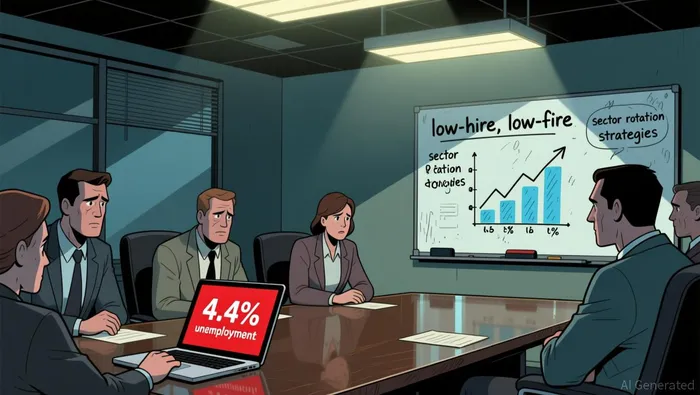
The U.S. labor market in 2025 has become a study in contradictions. While the unemployment rate remains stubbornly at 4.4%-a level consistent with full employment in many historical contexts-underlying metrics paint a far more fragile picture. Job growth has slowed to a crawl, layoffs are rising, and hiring and quitting rates have collapsed, creating a "low-hire, low-fire" environment that defies traditional interpretations of labor market strength according to market analysis. These conflicting signals have left the Federal Reserve in a policy quandary, forced to balance persistent inflation with a labor market that is clearly cooling. For investors, the implications are profound: the Fed's cautious approach to rate cuts and the resulting sector rotation strategies demand a nuanced understanding of both macroeconomic risks and asset-class opportunities.
Contradictory Labor Market Indicators: A Puzzle for Policymakers
The November 2025 jobs report, released as this article is written, underscores the complexity. Despite an unchanged unemployment rate, job creation has been modest, and the JOLTS report reveals a paradox: job openings are rising, but hiring and voluntary turnover are declining according to recent data. This divergence reflects structural shifts in the labor market, including reduced immigration and an aging population, which have compressed the labor supply. As one economist noted, "The unemployment rate is a lagging indicator that masks the true fragility of the market" according to market analysis.
 The Federal Reserve's December 2025 policy decision-a third consecutive 25-basis-point rate cut-was driven by these concerns. The central bank now acknowledges that the labor market is "gradually cooling," even as inflation remains above its 2% target according to economic analysis. This duality complicates the Fed's dual mandate, forcing it to prioritize data-dependent adjustments over preordained policy paths. The December jobs report, scheduled for early January 2026, is expected to provide clearer insights, as it will include less distorted data and a more accurate reflection of labor market dynamics according to market forecasts.
Sector Rotation: From Tech to Cyclical Plays
The labor market's fragility has already triggered a significant sector rotation. Equity markets have shifted away from AI-driven technology stocks-long the beneficiaries of accommodative monetary policy-toward cyclical and value-oriented sectors such as financials, materials, and industrials according to market analysis. This reallocation reflects investor expectations of a Fed that is more willing to cut rates to support growth, even at the risk of prolonging inflation.
Small-cap stocks have also surged, reaching record highs, as investors seek exposure to companies that benefit from a weaker dollar and global trade expansion according to market data. International equities, particularly in emerging markets, are gaining traction, supported by the expectation that a weaker U.S. dollar will persist into the first half of 2026 according to market analysis. For large-cap growth stocks, the outlook remains mixed: while rate cuts should support valuations, the shift in investor sentiment toward more economically sensitive sectors suggests a narrowing of market leadership.
Fixed-Income Opportunities in a Low-Yield World
Fixed-income markets have responded to the Fed's dovish pivot with a re-rating of the Treasury yield curve. Initially, yields rose in anticipation of rate cuts, but they subsequently eased after the Fed announced $40 billion in monthly Treasury bill purchases to bolster liquidity according to market analysis. The "belly" of the yield curve-maturities between three and seven years-now offers a compelling risk-reward profile, as it is less exposed to inflation risks while benefiting from the Fed's accommodative stance according to market analysis.
Investors in alternatives are also positioning for a low-interest-rate environment. Gold and bitcoinBTC--, which have historically performed well during periods of monetary easing, are seeing renewed interest according to market analysis. However, the key challenge remains managing duration risk: while short-term yields are attractive, longer-term bonds remain vulnerable to inflation surprises.
Conclusion: Preparing for a Policy-Driven 2026
The U.S. labor market's contradictions highlight the Fed's delicate balancing act in 2026. For investors, the path forward requires agility. Equity portfolios should overweight sectors that benefit from rate cuts and global trade, while fixed-income strategies must navigate the yield curve's nuances. As the Fed continues to prioritize data over dogma, the ability to adapt to shifting signals-from JOLTS reports to inflation prints-will be critical. In this environment, patience and precision, not speculation, will define successful outcomes.






Comentarios
Aún no hay comentarios