
Navigating the Fractured Oil Price Cap: Investment Opportunities in a Shifting Energy Landscape
The Russian oil price cap, once hailed as a cornerstone of Western sanctions against Moscow, is unraveling under the weight of market adaptation and enforcement gaps. As of July 2025, the EU's revised $47.60 per barrel cap—15% below the global average—has proven insufficient to curb Russian revenues, with Urals crude trading as high as $65.10 per barrel in June. This divergence creates a unique inflection pointIPCX-- for investors, where geopolitical missteps and market loopholes are fueling both risk and reward across energy sectors.
The Enforcement Vacuum: A Gold Rush for Compliant Shipping
The price cap's weakest link remains its enforcement. Despite a 48-hour ship-to-ship (STS) transfer rule that reduced risky transfers by 20%, 44% of Russian oil still flows through shadow fleets—older, poorly insured tankers operating outside G7+ jurisdictions. This has triggered a surge in demand for compliant shipping operators, such as Golar LNG (GLNG) and Teekay Corp (TK), which are now reaping the benefits of EU regulatory alignment.
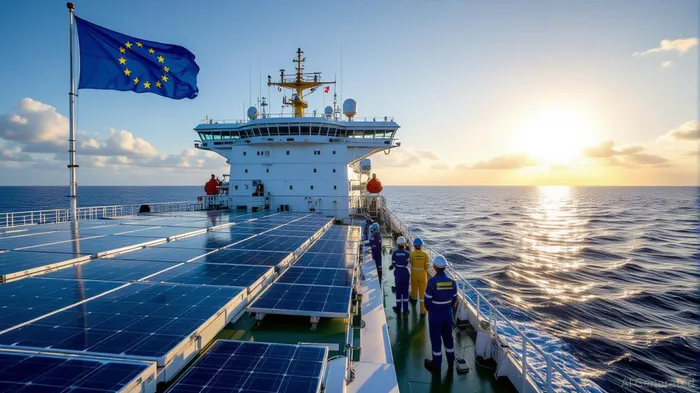
Investors should monitor to gauge the sector's momentum. These firms are not only securing long-term contracts but also modernizing fleets to meet EU environmental standards, a critical edge over shadow operators. Meanwhile, insurers of shadow fleets face growing liability risks, making them poor long-term bets.
The Rise of Renewable Arbitrage
As the price cap falters, the EU's REPowerEU plan is accelerating a parallel energy transition. With $300 billion allocated to renewables, hydrogen hubs, and LNG terminals, solar and wind firms are capturing market share lost by fossil fuels. The Invesco Solar ETF (TAN) has surged 35% year-to-date, outpacing the volatile oil market.
Consider NextEra Energy (NEE) and Enphase Energy (ENPH), whose grid-scale solar and battery storage solutions are now essential to EU decarbonization goals. The price cap's instability is driving institutional capital toward these predictable, regulated assets.
Hydrogen, though nascent, is another frontier. The EU's focus on green hydrogen—produced via renewable energy—could create a $1.5 trillion market by 2040, per BloombergNEF. Early movers like Plug Power (PLUG) and Air Products & Chemicals (APD) are worth watching, despite their current volatility.
Geopolitical Risks and Strategic Hedges
The price cap's erosion highlights a broader truth: enforcement gaps will persist as long as Asian buyers (notably China and India) outbid Western sanctions. This creates a binary outcome: either the EU tightens the cap further (risking global price spikes) or Russian oil continues to flow at a premium.
Investors should hedge against both scenarios. Overweight G7+ aligned shipping firms and underweight shadow fleet insurers. Meanwhile, a long-term bullish stance on renewables and hydrogen remains justified, as the EU's 18th sanctions package signals a 10-year transition away from Russian hydrocarbons.
Conclusion: Capitalizing on the Fracture
The Russian oil price cap is a fractured tool, but its cracks are opportunities. By aligning with compliant shipping operators, renewable energy innovators, and hydrogen pioneers, investors can profit from the enforcement chaos while hedging against geopolitical uncertainty. The key is to act decisively—before the next EU price review in March 2026 forces another recalibration of the market.
In a world where energy markets are increasingly shaped by sanctions and subterfuge, the winners will be those who navigate the divide—not just survive it.





Comentarios
Aún no hay comentarios