
Navigating Fiscal Uncertainty: Identifying Undervalued Sectors in the Shadow of Government Shutdowns
Government shutdowns, though politically charged and economically disruptive, have historically shown limited long-term impact on broad market indices like the S&P 500. According to a report by Davemanuel.com, the S&P 500 has averaged a slight gain during shutdown periods since 1976, with notable exceptions for shutdowns lasting 10 days or more, which saw a median decline of 10.2% in the lead-up to closure, according to S&P sector P/E data. However, markets have historically rebounded, often outperforming in the months following resolution. This pattern underscores the importance of sector-specific analysis to identify opportunities during fiscal uncertainty.
Historical Resilience and Sector Vulnerabilities
During past shutdowns, sectors reliant on federal contracts-such as defense and aerospace-have faced sharper declines due to halted operations and delayed funding. For instance, the 2018-2019 shutdown disrupted defense spending, directly impacting companies in the aerospace industry, according to CSIMarket valuation data. Conversely, sectors like technology and utilities have demonstrated resilience, as their earnings are less tied to government operations. The Federal Reserve's dovish policies during such periods have further cushioned market declines, as seen in 2018-2019 when accommodative monetary policy supported tech stocks despite political gridlock (CSIMarket valuation data).
Current Valuation Metrics: Overvalued Tech and Fairly Valued Utilities
As of July 2025, the Information Technology sector trades at a trailing P/E ratio of 40.65, significantly above its five-year average of 26.78–34.08, according to Siblis Research data. This premium reflects investor optimism around AI and cloud computing, but also raises concerns about overvaluation. In contrast, the Utilities sector's P/E of 20.39 aligns with its historical average, offering a defensive profile with stable, albeit modest, growth potential. While utilities may not outperform in high-growth environments, their low volatility makes them a safe harbor during fiscal uncertainty.
Energy: The Undervalued Outperformer
The Energy sector emerges as a compelling candidate for outperformance. As of September 2025, its P/E ratio stands at 16.14, which is overvalued relative to its five-year average of 12.44 but falls within a "fair" range when compared to its 10-year average of 18.62 (S&P 500 Sectors and current P/E Ratios). However, the sector's trailing P/E of 15.03 as of July 2025 (Siblis Research data) suggests undervaluation, particularly given the decline in commodity prices in 2024. This mispricing creates an opportunity for investors, as energy stocks could rebound if fiscal uncertainty spurs demand for tangible assets or commodity prices stabilize.
The sector's resilience during past shutdowns is less documented, but its low valuations and exposure to cyclical demand make it a strategic bet. For example, during the 2025 shutdown, the 10-Year Treasury yield fell to 4.16% as investors flocked to safety, yet energy's low P/E suggests it was not fully priced for such volatility (S&P 500 Sectors and current P/E Ratios). If fiscal uncertainty persists, energy companies could benefit from a "flight to value" as markets reprice assets.
Financials: A Mixed Picture
The Financials sector, with a P/E of 19.64 as of September 2025 (S&P 500 Sectors and current P/E Ratios), is classified as "expensive" relative to its 10-year average. While government shutdowns historically create mixed impacts-driving Treasury volatility but also safe-haven flows-the sector's overvaluation limits its upside potential. A P/B ratio of 2.02, per CSIMarket valuation data, further indicates that investors are paying a premium for book value, which may not justify returns during periods of economic stagnation.
Strategic Implications for Investors
For investors navigating potential government shutdowns, the data suggests a focus on undervalued sectors with strong fundamentals. Energy, in particular, offers a compelling risk-reward profile. Its low P/E ratio, combined with historical resilience to macroeconomic shocks, positions it to outperform if fiscal uncertainty drives a rotation into value stocks. Meanwhile, utilities provide defensive ballast, while overvalued tech and financials warrant caution. 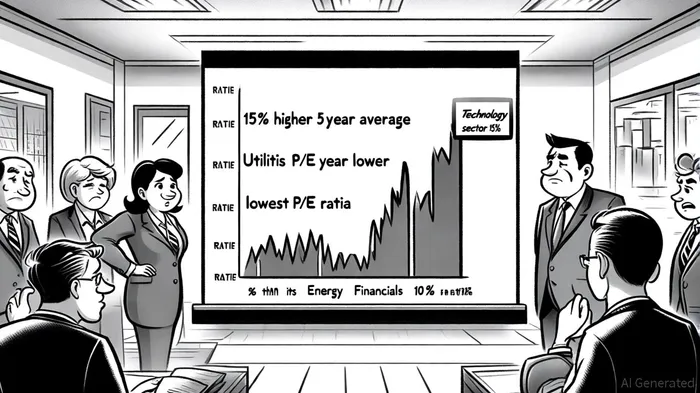







Comentarios
Aún no hay comentarios