
Navigating the Fire Risk Dilemma in Battery Storage: A Strategic Investment Analysis of Resilient Alternatives
Navigating the Fire Risk Dilemma in Battery Storage: A Strategic Investment Analysis of Resilient Alternatives
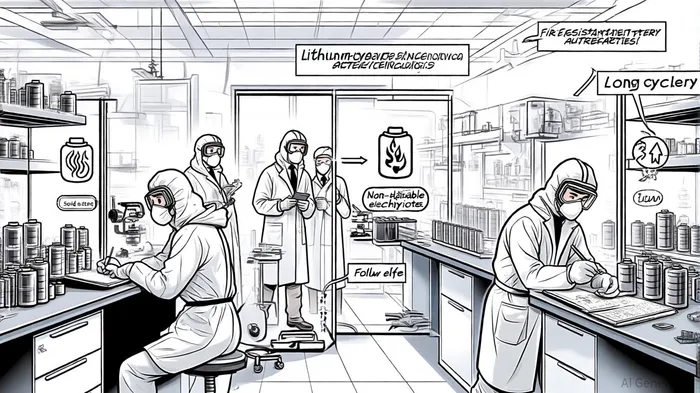
The global energy transition is at a crossroads. While lithium-ion battery storage has been a cornerstone of renewable energy integration, growing public resistance to large-scale projects-driven by fire risks and safety concerns-is reshaping the investment landscape. From California's Moss Landing facility fire in January 2025 to New York's moratoriums on battery storage projects, communities are demanding safer alternatives. For investors, this presents both a challenge and an opportunity: to identify technologies and companies that address fire risks while meeting the scalability demands of a decarbonizing world.
The Lithium-Ion Conundrum: Safety vs. Scalability
Public skepticism is rooted in the inherent vulnerabilities of lithium-ion batteries. Thermal runaway-a chain reaction of uncontrolled heating-remains a critical risk, particularly in densely packed storage facilities, as described in a HarbingerLand analysis. The U.S. added 5 GW of battery energy storage system (BESS) capacity in the first seven months of 2024 alone, according to a NEN Power blog, yet incidents like the Moss Landing fire, which forced the evacuation of 1,500 residents, underscore the urgency of safer solutions. Regulatory bodies, including California's CPUC, are scrambling to update safety protocols, as noted in a Greyb report, but community trust is eroding. In New York, residents near proposed projects have launched petitions citing proximity to schools and homes, according to Market Intelligence, reflecting a broader trend of localized pushback.
The Rise of Fire-Resistant Alternatives: A New Frontier
The market is responding with innovations that prioritize safety without compromising performance. Four technologies stand out:
Solid-State Batteries: By replacing liquid electrolytes with solid ones, these batteries reduce fire risks by up to 50%, and companies like Ion Storage Systems are pioneering solid-state solutions for defense and aerospace, while CATL is scaling production for grid applications. CATL's TENER Stack system, which passed rigorous safety tests, exemplifies how energy density and fire resistance can coexist.
Lithium Iron Phosphate (LFP) Batteries: LFP's thermal stability and lower flammability make it a safer alternative to conventional lithium-ion. CATL's 587 Ah cells, designed for grid storage, highlight LFP's growing dominance in utility-scale projects.
Sodium-Ion Batteries: Leveraging abundant sodium, these batteries offer cost advantages and improved safety. Faradion, now under Reliance Industries, is building a 30 GWh manufacturing hub in India, targeting EVs and grid storage, while HiNa Battery has partnered with Chinese automakers to integrate sodium-ion cells into passenger vehicles.
Flow Batteries: Vanadium flow and iron-air systems, such as those developed by Form Energy, provide long-duration storage without thermal runaway risks. Though higher upfront costs persist, their scalability makes them ideal for industrial applications.
Investment Opportunities: Companies Leading the Charge
The non-lithium-ion battery market, valued at $5.8 billion in 2024, is projected to reach $14.2 billion by 2033 at a 10.5% CAGR, per Market Intelligence. Key players are capitalizing on this growth:
- CATL: Despite a 12.48% revenue decline in Q3 2025 due to falling lithium prices, the company's net profit surged 25.97% year-on-year, driven by high-margin products like the Kirin Battery. Its 40 GWh sodium-ion production line, slated for 2025, positions it to dominate both EV and grid markets.
- Faradion: Backed by Reliance Industries, the UK-based firm is scaling sodium-ion production in India, targeting 200 Wh/kg energy density by 2027. Its partnership with JAC Motors underscores its potential in emerging markets.
- TIAMAT: The French company secured €30 million to build a 5 GWh sodium-ion factory, focusing on fast-charging solutions for mobility and stationary storage, as highlighted by Sodium Battery Hub.
However, the sector is not without risks. Natron Energy, a U.S. sodium-ion pioneer, collapsed in September 2025 despite $363 million in funding, highlighting challenges in certification delays and liquidity. This underscores the need for diversified portfolios and rigorous due diligence.
Policy and Market Dynamics: Catalysts for Change
Government incentives are accelerating the shift. The U.S. Inflation Reduction Act and EU green policies are fueling investments in long-duration storage, according to a Mordor Intelligence report, while China's market-driven reforms are reducing reliance on lithium imports. Import tariffs in the U.S., however, pose a double-edged sword: while they increase costs for lithium-ion, they may indirectly boost non-Li-ion adoption by diversifying supply chains.
Conclusion: Balancing Risk and Resilience
The battery storage landscape is evolving rapidly. For investors, the key lies in balancing innovation with safety. While lithium-ion remains dominant, the rise of fire-resistant alternatives-backed by companies like CATL, Faradion, and TIAMAT-offers a path to mitigate public resistance and regulatory scrutiny. As the U.S. and EU grapple with safety standards and the UK confronts BESS fires, the market for resilient technologies will only expand. The question is no longer if the transition will happen, but who will lead it.







Comentarios
Aún no hay comentarios