
Navigating the Fed's Uncertain Path: Strategic Opportunities Amid Rate Cuts and Data Gaps
The Fed's Policy Pivot: From QT to Liquidity Support
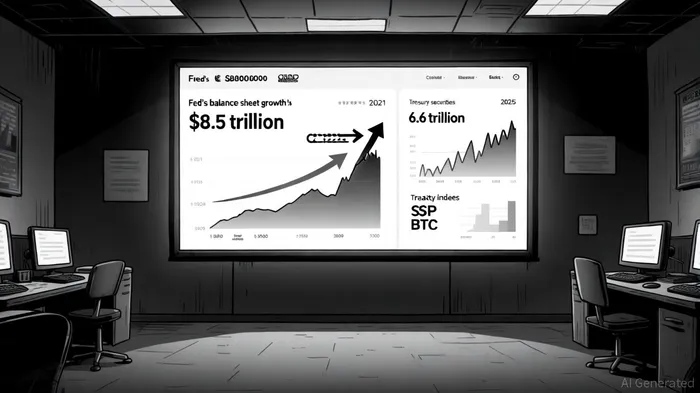
The Fed's decision to end its three-year QT program in December 2025 marks a pivotal shift. Starting in Q1 2025, the central bank will resume monthly Treasury purchases of $35 billion, expanding its balance sheet by $20 billion each month, as noted in a StreetInsider report. This move aims to stabilize liquidity amid a growing banking system and economy, while avoiding the aggressive stimulus of the 2020–2021 period, according to a Coinotag report. The balance sheet, now maintained at approximately $6.6 trillion, will focus on shorter-duration, lower-risk assets, per a Discovery Alert analysis.
This pivot has direct implications for risk assets. Eased financial conditions could buoy equities and cryptocurrencies, which have historically thrived in accommodative environments, as the Coinotag report argues. However, the Fed's cautious approach-avoiding rate cuts unless inflation or employment data deteriorates further-means investors must balance optimism with vigilance, according to a Morningstar analysis.
Political Pressures: Tariffs, Inflation, and the Fed's Independence
The Trump administration's aggressive tariff policies-raising average rates from 2.4% to 18%-have introduced a new layer of complexity. These tariffs are projected to push inflation 1 percentage point higher and increase unemployment by 0.5 percentage points, according to CEPR. While the Fed's revised monetary policy framework (August 2025) emphasizes a balanced approach to employment and inflation, as outlined in a Brookings analysis, political pressures threaten to complicate its dual mandate.
The Federal Reserve Act's independence safeguards remain critical, but the interplay between fiscal and monetary policy is no longer abstract. For instance, Treasury General Account (TGA) liquidity preferences have introduced volatility into interbank markets, complicating the Fed's control over interest rates, according to a BlackRock note. Investors must monitor how these cross-currents influence both policy outcomes and asset valuations.
Data Gaps and Uncertainty: Navigating the Fog
A major challenge in 2025 has been the federal government shutdown, which has left critical economic indicators-like GDP and employment data-unavailable, a point highlighted in the Morningstar piece. This lack of clarity has forced the Fed to rely on lagging metrics, increasing uncertainty for the December meeting. Chair Jerome Powell has explicitly stated that a rate cut is "not a forgone conclusion," as the Morningstar piece notes, underscoring the Fed's data-dependent approach.
Meanwhile, conflicting signals-robust GDP growth versus a slowing labor market-have created a policy dilemma. The FOMC's recent 0.25% rate cut (bringing the federal funds rate to 3.75–4.00%) reflects this tension, per the Morningstar coverage, but the path forward remains murky. Investors should prepare for a range of scenarios, including additional 25-basis-point cuts by year-end, as shown in the FOMC minutes.
Portfolio Positioning: Flexibility and Diversification
Given these uncertainties, portfolio strategies must prioritize adaptability. BlackRockBLK-- has already reduced directional equity exposure and duration shorts to hedge against liquidity tightening, a move BlackRock describes in its note. Key tactics include:
1. Diversification: Allocating to assets that benefit from accommodative monetary policy, such as high-quality equities and cryptocurrencies, as the Coinotag report suggests.
2. Duration Management: Shortening bond durations to mitigate interest rate risk while maintaining exposure to sectors insulated from rate volatility, consistent with the Discovery Alert analysis.
3. Fiscal-Monetary Synergy: Monitoring how fiscal policy (e.g., deficit spending) interacts with Fed actions, particularly as the balance sheet stabilizes, per the Discovery Alert analysis.
Investors should also consider the implications of the Fed's revised framework. The removal of "average inflation targeting" means the Fed will not automatically cut rates in response to a weak labor market, as the Brookings analysis explains. This signals a more balanced approach, requiring portfolios to remain agile across both inflationary and deflationary risks.
Conclusion: Staying Ahead of the Curve
The Fed's 2025 policy environment is defined by duality: a data-dependent central bank navigating political pressures and data gaps. For investors, the key is to align portfolios with the Fed's evolving priorities while maintaining flexibility. By focusing on liquidity, diversification, and close monitoring of fiscal-monetary interdependencies, portfolios can thrive in this uncertain landscape.





Comentarios
Aún no hay comentarios