
Navigating the Fed's Tightrope: Miran's Dissent and Investor Strategy in a Low-Rate Era
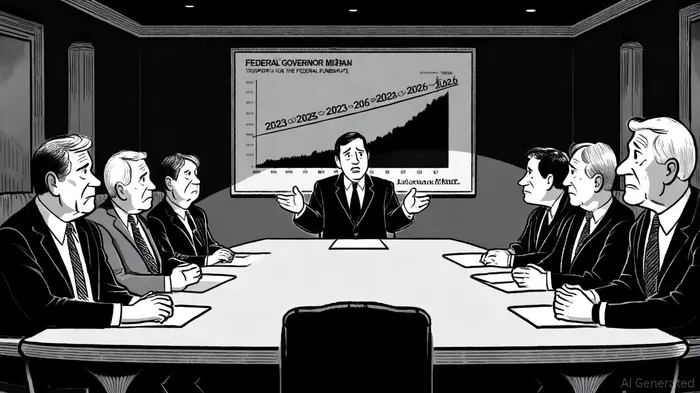
The Federal Reserve's September 2025 rate cut—its first of the year—has ignited a critical debate about the trajectory of monetary policy. While the 25-basis-point reduction was framed as a “risk management” move to address softening labor markets, Fed Governor Stephen I. Miran's lone dissenting vote for a 50-basis-point cut has introduced a new layer of uncertainty for investors. Miran, a Trump appointee, argued that the current funds rate of 4–4.25% remains “very restrictive” and that broader economic forces, including immigration and fiscal policy, are underappreciated in traditional models [1]. His stance reflects a growing tension between the Fed's data-driven approach and political pressures to stimulate growth, with profound implications for equity and fixed income markets.
Equity Markets: Volatility and Sector Rotation
Miran's advocacy for a more aggressive rate cut underscores the potential for an extended low-rate environment, which historically favors growth-oriented equities. A steeper reduction in borrowing costs would likely boost sectors like technology and consumer discretionary, which thrive on cheap capital and robust consumer spending. However, the Fed's cautious stance—projecting only two additional 25-basis-point cuts by year-end—suggests a measured path, limiting the upside for rate-sensitive stocks.
The market's mixed reaction to the September decision highlights this duality. While the S&P 500 rallied 1.2% post-announcement, the rally was underpinned by speculation about Miran's dissent rather than confidence in the Fed's projections [2]. Investors are now hedging against divergent scenarios: a “Miran scenario” of rapid rate cuts and a “Powell scenario” of gradualism. This duality has led to increased volatility in high-growth sectors, as seen in the 3% swing in Nasdaq futures following Miran's post-meeting speech [3].
Fixed Income: Duration Risk and Yield Compression
For fixed income markets, Miran's dissent signals a potential shift in the Fed's long-term policy framework. If his vision of a 1% terminal rate by year-end gains traction, long-duration bonds could face renewed demand, pushing yields lower and compressing spreads. However, the Fed's current projections—ending 2025 at 3.5–4%—suggest a more moderate path, creating a tug-of-war between short-term technical factors (e.g., quantitative tightening) and long-term expectations.
The 10-year Treasury yield dipped to 3.8% immediately after the September decision, reflecting market skepticism about the Fed's ability to balance inflation and employment risks [4]. Yet, Miran's emphasis on nonmonetary forces—such as the inflationary impact of tariffs—introduces a wildcard. If his analysis proves correct, the Fed may face renewed pressure to accelerate cuts, potentially eroding the appeal of long-duration bonds. Investors are increasingly favoring intermediate-term maturities and inflation-linked securities to hedge against this uncertainty [5].
Investor Positioning: Preparing for a Prolonged Low-Rate Regime
The key takeaway for investors is the need to adapt to a potentially extended low-rate environment, regardless of the Fed's ultimate path. Here are three strategic considerations:
1. Equity Allocation: Overweight sectors with strong cash flow generation (e.g., industrials, healthcare) and underweight rate-sensitive sectors (e.g., utilities, real estate) until the Fed's trajectory clarifies.
2. Fixed Income Diversification: Allocate to short- to intermediate-term bonds to mitigate duration risk while maintaining exposure to high-quality corporate debt to capitalize on yield differentials.
3. Alternative Assets: Consider inflation-protected assets (e.g., TIPS, commodities) to hedge against Miran's warning about “structural inflation” from fiscal and trade policies [6].
The Fed's September decision and Miran's dissent highlight a critical inflection point. While the central bank remains committed to its dual mandate, the political and economic forces Miran has spotlighted—immigration, fiscal policy, and trade—could reshape the policy landscape. Investors must navigate this uncertainty by balancing tactical flexibility with a long-term focus on capital preservation.







Comentarios
Aún no hay comentarios