
Navigating the Fed's Tightrope: How Dual Mandate Tensions Drive Market Volatility and Sector Shifts in 2025
The Dual Mandate Dilemma: A Source of Policy Uncertainty
The Federal Reserve's 2025 policy landscape is defined by a delicate balancing act. A 25-basis-point rate cut in September 2025, the first of what officials anticipate will be multiple reductions by year-end, underscores the Fed's response to cooling labor markets and persistent inflation[3]. Chair Jerome Powell has emphasized the "challenging situation" of two-sided risks, with rising unemployment and stubborn inflation pulling policy in opposing directions[4].
Political interference has further complicated this calculus. House Financial Services Committee Chairman French Hill's proposal to eliminate the maximum employment component of the dual mandate reflects growing skepticism about the Fed's broad remit[1]. Conversely, officials like Atlanta Fed President Raphael Bostic defend the dual mandate as a cornerstone of U.S. monetary policy, stressing the need to anchor inflation expectations while supporting labor market resilience[2]. These internal and external tensions have eroded confidence in forward guidance, leaving markets to second-guess the Fed's next move.
Market Volatility: The Cost of Uncertainty
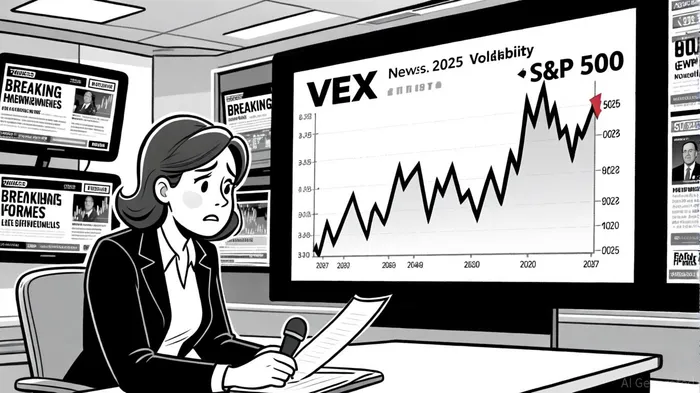
The Fed's policy ambiguity has directly influenced financial market volatility. The CBOE Volatility Index (VIX) spiked to a 30.8-point increase in early April 2025 following aggressive tariff announcements, reflecting heightened uncertainty over trade policy and its macroeconomic implications[5]. Similarly, the S&P 500 experienced sharp corrections during this period, with volatility metrics hitting historical extremes[5].
Data from the St. Louis Fed's Equity Market Volatility Tracker aligns with these trends, showing elevated volatility expectations as investors grapple with conflicting signals from the Fed[6]. While stable corporate earnings and systematic inflows have temporarily subdued volatility, risks from macroeconomic shifts-such as the Fed's rate-cutting pivot-remain potent catalysts for swings in asset prices[6].
Sector Rotation: Winners and Losers in a Dovish Environment
The Fed's dovish tilt has triggered a pronounced rotation across sectors. Technology and communication services, already buoyed by AI-driven innovation, have surged post-rate cut, with ETFs like XLK (Technology Select Sector SPDR) and VGT (Vanguard Information Technology ETF) outperforming the broader market[7]. Lower discount rates have amplified valuations for growth stocks, while reduced borrowing costs have boosted profitability in capital-intensive industries[8].
Financials have also benefited, with XLF (Financial Select Sector SPDR) rising 3.9% year-to-date as rate cuts compress credit spreads and stimulate lending activity[9]. Conversely, energy and healthcare sectors have lagged. The Energy Select Sector SPDR (XLE) underperformed due to falling oil prices, while healthcare (XLV) faced pressure from shifting investor preferences toward cyclical plays[9].
Investor Implications: Navigating a Fragmented Landscape
For investors, the Fed's policy uncertainty demands a nuanced approach. The shift toward monetary easing favors long-duration assets, including U.S. large-cap growth stocks and intermediate-term bonds, while sectors like real estate and consumer discretionary stand to gain from lower borrowing costs[10]. However, risks persist: geopolitical tensions, such as the aforementioned tariffs, could reignite volatility, particularly in export-sensitive industries[5].
Advisors are increasingly advocating for diversified portfolios that balance exposure to rate-sensitive sectors with defensive holdings. For instance, while technology and financials offer growth potential, allocations to utilities and gold (via ETFs like XLU and GLD) may provide ballast against macroeconomic shocks[10].
Conclusion
The Federal Reserve's dual mandate remains a double-edged sword in 2025. While its flexibility allows for tailored responses to economic challenges, the resulting policy uncertainty has amplified market volatility and driven sector-level reallocations. As the Fed navigates political pressures and conflicting economic signals, investors must stay attuned to both the direction of rate changes and the broader implications for asset class performance.







Comentarios
Aún no hay comentarios