
Navigating the Fed's Tariff Dilemma: Yield Curve Shifts and Credit Risks in a 3% Inflation World
The Federal Reserve's acknowledgment that trade tariffs are driving a temporary 3% inflation spike has upended traditional fixed income strategies. As New York Fed President John WilliamsWMB-- projects a near-term trade-off between slower growth and elevated prices, investors must recalibrate portfolios to navigate yield curve distortions and sector-specific credit risks. The path forward demands a dual focus on duration management and sector rotation to capitalize on evolving monetary policy uncertainties.
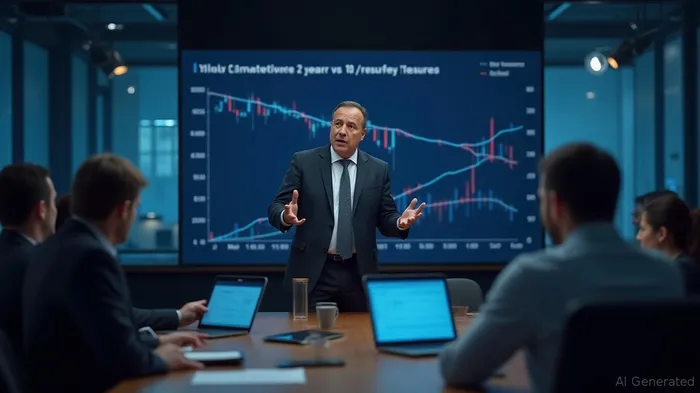
The flattening yield curve—now inverted between short- and long-term maturities—reflects market skepticism about the Fed's ability to sustain its “modestly restrictive” stance. Williams' scenario of a 1% GDP growth slowdown and rising unemployment suggests the Fed may be forced to pivot toward rate cuts sooner than expected. This dynamic creates a tactical opportunity in short-duration Treasuries, which historically outperform when rate expectations shift.
The 10-year yield's volatility, currently hovering near 3.5%, underscores this tension. Investors should consider laddering maturities between 1–3 years to capture rising rates while hedging against a potential Fed reversal. The steepness of this segment of the curve—currently at its narrowest in a decade—signals that the market is pricing in both near-term inflation persistence and longer-term disinflationary pressures from trade-driven slowdowns.
On the credit side, Williams' analysis highlights asymmetric risks. Rate-sensitive sectors like autos, tech, and consumer discretionary face dual pressures: higher borrowing costs and weaker demand as household costs rise by $2,000 annually.
The widening spread between auto and utility bonds illustrates this divergence. Utilities, benefiting from stable demand and inflation-linked revenues, now offer a 200-basis-point premium over autos—a gap that could widen as manufacturing declines (down 1.5% YTD) and consumer sentiment indices hit 4-month lows.
Investors should rotate capital into investment-grade bonds with shorter durations and inflation-hedging characteristics. Municipal bonds, which offer tax-advantaged yields and insulation from trade disputes, present an attractive alternative. The Fed's own projections—showing inflation moderating to 2% by 2026—support a gradual shift toward intermediate-term bonds by year-end.
Meanwhile, the market's pricing of two rate cuts by mid-2025 reflects a growing consensus that tariffs will ultimately force the Fed to retreat. This expectation validates a “barbell” strategy: pairing short-term Treasuries (e.g., 2-year notes) with ultra-long bonds (30-year TIPS) to capture both rate cuts and inflation compensation.
Critically, this environment rewards patience. While policymakers like Michelle Bowman downplay tariff-driven inflation risks, Williams' emphasis on business sentiment and manufacturing weakness suggests the Fed's hands are tied. The resulting uncertainty creates a “sweet spot” for active managers: by shortening duration, favoring defensive sectors, and preparing for Fed policy reversals, fixed income investors can turn Williams' growth-inflation dilemma into a durable alpha opportunity.
Actionable Strategy:
1. Duration: Cap portfolio duration at 3–5 years; allocate 40% to 1–3 year Treasuries.
2. Sector Rotation: Reduce exposure to rate-sensitive industrials; overweight utilities and munis.
3. Hedging: Use 10-year TIPS to hedge against near-term inflation spikes.
In a world where trade wars distort traditional economic signals, fixed income investors must abandon passive indexing. The Fed's tariff-driven dilemma demands dynamic positioning—a blend of tactical yield curve plays and sector-specific credit selection—to thrive in this uncertain environment.







Comentarios
Aún no hay comentarios