
Navigating Fed Policy Divergence in a 3.0% Inflation Environment
The Fractured Consensus: Aggressive vs. Cautious Stances
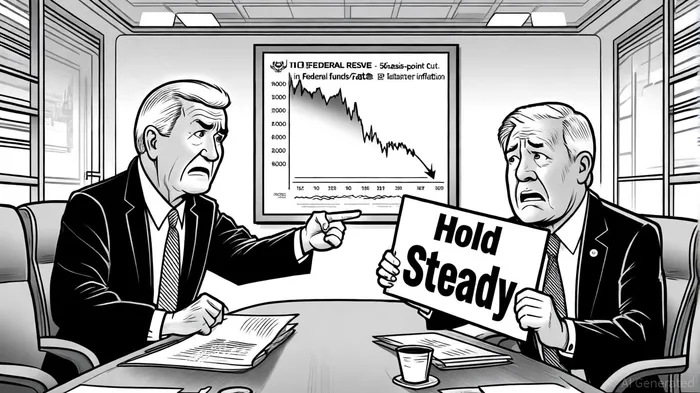
The October 2025 rate cut marked the Fed's second consecutive reduction, but the internal debate over its magnitude exposed deep ideological divides. Governor Milan, a vocal advocate for aggressive easing, pushed for a 50-basis-point cut, arguing that the labor market's "downside risks have increased materially" and that monetary policy remains "restrictive," according to a Federal Reserve roadmap. Conversely, Schmid and others, including Dallas Fed President Lorie Logan, cautioned against premature action, emphasizing that inflation remains "too high" and that a 25-basis-point cut failed to address structural price pressures, Investopedia reported.
This divergence reflects broader tensions within the FOMC. While the majority prioritized stabilizing employment amid a government shutdown-induced data blackout, dissenters warned of the risks of overreacting to transitory labor market softness. The Fed's decision to end its balance sheet reduction program in December 2025-replacing maturing mortgage-backed securities with short-term Treasuries-further complicated the narrative, signaling a shift toward liquidity support, as NerdWallet noted.
Market Stability and Inflation Control: A Delicate Balancing Act
The Fed's fragmented approach has introduced uncertainty into financial markets. Historically, policy divergence has been a double-edged sword: while it can signal adaptability, it also risks eroding market confidence in the central bank's ability to anchor expectations. In this case, the Fed's 25-basis-point cuts have been met with skepticism by investors who fear that the pace of easing is insufficient to curb inflation or stimulate growth.
Data from the University of Michigan Survey of Consumers reveals a troubling trend: one-year-ahead inflation expectations have surged to 3.8%, suggesting that households are beginning to internalize higher price levels, according to a Boston Fed analysis. This de-anchoring of expectations could complicate the Fed's 2025 review of its monetary policy framework, which aims to reinforce a 2% inflation target while addressing nonlinearities in the economy, as detailed in the Fed's 2025 strategy statement. If expectations become unmoored, even aggressive rate cuts may fail to restore price stability, creating a self-fulfilling cycle of inflation persistence.
Investment Strategies for a Fragmented Fed Landscape
For investors, the key is to hedge against both inflationary risks and the potential for further policy divergence. Here are three actionable strategies:
Tilt Toward Inflation-Protected Assets: Treasury Inflation-Protected Securities (TIPS) and commodities like gold remain defensive plays in a 3.0% inflation environment. The Fed's delayed response to inflation has already driven real yields into negative territory, making these assets more attractive, per the Fed's announcement.
Position for Rate Volatility: The FOMC's internal disagreements suggest that future rate decisions will remain data-dependent and unpredictable. Investors should consider options strategies (e.g., straddles or strangles) to capitalize on potential volatility in the federal funds rate.
Focus on Sectoral Divergence: Sectors like consumer staples and utilities, which are less sensitive to interest rates, may outperform in a fragmented Fed environment. Conversely, rate-sensitive sectors like real estate and financials could face headwinds if the Fed's easing path is delayed, as a Bitget report noted.
Conclusion: A Path Forward in Uncertainty
The Fed's 2025 policy moves highlight a critical juncture in its battle against inflation and economic slowdown. While the central bank has taken steps to ease financial conditions, the lack of consensus among its officials underscores the complexity of balancing growth and price stability. For investors, the path forward requires vigilance, flexibility, and a willingness to adapt to a landscape where policy signals are as fragmented as the economy itself.







Comentarios
Aún no hay comentarios