
Navigating the Fed's Divided Policy Outlook: Strategic Sectors to Position for 2026 Rate Cut Scenarios
As the Federal Reserve navigates a divided policy outlook ahead of 2026, investors face a critical juncture in positioning portfolios for a potential "hawkish cut" environment. A hawkish rate cut-a scenario where the Fed lowers borrowing costs while signaling caution about future easing-presents a nuanced landscape where sectoral performance will diverge sharply. Drawing on recent expert analysis, this article outlines strategic sectors poised to thrive and those likely to underperform, offering a roadmap for capitalizing on the Fed's evolving stance.
Strategic Sectors to Position: Winners in a Hawkish Cut Environment
1. Fixed Income: Locking in Yields Before the Window Closes
In a hawkish rate cut environment, high-quality bonds with maturities of 2 to 5 years emerge as compelling assets. As cash yields decline, investors are incentivized to secure current returns before further rate cuts erode future bond prices. According to a PIMCO report, this strategy allows portfolios to balance income generation with manageable duration risk, avoiding the volatility of longer-dated bonds.
2. Value Stocks: A Counterbalance to Growth Volatility
Value stocks, historically undervalued relative to growth-oriented sectors like technology, gain traction in a hawkish cut scenario. Lower interest rates reduce the discount rate applied to future cash flows, making the rich valuations of growth stocks less attractive. PIMCO highlights that value equities offer a "mean reversion opportunity," particularly in sectors such as industrials and energy, where earnings visibility and cash flow stability shine.
3. Capital-Intensive Sectors: Telecom, Utilities, and Real Estate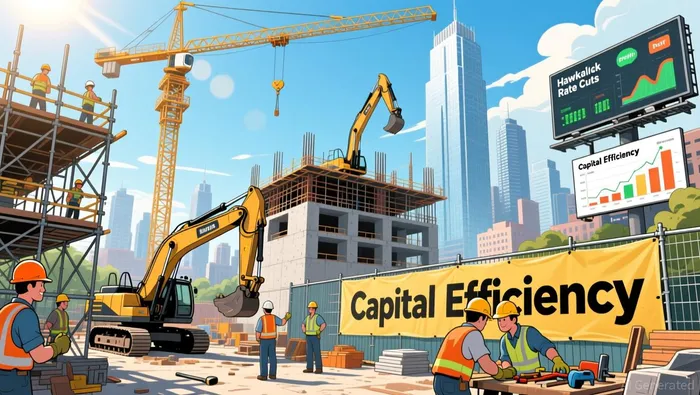 Sectors requiring significant capital investment-such as telecom, utilities, and real estate-benefit from reduced borrowing costs. Kiplinger notes that lower interest rates ease financing for large-scale infrastructure projects, enhancing profitability for companies in these industries. For example, real estate investment trusts (REITs) could see improved leverage metrics, while utilities may accelerate grid modernization initiatives.
4. Regional Banks and Small-Cap Stocks
A rate-cut environment typically stimulates loan demand, benefiting regional banks that serve small businesses and consumers. Kiplinger underscores that these institutions, often overlooked in favor of megabanks, stand to gain from expanded credit activity. Similarly, small-cap stocks could outperform as cheaper financing fuels growth and operational flexibility.
5. Commodities and Gold: Diversification and Inflation Hedges
Commodities like copper and lithium, tied to AI-driven infrastructure demand, offer indirect exposure to rate-cut-driven economic activity. Meanwhile, gold remains a strategic asset for diversification, though its elevated valuation requires careful consideration. PIMCO emphasizes that gold's role as an inflation hedge becomes more relevant in a hawkish cut environment, where policy uncertainty may persist.
Sectors to Avoid: Losers in a Hawkish Cut Environment
1. Financials and Insurers: Margin Compression Risks
While some financials benefit from increased lending, others face headwinds. A hawkish cut may reduce net interest margins without a corresponding surge in loan demand, squeezing profitability. As US News highlights, insurers and larger banks with complex balance sheets are particularly vulnerable if rate cuts fail to stimulate borrowing activity.
2. Utilities and Real Estate: Sensitivity to Policy Signals
Despite their traditional affinity for low rates, utilities and real estate may falter if the Fed signals caution about future easing. These sectors rely on long-term, stable interest rates for capital-intensive projects, and a hawkish tone could dampen investor confidence in their growth trajectories.
3. Consumer Discretionary: Confidence Dilemmas
Consumer discretionary sectors, which thrive on spending for big-ticket items, may struggle if a hawkish Fed dampens consumer confidence. Even with lower borrowing costs for mortgages or auto loans, economic uncertainty could curb demand, according to US News.
4. Technology: Valuation Pressures
Growth-oriented tech companies, which rely on discounted future cash flows, face valuation pressures in a hawkish cut environment. Without aggressive rate cuts to maintain low discount rates, their lofty multiples may contract, leading to underperformance relative to value stocks according to US News.
Conclusion: Strategic Positioning for 2026
The Fed's divided policy outlook demands a nuanced approach to sector selection in 2026. By prioritizing fixed income, value stocks, capital-intensive industries, and commodities while avoiding overexposure to financials, utilities, consumer discretionary, and tech, investors can align portfolios with the dynamics of a hawkish cut environment. As always, diversification and active monitoring of Fed signals will remain critical to navigating this complex landscape.







Comentarios
Aún no hay comentarios