
Navigating the Fed's Crossroads: Timing and Positioning in a Fractured Policy Landscape
The Fed's Dilemma: Inflation, Employment, and Policy Paralysis
The Fed's October 2025 decision to cut rates by 25 basis points was far from unanimous. While the move aimed to address a rising unemployment rate (4.3%) and slowing wage growth, officials like Governor Stephen Miran advocated for a more aggressive 50-basis-point cut, while others, including Kansas City Fed President Jeffrey Schmid, favored no change according to policy minutes. This schism underscores a broader tension: the Fed's dual mandate of price stability and maximum employment is pulling policymakers in opposite directions.
Inflation remains a persistent headwind, with CPI at 3.1% and PCE at 2.8%, driven by sticky services-sector prices. Meanwhile, the labor market's "softening" rather than collapse-marked by upside payroll surprises and a gradual rise in unemployment-has left officials debating whether to prioritize growth or inflation control according to market analysis. The result? A policy environment where market expectations for a December rate cut have plummeted to 50%, reflecting the Fed's inability to coalesce around a clear path.
Market Anticipation: Positioning in a High-Volatility Regime
The Fed's indecision has amplified market sensitivity to incoming data, particularly after a government shutdown delayed key economic reports like CPI and retail spending according to market reports. This uncertainty has created a "structural fragility" in rate-sensitive assets, where thin liquidity and leveraged positioning can amplify price swings beyond fundamental justifications according to market analysis.
For bonds, the inverse relationship between yields and rates remains intact. The October 2025 rate cut initially drove Treasury yields lower, but they rebounded to 4.1% as investors recalibrated expectations for a December pause. Long-term bonds, however, remain attractive for their duration advantage, as existing higher-yielding securities gain relative value in a low-rate environment according to investment commentary.
Equities have shown a more nuanced response. Growth sectors like technology and real estate benefited from the October cut, as cheaper financing boosted valuations. Yet the S&P 500's cautious performance reflects lingering concerns about inflation and a potential policy misstep. Historically, rate cuts tied to growth support (e.g., post-2008) have driven multiyear bull markets, but cuts signaling deeper economic risks often trigger initial turbulence according to economic analysis.
Real estate and mortgage markets are indirectly impacted. The October cut pushed 30-year fixed mortgage rates to 6.35%, improving affordability and refinancing activity. However, the Fed's reluctance to cut further-evidenced by Boston Fed President Susan Collins' "mildly restrictive" stance-suggests mortgage rates may remain elevated for longer according to Fed commentary.
Strategic Positioning: Lessons from History and Structural Realities
Historical precedents offer mixed signals. During the 2008 financial crisis, Fed rate cuts and quantitative easing drove gold prices to $1,900 per ounce and fueled a decade-long equity bull market. Conversely, the 2022-2023 tightening cycle saw equities and real estate underperform as borrowing costs surged according to investment analysis. The current environment, however, is distinct: a Fed divided by inflationary pressures and a market dominated by passive flows that amplify volatility.
Investors should prioritize assets with durable demand and long-cycle tailwinds. Sectors like energy infrastructure, power generation, and critical minerals (e.g., copper, lithium) remain well-supported, as global demand for these resources is structurally elevated. Balance sheet strength and cash flow visibility are also critical, given the fragility of leveraged positions in a high-volatility regime.
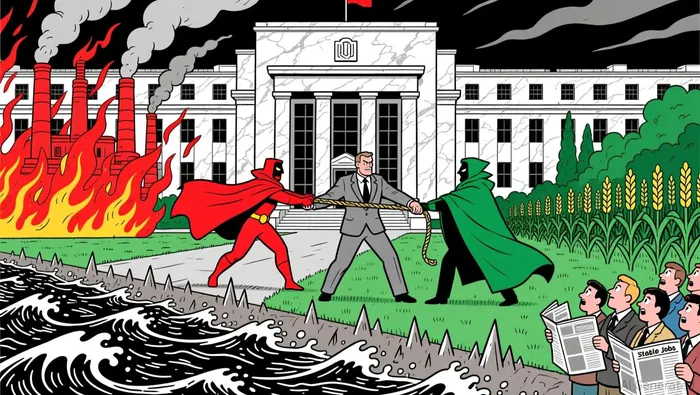
Risk Management: Navigating the Fed's Flawed Framework
Critics argue the Fed's monetary framework is inherently flawed, relying on an arbitrarily low inflation target, outdated price indices, and Keynesian models that fail to account for modern economic complexities. This framework may exacerbate market uncertainty, particularly if policymakers continue to prioritize inflation control over growth.
To mitigate risks, investors should avoid over-leveraged assets and focus on sectors with real demand visibility. Gold, as a safe-haven asset, could benefit from prolonged uncertainty and a weaker dollar according to market analysis. Meanwhile, high-quality corporate bonds and REITs with strong cash flows may offer relative stability compared to more speculative rate-sensitive assets according to investment research.
Conclusion: Timing the Pause, Positioning for Resilience
The Fed's December meeting will likely cement its fractured stance, with a pause in rate cuts becoming increasingly probable. While this creates near-term uncertainty, it also presents opportunities for investors who can navigate the structural fragility of markets. By focusing on long-cycle sectors, prioritizing balance sheet strength, and hedging against policy missteps, investors can position themselves to thrive in an environment where timing and resilience matter more than ever.







Comentarios
Aún no hay comentarios