
Navigating the EV Price War: Mercedes’ Strategy to Counter Chinese Competition
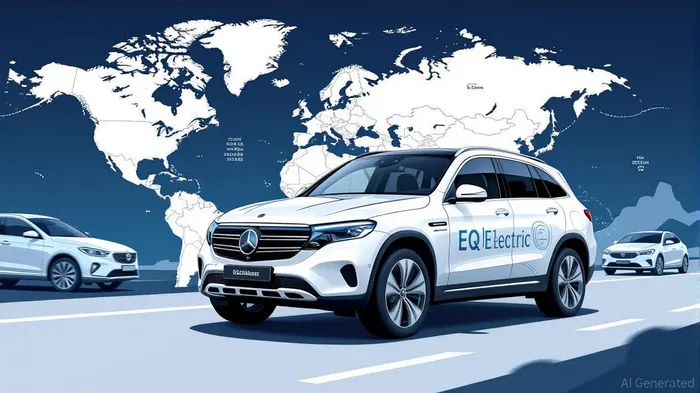
The global electric vehicle (EV) market is in a state of flux, with Chinese automakers dominating production and sales while Western manufacturers like Mercedes-Benz grapple with margin pressures and shifting consumer preferences. As the EV price war intensifies—driven by aggressive discounting from Chinese firms and regulatory headwinds in Europe—Mercedes has adopted a dual strategy of cost innovation and strategic global positioning to maintain its premium brand identity and market share. This analysis examines how Mercedes is navigating these challenges while countering the rise of Chinese EVs.
Cost Innovation: Streamlining Platforms and Cutting Expenses
Mercedes-Benz has taken decisive steps to reduce production costs and enhance efficiency in its EV lineup. A pivotal move was the cancellation of its planned new EV platform, saving an estimated $4.3 to $6.5 billion in development costs [2]. Instead, the company is optimizing its existing EVA 2 platform with upgrades like an 800-volt system and advanced battery components, allowing for faster development cycles and lower capital expenditures [2].
Beyond platform adjustments, Mercedes has implemented broader cost-cutting measures. By outsourcing finance and HR departments, avoiding worker replacements for retirees, and relocating production to lower-cost regions like Hungary (where costs are 70% cheaper than in Germany), the company aims to reduce overall production costs by 10% by 2027 and double that by 2030 [1]. These efforts are critical in an industry where Chinese automakers leverage state subsidies and economies of scale to undercut prices. For instance, BYD’s quarterly net profit fell 29.9% in Q2 2025 due to margin compression from heavy discounting, underscoring the financial risks of unbridled price competition [3].
Global Market Positioning: Localizing Production and Embracing Hybrid Technology
Mercedes is also recalibrating its global strategy to mitigate the impact of tariffs and supply chain disruptions. The EU’s 45% tariffs on Chinese EVs, imposed in October 2024, have prompted Mercedes to accelerate localized production in Europe, reducing reliance on imported components and enhancing cost competitiveness [4]. Similarly, the company is expanding manufacturing in the U.S. and China to align with regional demand and regulatory requirements.
A key component of this strategy is the shift toward hybrid electric vehicles (HEVs). While Chinese automakers dominate with pure EVs, Mercedes has prioritized HEVs to address range anxiety and maintain price parity with battery electric vehicles (BEVs). This approach aligns with European consumer preferences, where plug-in hybrids now account for 30% of EV sales [1]. By focusing on HEVs, Mercedes balances sustainability with practicality, preserving its premium positioning in a market increasingly saturated by low-cost Chinese imports.
Countering Chinese Competition: Technology and Brand Resilience
Chinese EVs have surged into European markets, capturing 10% of plug-in hybrid sales despite high tariffs [4]. To counter this, Mercedes is leveraging its "Sensual Purity" design ethos and cutting-edge technology. The all-electric GLC SUV, unveiled at IAA Mobility 2025, exemplifies this strategy. Equipped with intelligent energy management, extended range, and over-the-air updates, the GLC merges luxury with electrification, directly challenging Chinese models like BYD’s Han EV [1].
Moreover, Mercedes is investing in software-defined architectures to differentiate its offerings. Partnerships with tech firms enable personalized features and continuous updates, a critical edge in an industry where innovation cycles are accelerating. This contrasts with Chinese automakers, who, despite advancements in battery technology, still face brand perception challenges in Western markets [3].
Challenges and Opportunities
While Mercedes’ strategies are robust, challenges persist. Chinese automakers continue to expand into Europe and Southeast Asia, with BYDBYD-- planning local production in Pakistan and other emerging markets [3]. Additionally, the EU’s push for domestic battery manufacturing and rare earth material sourcing could further disrupt global supply chains [4].
However, Mercedes’ focus on premium innovation and localized production positions it to weather these pressures. Analysts note that the company’s ability to balance cost efficiency with brand value will be critical in maintaining profitability. As Bloomberg reports, BYD’s gross margin has already fallen to 18% in 2025, illustrating the long-term risks of price-driven competition [2].
Conclusion
Mercedes-Benz is navigating the EV price war through a combination of cost innovation, strategic localization, and technological differentiation. By streamlining platforms, cutting expenses, and adapting to regional markets, the company is countering the aggressive expansion of Chinese automakers while preserving its premium identity. As the global EV landscape evolves, Mercedes’ ability to balance affordability with luxury will determine its success in an increasingly competitive arena.
**Source:[1] Global Automotive Outlook- 2025, [https://www.marketsandmarkets.com/Market-Reports/global-automotive-industry-outlook-77960341.html][2] Mercedes-Benz Scraps Plans for New EV Platform, Poor Sales to Blame, [https://headlight.news/2024/05/15/mercedes-benz-scraps-plans-for-new-ev-platform-poor-sales-to-blame/][3] BYD's quarterly profit down as China price war bites, [https://www.just-auto.com/news/byd-quarterly-profit/][4] How Chinese EVs are shaking up the global auto industry, [https://www.thirdbridge.com/en-us/about-us/media/perspectives/how-chinese-evs-are-shaking-up-the-global-auto-industry]







Comentarios
Aún no hay comentarios