
Navigating U.S. Equity Volatility Amid Holiday Liquidity Constraints and Shifting Fed Policy Outlooks
The U.S. equity market in 2026 faces a complex interplay of forces: a Federal Reserve recalibrating its policy stance amid inflationary pressures, seasonal liquidity constraints during holiday periods, and a polarized economic landscape driven by AI-driven growth. For investors, strategic positioning requires a nuanced understanding of these dynamics to balance resilience and risk.
The Fed's Policy Trajectory: A Delicate Balancing Act
The Federal Reserve's December 2025 rate cut-its third consecutive reduction-underscored a shift toward easing, with the federal funds rate now at 3.5%–3.75%. This move, supported by a 9-3 FOMC vote, reflects the central bank's dual mandate of fostering employment and curbing inflation. While policymakers projected only one additional 25-basis-point cut for 2026, market expectations suggest a more aggressive path, with two to three cuts anticipated by year-end according to analysts. This divergence highlights the Fed's cautious approach, as Chair Jerome Powell emphasized the need to "wait and see how the economy evolves" as reported in official statements.
However, the Fed's forward guidance remains ambiguous. Despite upward revisions to GDP growth forecasts (2.3% for 2026) and stable unemployment projections (4.4%), inflation remains stubbornly above target, with PCE inflation expected to ease to 2.4% by year-end. This uncertainty, compounded by the anticipated transition of Fed leadership in May 2026, could introduce volatility as new priorities and data surprises reshape policy expectations.
Holiday Liquidity Constraints: A Seasonal Amplifier of Volatility
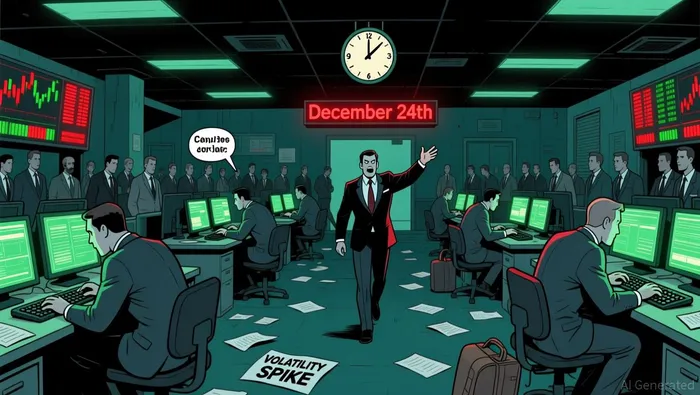 Seasonal liquidity constraints pose a critical challenge for equity resilience. Historical data reveals that global equity trading volumes typically drop to 45–70% of normal levels during December and early January, driven by overlapping holidays and reduced market participation. This thin liquidity environment exacerbates price swings, widens bid-ask spreads, and increases execution costs-a phenomenon observed in 2025 and expected to persist in 2026.
The interplay between these liquidity constraints and Fed rate-cut expectations creates a double-edged sword. While lower rates generally support equities, the delayed market response during low-liquidity periods could amplify short-term volatility. For instance, a 25-basis-point rate cut in January 2026 might not translate immediately into broad equity gains if trading volumes remain subdued and investor sentiment is cautious. This dynamic is further complicated by external factors such as mid-term elections and potential Supreme Court decisions on tariffs, which could heighten market polarization.
Strategic Positioning: Sector Diversification and AI-Driven Opportunities
Amid these challenges, strategic positioning must prioritize sectoral resilience and risk mitigation. J.P. Morgan Global Research forecasts a K-shaped recovery in 2026, with AI-driven sectors outperforming non-AI counterparts. The S&P 500 is projected to rise by 14% in 2026, fueled by AI-related productivity gains and supportive monetary policy. However, this optimism is tempered by a 35% probability of a U.S. or global recession, underscoring the need for diversified exposure.
Investors should focus on sectors with strong cash flows and defensiveness, such as technology and healthcare, while hedging against macroeconomic risks in cyclical industries like industrials and materials. Additionally, the resumption of Treasury purchases by the Fed-starting with $40 billion in bills-signals a broader effort to stabilize funding markets, which could indirectly benefit equities by reducing systemic stress.
Conclusion: Preparing for a Fragmented Landscape
The 2026 equity market will be defined by fragmentation: a Fed navigating inflation and employment trade-offs, seasonal liquidity constraints amplifying volatility, and a polarized economic recovery driven by AI. For investors, success lies in proactive risk management, sectoral agility, and a long-term perspective. By aligning portfolios with structural growth trends while mitigating short-term liquidity risks, market participants can position themselves to capitalize on resilience amid uncertainty.







Comentarios
Aún no hay comentarios