
Navigating Equity Volatility and Central Bank Shifts: Strategic Reassessment in the Post-Powell Era
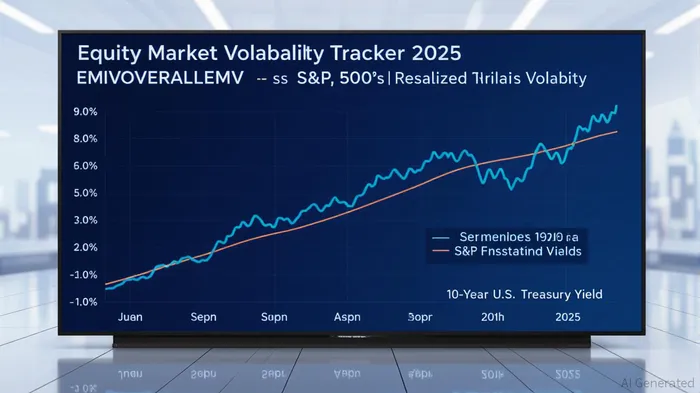
The post-Powell era has ushered in a new phase of equity market dynamics, marked by heightened volatility and shifting central bank priorities. As investors reassess long-term strategies, the interplay between market concentration, policy uncertainty, and macroeconomic risks demands a nuanced approach.
Drivers of Current Volatility
Equity markets have experienced pronounced swings since 2023, driven by a confluence of factors. The "Mag 7" stocks—Alphabet, AmazonAMZN--, AppleAAPL--, MetaMETA--, MicrosoftMSFT--, NvidiaNVDA--, and Tesla—have dominated returns, accounting for over half of the S&P 500's 2024 gains. This concentration mirrors the dot-com boom of the 1990s, raising concerns about systemic fragility if these leaders underperform [1]. Meanwhile, political polarization in Washington has amplified uncertainty, with potential shifts in tax, immigration, and trade policies threatening to disrupt corporate earnings and investor sentiment [1].
Interest rate dynamics further complicate the landscape. The 10-year U.S. Treasury yield, currently in the 4.5%–5% range, has made equities more sensitive to macroeconomic data. A steepening yield curve and mixed inflation readings—driven in part by Trump-era tariffs—could exacerbate equity price swings [1]. Morgan StanleyMS-- analysts warn that this environment increases the likelihood of sharp corrections, particularly if earnings growth fails to meet lofty expectations [1].
Central Bank Policy: A Tectonic Shift
The Federal Reserve's recent 0.25 percentage point rate cut in September 2025 marks a pivotal pivot from its inflation-fighting stance. This move, the first of its kind since December 2024, reflects a recalibration toward labor market support amid slowing job growth [2]. While Fed Chair Jerome Powell emphasized data-driven decision-making, internal debates within the Federal Open Market Committee (FOMC) reveal growing political tensions. Governor Stephen Miran, a Trump appointee, advocated for a larger 0.50 percentage point cut, underscoring the administration's influence on monetary policy [2].
The Fed's forward guidance now anticipates two more rate cuts in 2025, with only one projected for 2026. This cautious approach signals a shift from the aggressive tightening of the Powell era to a more measured normalization path. However, the central bank's dual mandate—balancing price stability and maximum employment—remains under strain as inflationary pressures persist [2].
Strategic Reassessment for Investors
In this environment, long-term investors must prioritize resilience over momentum. Diversification remains critical, particularly as narrow market leadership creates a "house of cards" effect. Rebalancing portfolios to include defensive sectors (e.g., utilities, healthcare) and non-U.S. equities can mitigate exposure to domestic volatility [1].
For those seeking downside protection, tail risk hedging strategies—such as out-of-the-money put options or volatility-linked ETFs—offer cost-effective safeguards against sharp drawdowns. Parametric Portfolio's analysis highlights that volatility itself can be an opportunity, as dislocations often precede new bull markets [2].
Central bank policy shifts also necessitate a reevaluation of duration risk. With the Fed signaling a slower pace of rate cuts, investors should avoid overexposure to long-duration assets that could suffer if inflation resurges. Instead, a barbell approach—combining short-term fixed income with high-quality equities—may better navigate the uncertainty [2].
Conclusion
The post-Powell era is defined by a fragile equilibrium between market exuberance and macroeconomic headwinds. As central banks navigate political pressures and investors grapple with concentrated returns, adaptability will be the hallmark of successful strategies. By anchoring decisions in diversification, hedging, and a keen eye on policy signals, long-term investors can position themselves to weather—and potentially benefit from—the turbulence ahead.





Comentarios
Aún no hay comentarios