
Navigating U.S. Equity Momentum: Strategic Advantages in Large-Cap Growth and Defensive Sectors Amid Fed Rate Cuts
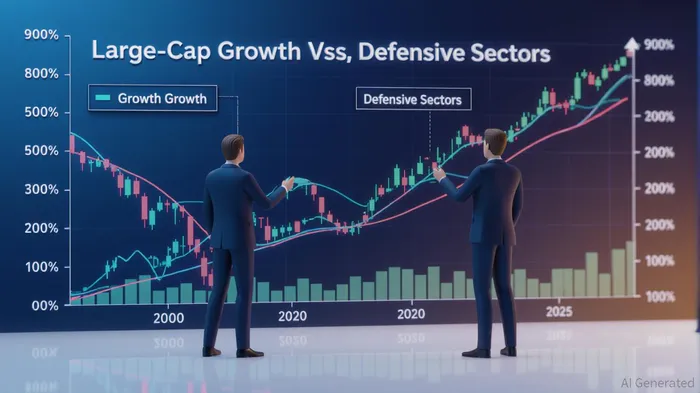
The U.S. equity market in 2025 is poised at a critical juncture, with Federal Reserve rate cuts expected to reshape sector dynamics. As traders price in three 25-basis-point reductions by year-end—potentially accelerating to a 50-basis-point cut in September—investors must weigh the strategic advantages of maintaining exposure to large-cap growth stocks versus defensive sectors. This analysis examines historical performance, current macroeconomic signals, and sector-specific risks to determine where capital may thrive in a dovish policy environment.
Large-Cap Growth: Resilience Amid Dovish Pivots
Large-cap growth stocks, particularly in technology, have historically outperformed during the early stages of Fed rate cut cycles. Data from 2000 to 2025 shows that the S&P 500's growth-heavy constituents averaged 4.9% returns one year after the first rate cut, with rebounds often materializing by the six-month mark [1]. For example, during the 2019 easing cycle, the S&P 500 surged 14.5% in the following year, driven by tech giants like AppleAAPL-- and MicrosoftMSFT-- [1].
The current environment mirrors this pattern. Despite high interest rates, the S&P 500 reached record highs in 2025, fueled by robust earnings growth (+10% in Q1 2025) and innovation-driven momentum in AI and cloud computing [2]. A report by Goldman SachsGS-- notes that three rate cuts in 2025 could further amplify this trend, as lower discount rates make long-duration assets more attractive [3]. However, caution is warranted: if rate cuts are priced in too aggressively, investors may rotate out of overvalued tech stocks into sectors with more predictable cash flows [3].
Defensive Sectors: A Hedge Against Uncertainty
Defensive sectors like utilities, consumer staples, and healthcare have historically outperformed large-cap growth during periods of economic uncertainty. From 2000 to 2025, Consumer Non-Cyclicals averaged +7.7 percentage points relative to the S&P 500 during rate cut cycles, while Utilities lagged significantly [1]. In 2025, this trend has gained renewed relevance. Defensive dividend stocks traded at a 20% discount to the S&P 500 in Q2 2025, with high-yield leaders like AltriaMO-- and VerizonVZ-- maintaining stable payout ratios [2].
The rationale is twofold. First, lower interest rates reduce the discount rate for future earnings, making stable-cash-flow businesses more appealing. Second, defensive sectors have underperformed growth stocks in recent years, creating a valuation gap that may narrow as investors seek safety. For instance, the Morningstar Consumer Defensive Index rose 7.25% in Q2 2025, outpacing the S&P 500 as Treasury yields hit 4.23% [2]. Analysts at J.P. Morgan argue that a dovish Fed pivot could further boost these sectors, particularly if labor market weakness persists [3].
Strategic Implications for Portfolios
The strategic advantage of staying invested in large-cap growth or defensive sectors hinges on macroeconomic context. During the initial phase of rate cuts, growth stocks often lead due to optimism about economic expansion. However, as cycles mature and valuations stretch, defensive sectors tend to regain strength. In 2025, this dynamic is complicated by mixed signals: while the labor market is cooling (unemployment rose to 4.3% in August [2]), inflation remains above 2%, and geopolitical risks like Trump-era tariffs persist [3].
A balanced approach may be optimal. Historical data suggests that defensive sectors outperform in the six months following a rate cut, while large-cap growth stocks excel in the longer term [1]. For example, Technology rebounded after six months in prior cycles, benefiting from reduced borrowing costs [1]. Investors could allocate to both categories, leveraging growth stocks for upside potential and defensive sectors for downside protection.
Conclusion
The Fed's 2025 rate cuts are likely to ignite a tug-of-war between large-cap growth and defensive sectors. While growth stocks offer compelling long-term prospects, defensive sectors provide stability amid inflationary and policy uncertainties. As Fed Chair Powell emphasized, the central bank will proceed "carefully" [3], balancing growth support with inflation control. Investors who diversify across both categories may position themselves to capitalize on the best of both worlds.





Comentarios
Aún no hay comentarios