
Navigating Energy Sector Gains Amid Crude Oil Uncertainty: Why Woodside and Santos Offer Contrarian Value
The energy sector has faced significant headwinds in 2025, with crude oil prices oscillating near two-year lows and geopolitical tensions casting a shadow over global supply chains. Yet, amid this volatility, Australian majors Woodside Energy (ASX: WDS) and Santos (ASX: STO) have defied the gloom, outperforming crude futures and positioning themselves as contrarian plays for investors willing to look past short-term oil price swings. Their resilience stems from strategic asset plays, robust domestic demand drivers, and a macroeconomic backdrop that rewards companies with strong balance sheets and dividend discipline.
Why the Contrarian Thesis Holds Water
The contrarian opportunity here hinges on three pillars: gas-driven growth, dividend stability, and sector outperformance relative to crude oil. While crude prices have languished—falling to $60.48/barrel in May before rebounding to $74.23/barrel in June—Woodside and Santos have leveraged their focus on natural gas and LNG to insulate their earnings. Their stocks have risen 2.5% and 2.5%, respectively, in June 2025, even as WTI crude traded at $68.15/barrel, a 10% drop from June 2024 levels.
Woodside: Betting on Gas and Strategic Projects
Woodside's Scarborough LNG project ($12.5 billion), now cleared for construction, is the linchpin of its strategy. Expected to begin production in 2026, this project will supply 8.9 million tons of LNG annually, primarily to Asian markets. This diversification into gas—less volatile than oil—has shielded the company from crude's downturn.
Woodside's dividend yield of 7.9% also stands out, particularly as it maintains a disciplined approach to capital allocation. Analysts at Morgans note that its interim net profit, despite falling to $1.11 billion in H1 2025, remains robust enough to fund growth while retaining flexibility for future M&A.
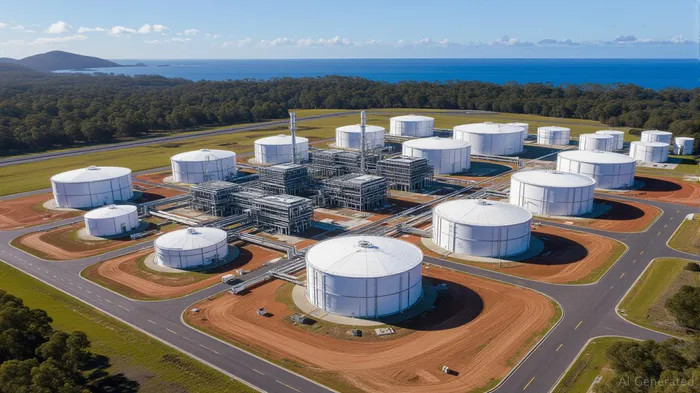
Santos: Navigating Volatility Through Asset Flexibility
Santos, though grappling with a 66% drop in H1 profit to $654 million, has signaled a willingness to pivot aggressively. Its openness to asset sales or even a full takeover ($16.3 billion valuation) reflects a focus on liquidity and operational focus. This strategy aligns with the ASX 200's 9.97% Q2 rebound, driven by sectors like financials and technology.
Santos' exposure to Asia—a region where LNG demand remains robust despite crude weakness—provides a critical buffer. Its Cooper Basin gas assets and PNG LNG interests ensure steady cash flows, while its 4.8% dividend yield offers income stability in a low-yield environment.
Macro Drivers: ASX Recovery and Manufacturing Resilience
The broader market's recovery supports energy stocks indirectly. The ASX 200's 13.81% FY2024-25 total return reflects investor optimism about Australia's economic fundamentals, including a manufacturing sector that, despite slowing growth (PMI at 50.6 in June), remains above contraction thresholds. Key factors:
- Domestic Energy Demand: Australia's manufacturing PMI, while muted, signals sustained, if modest, industrial activity. This supports gas demand for power generation and petrochemicals, a sector Woodside and Santos dominate.
- Geopolitical Stability: Unlike the Middle East, Australia's energy infrastructure faces minimal disruption risks, making its LNG assets a safer bet for investors.
- ESG Tailwinds: Both companies are aligning with net-zero goals—Woodside via gas's lower carbon profile, Santos through divestment of non-core, higher-emission assets. This aligns with global capital flows favoring ESG-compliant energy stocks.
Risks and the Case for a Long-Term View
Critics argue that weak crude prices could drag down energy stocks, and indeed, Woodside's P/E ratio of 20.2 reflects investor caution. Yet, the IEA's forecast of supply outpacing oil demand through 2030 suggests prolonged headwinds for crude, making gas-focused plays like these two firms even more compelling.
Short-term risks include:
- Tariffs and Trade Barriers: U.S. policies could curb Asian LNG demand.
- Project Delays: Scarborough's construction timeline is critical; any setback could impact Woodside's valuation.
However, these risks are offset by the sector's dividend yield advantage (4.8% average vs. ASX 200's 3.2%) and the likelihood of central banks easing rates later in 2025, boosting equity valuations.
Investment Thesis: Buy the Dip, Play the Long Game
The contrarian case is clear: Woodside and Santos offer asymmetric upside in an energy sector skewed bearish on crude. Key entry points:
- Price Pullbacks: Use dips below $23.50 (WDS) or $6.50 (STO) to accumulate shares.
- Dividend Capture: Both firms' payouts are secure unless oil plummets below $50/barrel—a scenario analysts deem unlikely.
- Sector Rotation: As the ASX 200 continues its recovery, energy stocks are poised to outperform defensive sectors.
Conclusion
Woodside and Santos are navigating a challenging energy landscape with discipline and foresight. Their focus on gas, strategic projects, and dividend stability positions them as top contrarian picks. While crude's volatility may unsettle the broader sector, these two stocks exemplify the adage: buy when others are fearful. For investors with a 3–5 year horizon, now is the time to capitalize on undervalued energy champions.
Final note: Monitor Middle East tensions and the ASX 200's momentum for clues on the next leg of energy's recovery.





Comentarios
Aún no hay comentarios