
Navigating Economic Uncertainty: Active ETFs as a Strategic Hedge Against Crypto and Tech Volatility
The Volatility Dilemma: Tech and Crypto in a Storm
The past two years have exposed the fragility of high-growth assets. Tech stocks, once buoyed by AI optimism, have seen sharp corrections. For instance, Dell and Hewlett Packard's shares dropped 7–8% amid profit-taking and profit warnings, while Bitcoin's plunge below $90,000-a 30% decline from its peak-highlighted the crypto market's susceptibility to macroeconomic fears. Analysts warn that innovation-driven sectors, though transformative, often experience "sharp volatility" as market participants reassess long-term viability.
Meanwhile, crypto and tech ETFs have faced divergent fates. Bitcoin and Ethereum ETFs collectively shed over $2.1 billion in assets in late 2025, while altcoin-focused funds like the Bitwise Solana Staking ETFBSOL-- (BSOL) and Canary XRPXRP-- ETF attracted record inflows despite broader price declines. 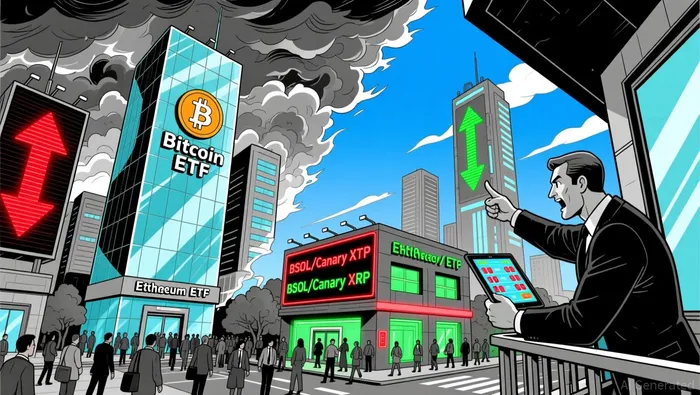 This divergence underscores a key insight: not all crypto or tech exposures behave uniformly during volatility.
Active ETFs: Precision in a Sea of Chaos
Active ETFs like ABIG, ALIL, and AMID-designed to capitalize on market dislocations-offer a compelling counterbalance. Unlike passive strategies, these funds leverage manager expertise to overweight resilient sectors or avoid overhyped narratives. For example, the Bitwise SolanaSOL-- Staking ETF, though not an active ETF per se, demonstrated how targeted exposure can thrive amid broader crypto weakness. It attracted $545 million in net inflows in its first week, even as Solana's price fell 29%. This suggests that investors are increasingly prioritizing specificity over broad crypto bets.
Similarly, the Canary XRP ETF's $26 million in 30-minute trading volume-surpassing analyst estimates-reflects demand for high-conviction strategies during uncertainty. While ABIG, ALIL, and AMID's direct performance metrics remain opaque in the current data, the broader trend is clear: active management can isolate opportunities in volatile markets.
Regulatory Tailwinds and Strategic Diversification
The U.S. Securities and Exchange Commission's (SEC) recent fast-tracking of crypto ETF approvals has further amplified this trend. By streamlining approvals, regulators are enabling a new generation of active ETFs to target niche opportunities, from AI infrastructure to blockchain innovation. This regulatory clarity reduces friction for investors seeking diversified, risk-managed exposure.
However, caution is warranted. Closed-end funds like SABA, which trades at a significant discount to its net asset value despite similar strategies to its peers, highlight the risks of market mispricing. Active ETFs, by contrast, offer transparency and liquidity, making them a more reliable hedge against crypto and tech volatility.
Conclusion: A Strategic Imperative
As economic uncertainty persists, investors must adopt a dual approach: balancing high-growth crypto and tech assets with active ETFs that provide downside protection. The success of altcoin ETFs like BSOLBSOL-- and Canary XRP demonstrates that specificity and active management can thrive where broad markets falter. For those seeking to navigate the choppy waters of 2025, the lesson is clear: leverage high-conviction equity ETFs to hedge volatility, not chase it.







Comentarios
Aún no hay comentarios