
Navigating Economic Data Blackouts: Market Volatility and Risk Management in the Shadow of BLS Shutdowns
The Bureau of Labor Statistics (BLS) is at the center of a growing crisis as the U.S. government teeters on the brink of a shutdown in September 2025. With its operations suspended, the agency will delay critical economic reports, including the September jobs data and consumer price index (CPI), creating a “data vacuum” that threatens to destabilize financial markets and policymaking, according to a Washington Post report. This scenario echoes historical precedents, as detailed in a Wikipedia entry on government shutdowns in the United States, where past BLS data delays amplified market volatility and eroded investor confidence.
Historical Precedents: Data Delays and Market Reactions
Government shutdowns have repeatedly disrupted the BLS's ability to collect and publish timely economic data. During the 16-day 2013 shutdown, the monthly jobs report and CPI were delayed by two weeks, triggering a 6.2% spike in the CBOE Volatility Index (VIX)—a stark indicator of investor anxiety, as documented in a MarketClutch analysis. Similarly, the 35-day 2018–2019 shutdown delayed GDP and personal income reports by a month, though the BLS itself was spared due to prior funding. Despite the uncertainty, the S&P 500 rose 10.3% during the 2018–2019 shutdown, a pattern noted in a Campaign for a Million analysis, suggesting that market resilience can offset short-term disruptions.
The 2025 shutdown, however, poses a more severe threat. With the BLS fully suspended, the September jobs report (scheduled for October 3) and CPI (October 15) will be delayed indefinitely. This creates a feedback loop: delayed data hampers the Federal Reserve's ability to adjust monetary policy, while uncertainty about economic conditions exacerbates market volatility, according to a The Hill report.
Quantitative Analysis: Volatility Clustering and GARCH Models
Academic studies have long used econometric tools like GARCH (Generalized Autoregressive Conditional Heteroskedasticity) models to analyze market volatility. These models reveal that volatility clusters during periods of uncertainty, such as government shutdowns, as shown in a PMC study. For instance, the 2013 shutdown's VIX spike was followed by prolonged volatility, as investors grappled with the lack of reliable data. A 2024 study demonstrated that asymmetric GARCH models (e.g., EGARCH) are particularly effective in capturing the asymmetric impact of negative news—such as prolonged data delays—on market stability (the PMC study above).
The 2025 shutdown could amplify these effects. With the BLS's 2,055 employees furloughed and its website frozen, as reported by the Washington Post, the absence of key employment and inflation data will force investors to rely on alternative indicators, such as real-time hiring surveys or private-sector wage data. However, these substitutes lack the granularity and credibility of official BLS reports, increasing the risk of misinformed decisions, according to a GovFacts analysis.
Risk Management Strategies: Lessons from Past Shutdowns
Investors and institutions must adopt proactive strategies to mitigate the risks of data blackouts. Historical patterns suggest that maintaining long-term investment horizons is critical. For example, the S&P 500 has historically rebounded within 100 days of a shutdown's end, rewarding those who avoided overreacting to short-term volatility, as discussed in a Fidelity commentary. Diversification across sectors also proves vital: defense and aerospace stocks often underperform during shutdowns due to reliance on federal contracts, while utilities and technology sectors tend to remain stable, a point highlighted in the Campaign for a Million analysis referenced above.
Advanced risk management tools, such as value-at-risk (VaR) modeling and machine learning-driven predictive analytics, can further enhance resilience. A 2025 Northern Trust analysis emphasized the importance of stress-testing portfolios against prolonged data gaps, particularly for sectors sensitive to interest rate changes. Additionally, investors should prioritize liquidity and avoid over-leveraging during periods of uncertainty, a strategy supported by a ResearchGate paper.
Conclusion: Preparing for the Unpredictable
The 2025 BLS shutdown underscores the fragility of the U.S. economic data system and its cascading effects on financial markets. While historical data shows that markets can recover from short-term disruptions, the growing frequency of government shutdowns and BLS operational challenges—such as staff shortages and budget cuts—pose long-term risks, as outlined in a Brookings article. Investors must remain vigilant, leveraging alternative data sources and adaptive risk management frameworks to navigate the volatility of a data-starved environment.
As the Federal Reserve and policymakers grapple with delayed signals, the market's ability to adapt will hinge on its capacity to balance caution with confidence—a lesson etched in the annals of past shutdowns.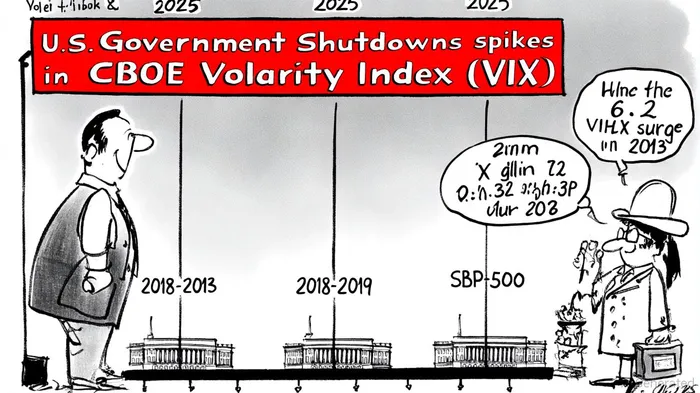







Comentarios
Aún no hay comentarios