
Navigating Dividend Investing in Low-Growth Economies: The Power of Sustainable Payout Ratios and Financial Health
Navigating Dividend Investing in Low-Growth Economies: The Power of Sustainable Payout Ratios and Financial Health
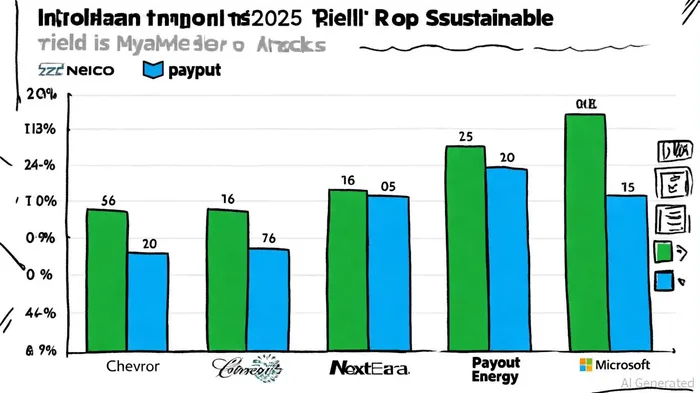
In an era of sluggish economic growth, dividend stocks remain a cornerstone for income-focused investors. However, selecting the right equities requires more than just chasing high yields. Sustainable payout ratios and long-term financial health are critical metrics for identifying companies capable of maintaining dividends without jeopardizing reinvestment or stability. This analysis explores how firms in defensive sectors-such as healthcare, utilities, and energy-balance shareholder returns with prudent capital management, supported by academic insights and real-world case studies.
The Case for Sustainable Payout Ratios
A company's payout ratio-the proportion of earnings distributed as dividends-serves as a barometer of its financial discipline. In low-growth economies, where reinvestment opportunities are limited, firms with lower payout ratios (typically below 50%) are better positioned to weather earnings volatility. For example, Microsoft (MSFT) maintains a payout ratio of 24.25% as of September 2025, ensuring ample retained earnings for innovation and debt reduction, according to a FinanceCharts screener. Similarly, Apple (AAPL) operates with a 15.39% payout ratio, reflecting its ability to sustain dividends while funding growth in stagnant markets.
Academic research underscores the importance of this balance. A study of S&P 500 companies between 2021 and 2023 found that profitability metrics like return on equity (ROE) and retention ratios are pivotal in determining sustainable growth rates (SGR), calculated as SGR = ROE × (1 - Payout Ratio), as shown in an SGR study. This framework highlights how firms can grow organically without diluting shareholder value-a critical consideration in low-growth environments.
Sector-Specific Resilience: Utilities, Healthcare, and Energy
Defensive sectors with inelastic demand are prime candidates for sustainable dividend strategies. NextEra Energy (NEE), a utility giant, exemplifies this model. With a debt-to-equity ratio below industry averages and a decades-long dividend growth streak, it offers a 4.7% yield while retaining earnings for infrastructure investments, as noted in a European Business Magazine article. Similarly, Pfizer (PFE), a pharmaceutical leader, sustains a 5% yield despite R&D costs, thanks to its 9.81% five-year average payout ratio.
Energy companies like Chevron (CVX) and Enterprise Products Partners (EPD) also demonstrate resilience. Chevron's 4.7% yield is supported by strong cash flow from fixed-fee contracts, while EPD's 7.1% yield benefits from midstream energy's stable revenue streams, according to a ScienceDirect analysis. These firms leverage sector-specific advantages-such as pricing power in healthcare or long-term contracts in energy-to maintain dividends even during economic downturns.
ESG Integration and Dividend Stability
Recent academic studies reveal a growing link between ESG performance and dividend sustainability. Firms with high ESG scores, such as Cigna (CI) and American Express (AXP), are more likely to maintain consistent payouts. A 2024 study found that ESG controversies-such as governance scandals or environmental violations-negatively correlate with dividend stability, emphasizing the need for transparency. Conversely, companies like Walmart (WMT) and Costco (COST) combine low payout ratios with robust ESG practices, ensuring long-term financial health.
The Risks of Overreliance on High Yields
While high yields are tempting, they often signal financial strain. For instance, Altria Group (MO) offers an 8.4% yield, but its tobacco business faces declining demand. Academic research warns that firms in the top quintile of payout ratios (averaging 74%) are more prone to dividend cuts during earnings declines. This underscores the need to evaluate not just yield, but also free cash flow, debt levels, and sector dynamics.
A Strategic Framework for Investors
To identify sustainable dividend stocks in low-growth economies, investors should:
1. Prioritize Low Payout Ratios: Target companies with payout ratios below 50% to ensure reinvestment flexibility.
2. Assess Sector Fundamentals: Favor industries with stable demand (e.g., utilities, healthcare) and pricing power.
3. Evaluate ESG Performance: Favor firms with strong governance and minimal controversies.
4. Monitor Financial Health: Scrutinize debt-to-equity ratios, earnings growth, and free cash flow.
Conclusion
Dividend investing in low-growth economies demands a nuanced approach. By focusing on sustainable payout ratios, sector resilience, and ESG alignment, investors can identify companies that balance shareholder returns with long-term stability. As demonstrated by firms like MicrosoftMSFT--, Pfizer, and NextEra Energy, the key lies in retaining enough earnings to fund growth while rewarding investors-a strategy validated by both market performance and academic research.





Comentarios
Aún no hay comentarios