
Navigating the New Divide: Why the Labor Market's Fragility Demands a Shift in Equity Strategies
The U.S. labor market is at a crossroads. While the overall unemployment rate held steady at 4.2% in April 2025, beneath the surface lies a deepening “tale of two economies.” Recent graduates aged 22–27 face an unemployment gap of 3.7 percentage points between those with advanced degrees and those without, a chasm widening as tech-driven sectors falter and AI reshapes job markets. For equity investors, this is not merely a labor issue—it's a call to reassess risk exposure and pivot toward sectors insulated from—or benefitting from—these seismic shifts.
The Widening Unemployment Gap: A Structural Shift
The Bureau of Labor Statistics (BLS) reveals stark disparities: in April 2025, 25–34-year-olds with bachelor's degrees or higher had an unemployment rate of 2.5%, while those with only a high school diploma faced 6.2% unemployment. This gap has grown by 1.2 percentage points since 2020, with 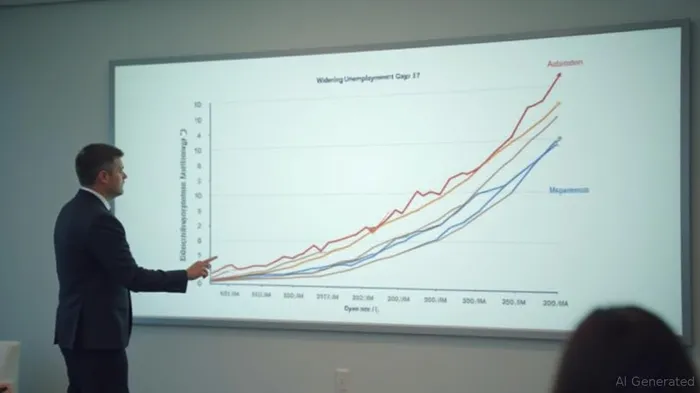 tech-driven industries like software and marketing bearing the brunt of AI displacement.
Meanwhile, job postings in tech sectors have fallen by 18% year-over-year, per Burning Glass Technologies, as firms automate routine roles. The starkly illustrates this divergence: while software engineering listings decline, demand for AI engineers and data architects surges.
Why Tech-Driven Sectors Are Vulnerable
The “tale of two economies” is clearest in industries reliant on entry-level or white-collar talent. Consider:
- Software & IT Services: AI tools now perform tasks once reserved for junior developers, reducing demand for mid-tier roles.
- Marketing & Advertising: Automation of ad targeting and analytics has cut entry-level openings.
- Financial Services: Robo-advisors and algorithmic trading squeeze roles in wealth management.
These sectors face a dual threat: reduced hiring for displaced roles and compressed wage growth as labor costs shift toward specialized AI expertise. Investors exposed to these industries risk prolonged underperformance as companies prioritize efficiency over workforce expansion.
Where to Reallocate: Sectors with Resilience and Growth
The solution lies in sector rotation toward industries insulated from—or directly benefiting from—AI-driven disruption:
1. AI Infrastructure & Hardware
The backbone of the AI revolution demands semiconductor chips, cloud infrastructure, and quantum computing advancements. Companies like NVIDIA and AMD are critical here, as their tools enable AI adoption across industries. The shows this sector's outperformance, with NVIDIA's revenue rising by 40% in 2024 as AI adoption accelerated.
2. Healthcare & Life Sciences
Healthcare's steady demand for care and innovation is immune to labor market headwinds. Aging populations, drug discovery breakthroughs, and AI-enhanced diagnostics (e.g., radiology tools) create durable growth. The highlights this contrast: healthcare unemployment remains below 4%, even as tech struggles.
3. Cybersecurity & Data Governance
As AI adoption grows, so does the need to protect systems and data. Regulations like the EU's AI Act and corporate compliance demands are fueling a boom in cybersecurity roles. This sector offers both defensive stability and high-growth potential.
Risk Mitigation: Positioning for a Post-AI Economy
Investors must ask: Is my portfolio aligned with the labor market's new reality? Exposure to vulnerable white-collar sectors—software, marketing, finance—should be minimized. Instead, focus on:
- High-skilled, AI-complementary roles (e.g., AI ethics officers, data scientists).
- Automation-resistant industries (e.g., skilled trades, healthcare).
- Companies with pricing power in AI-driven efficiency gains (e.g., industrial firms using AI to reduce costs).
The BLS data underscores a critical truth: the unemployment gap is not just a statistic—it's a market signal. Those who ignore it risk holding assets stranded in a fading economy.
Final Call to Action: Rotate Now, or Risk Irrelevance
The writing is on the wall: the labor market's fragility is reshaping equity performance. Investors must act decisively to:
1. Reduce exposure to tech-driven sectors with declining job postings and AI-displaced roles.
2. Increase allocations to AI infrastructure, healthcare, and cybersecurity—sectors thriving in this new divide.
3. Prioritize companies with clear AI integration strategies and pricing power.
The “tale of two economies” will only intensify as AI's impact deepens. The time to reposition is now—before the gap leaves your portfolio behind.







Comentarios
Aún no hay comentarios