
Navigating the December 2025 Volatility: ETF Strategies for a Fractured Market
The December market has long been a time of optimism, historically marked by the so-called "Santa rally." But in 2025, the script is being rewritten. With the CBOE Volatility Index (VIX) surging 14% in a single day amid waning expectations of a Federal Reserve rate cut and growing unease over AI sector valuations, investors are recalibrating their strategies. The traditional playbook is no longer sufficient. Instead, a new paradigm is emerging, one defined by defensive positioning, volatility-linked instruments, and a keen eye on market dispersion.
The Rise of Volatility-Linked ETFs
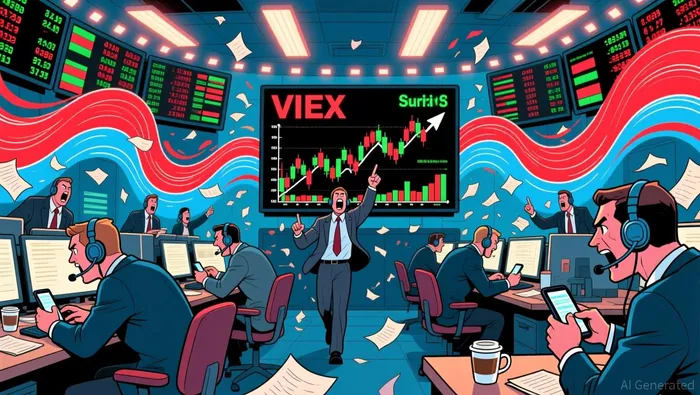 As uncertainty mounts, volatility-linked ETFs like the ProShares VIX Short-Term Futures ETF (VIXY) and the ProShares Ultra VIX Short-Term Futures ETF (UVXY) have become critical tools for managing risk. The VIX, often dubbed the "fear index," has spiked in response to a confluence of factors: legal uncertainties surrounding tariffs, a pending Supreme Court ruling, and early signs of a potential correction in the AI sector. UVXYUVXY--, which offers 1.5 times the performance of the VIX index, has seen renewed interest as a leveraged bet on short-term volatility according to market analysis. However, investors must tread carefully. While these funds can amplify gains during sharp market moves, their leveraged structures are prone to decay over time, making them better suited for tactical, short-term use.
Defensive Positioning: The Case for USMV
In contrast to the high-octane volatility of VIXYVIXY-- and UVXY, the iShares MSCI USA Min Vol Factor ETF (USMV) has emerged as a beacon of stability. Designed to reduce portfolio volatility by focusing on low-volatility stocks, USMV has delivered a 30% total return since November 2025, outperforming broader market benchmarks. This performance underscores the growing appeal of defensive strategies in an environment where macroeconomic risks-ranging from fiscal policy uncertainty to AI-driven market corrections-loom large. For investors prioritizing capital preservation, USMV offers a compelling alternative to traditional growth-oriented allocations.
Equal-Weight ETFs and Market Dispersion
The Invesco S&P 500 Equal Weight ETF (RSP) provides another lens through which to navigate the fractured market. By equally weighting all 500 components of the S&P 500, RSP mitigates the dominance of mega-cap stocks, which have historically skewed returns in recent years. While RSP has underperformed relative to the market-cap-weighted SPY-posting an annualized return gap of 31 bps through November 2025 according to Seeking Alpha analysis-its structure offers a hedge against the concentration risks inherent in today's market. As dispersion widens, particularly in sectors like AI where valuations are diverging sharply, RSP's diversified approach could unlock opportunities in smaller, undervalued components of the index.
AI-Driven Uncertainty and Strategic Implications
The AI sector's trajectory is a double-edged sword. While it has been a growth engine for years, analysts now warn of early signs of a potential correction, which could exacerbate market volatility according to AI market analysts.This uncertainty amplifies the role of volatility-linked ETFs like UVXY and VIXY, which serve as hedges against sharp downturns. At the same time, it highlights the strategic value of RSP and USMV. Equal-weight ETFs can capture gains from a broader swath of the market, while low-volatility funds like USMV provide a buffer against AI-driven shocks.
Conclusion: A Balanced Approach
The December 2025 market demands a nuanced strategy. Investors must balance the need for defensive positioning with the potential for dispersion-driven gains. Volatility-linked ETFs offer a way to capitalize on-or hedge against-sudden swings, while equal-weight and low-volatility alternatives provide stability and diversification. As the Federal Reserve's policy path remains unclear and AI sector dynamics evolve, a diversified portfolio that incorporates these tools will be essential for navigating the months ahead.





Comentarios
Aún no hay comentarios