
Navigating the DAX's Near-Record Momentum: Strategic Entry Points for Long-Term Equity Exposure in the German Market
Navigating the DAX's Near-Record Momentum: Strategic Entry Points for Long-Term Equity Exposure in the German Market
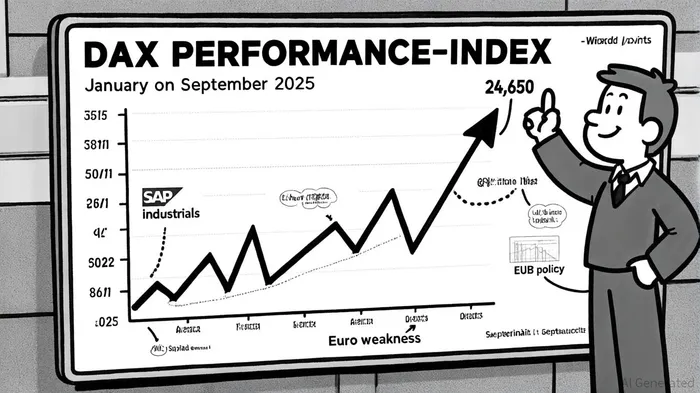
The DAX PERFORMANCE-INDEX has surged to near-record levels in 2025, trading at 23,600–24,000 points as of September, just 2.6% below its all-time high of 24,650 points, according to the DAX performance index. This momentum, despite Germany's modest GDP growth of 0.3–0.4% and a sluggish export sector, underscores the index's decoupling from macroeconomic fundamentals-a trend mirrored by the U.S. "Magnificent 7" stocks, according to a Varchev analysis. For long-term investors, the question is no longer whether the DAX will rise but how to position for its next phase of growth.
Sector-Driven Momentum: The New DAX Dynamics
The DAX's performance is increasingly concentrated in a handful of sectors. Food & Beverages, Media, and Insurance have contributed disproportionately to the index's gains, while SAP's AI-driven cloud revenue growth (up 25% year-on-year) has cemented its role as a bellwether, per an InvestorsHangout report. Industrials and Financial Services, representing 24.51% and 20.33% of the index respectively, have also benefited from a weaker euro and easing interest rates, according to Simply Wall St. These sectors exemplify the shift toward large-cap, export-oriented firms with global growth potential, a trend that has outpaced the broader economy.
However, this concentration raises concerns. The DAX's reliance on a few stocks-such as Siemens Energy AG and Munich RE-mirrors the S&P 500's dependence on the "Magnificent 7." While this has driven short-term gains, it introduces volatility if these firms underperform. Investors must weigh the risks of overexposure against the potential rewards of riding the momentum.
Valuation Metrics: A Premium Market with Mixed Signals
The German market's trailing P/E ratio of 17.94 as of September 2025 is significantly above its 5-year average of 12.10–15.70, according to the CentStoSense guide, suggesting elevated valuations. The DAX's forward P/E of 15.78 as of June 2025, according to Siblis Research, indicates that investors are pricing in future earnings growth, particularly in sectors like Technology and Industrials. Yet, this optimism contrasts with the broader European market, where energy and financial sectors trade at lower multiples, as noted in the CentStoSense guide.
The disparity highlights a key opportunity: while the DAX as a whole appears expensive, certain sub-sectors remain undervalued. For instance, Energy's P/E of 15.03 (per the CentStoSense guide) lags behind the market average, offering a potential entry point for investors seeking diversification. Similarly, Financials, with a P/E of 18.09 (noted in the CentStoSense guide), remain relatively cheap compared to their U.S. counterparts.
Strategic Entry Points: Timing the DAX's Next Leg
For long-term equity exposure, strategic entry points depend on three factors: macroeconomic stability, sector rotation, and risk management.
Macro Conditions: The DAX's trajectory hinges on the ECB's rate policy and inflation moderation. With inflation projected to fall to 2.2–2.4% per the CentStoSense guide, a pause in rate hikes could fuel further gains. Investors should monitor ECB statements and inflation data for signals of policy easing.
Sector Rotation: Diversifying across the DAX's high-growth and undervalued sectors can mitigate risk. For example, pairing exposure to SAPSAP-- and industrials with Energy or Financials could balance growth and value. ETFs like the iShares DAX ETF (DEU) offer broad exposure, while individual stocks allow targeted bets.
Risk Management: Given the DAX's elevated valuations, dollar-cost averaging into the index over the next 3–6 months could reduce entry risk. Investors should also consider hedging with options or short-term volatility indicators, as profit-taking could trigger corrections toward 22,000 points (as noted in the CentStoSense guide).
Conclusion: A Cautious Bull Case
The DAX's near-record performance reflects a unique confluence of sectoral strength and macroeconomic tailwinds. While valuations are stretched, the index's focus on global growth drivers-such as AI and renewable energy-justifies a cautious bullish stance. For long-term investors, the key is to balance exposure to high-growth sectors with undervalued opportunities, ensuring resilience against potential corrections. As the year progresses, the DAX's ability to sustain momentum will depend on its largest constituents-and the broader economy's ability to catch up.





Comentarios
Aún no hay comentarios