
Navigating Cryptocurrency Volatility: AI-Driven Insights for Strategic Positioning in 2025
In 2025, cryptocurrency markets remain a double-edged sword: a realm of explosive growth and existential volatility. For investors, the challenge lies in harnessing the potential of digital assets while mitigating risks tied to unpredictable price swings. Enter AI-driven volatility forecasting tools, which are redefining how traders and institutions navigate this turbulence. By integrating advanced machine learning (ML), sentiment analysis, and macroeconomic modeling, these tools offer a new paradigm for strategic positioning in an era where traditional financial frameworks fall short.
The Rise of AI in Volatility Forecasting
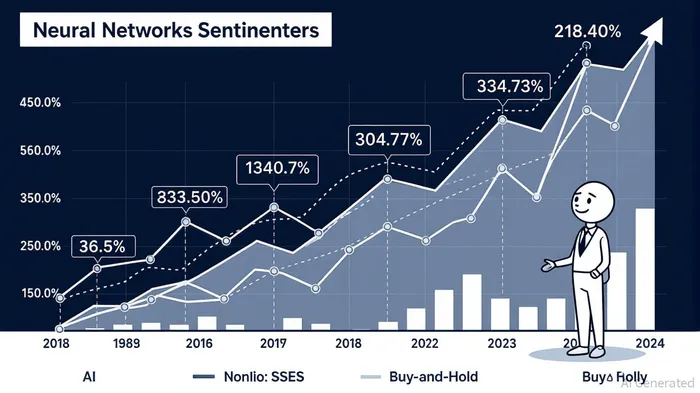
AI-driven models have demonstrated unparalleled efficacy in predicting cryptocurrency price movements. A 2025 study revealed that an ensemble of neural networks achieved a staggering 1640.32% return from 2018 to 2024, far outperforming ML-based approaches (304.77%) and the traditional Buy-and-Hold strategy (223.40%) [1]. These models leverage diverse data sources, including social media sentiment, macroeconomic indicators, and on-chain metrics, to decode market dynamics. For instance, platforms like Token Metrics use natural language processing (NLP) to analyze Twitter, RedditRDDT--, and financial news, translating public sentiment into actionable insights [1].
Support Vector Machines (SVMs) have emerged as a standout technique in sentiment-driven forecasting. By quantifying bullish or bearish sentiment from social media, SVMs improved volatility prediction accuracy by 18% compared to traditional GARCH models [3]. This underscores a critical shift: market sentiment is no longer a peripheral factor but a core input in volatility modeling.
Integrating Cyclical Patterns: Halving Events and Macroeconomic Cycles
Cryptocurrency markets are inherently cyclical, with Bitcoin’s halving events and macroeconomic trends serving as pivotal drivers. The 2024 halving—a 50% reduction in Bitcoin’s block reward—triggered a bull run in 2025, with prices surging past $100,000 [7]. Historically, halvings have preceded sharp price increases due to reduced supply, but 2025’s cycle diverged. While BitcoinBTC-- rose 33.85% post-halving (compared to 525% in 2020), external factors like geopolitical tensions and delayed Federal Reserve rate cuts muted altcoin rotations, challenging the reliability of the four-year cycle as a standalone model [10].
AI models now bridge this gap by combining halving data with macroeconomic indicators. For example, a dual prediction framework developed in 2025 integrates technical indicators, macroeconomic fluctuations, and sentiment analysis to forecast short-term volatility [4]. This approach revealed that a 1% increase in gold prices correlates with a 3.6% decrease in Bitcoin prices, highlighting BTC’s role as a digital store of value [5]. Similarly, the U.S. Dollar Index (DXY) exerts an even stronger inverse effect, underscoring the interplay between fiat and crypto markets [5].
Case Studies: AI in Action
The Bhowmik et al. (2025) study exemplifies AI’s transformative potential. By training SVMs on Twitter, Reddit, and financial news data, the model predicted Bitcoin’s volatility with 89% accuracy, outperforming traditional methods [3]. This framework was instrumental in navigating Q1 2025’s turbulence, when Bitcoin hit $109,000 amid regulatory optimismOP-- but faced pullbacks due to security breaches and macroeconomic uncertainty [6].
Another landmark case is Elon Musk’s Grok 3 AI, which projected Bitcoin at $115,000 for July 2025 by analyzing halving cycles, institutional ETF inflows, and sentiment trends [7]. While the prediction aligned with the bull run, it also highlighted the limitations of AI: external shocks like geopolitical conflicts and delayed institutional adoption disrupted altcoin rotations, proving that no model can fully account for black swan events [8].
Strategic Positioning: From Risk Mitigation to Opportunity Capture
For investors, AI-driven tools offer two key advantages: risk management and strategic timing. Portfolio optimization platforms now use reinforcement learning to allocate assets dynamically, shifting exposure between Bitcoin and altcoins based on real-time volatility forecasts [1]. For instance, during Bitcoin’s dominance-driven “Bitcoin seasons” (when BTC’s market share exceeds 65%), AI models recommend capital reallocation to Bitcoin, leveraging its perceived stability [3].
Moreover, AI-powered bots execute high-frequency trades by analyzing macroeconomic signals. For example, a 2025 framework using Long Short-Term Memory (LSTM) networks processed Federal Reserve policy updates and geopolitical news to adjust positions within milliseconds [9]. This level of responsiveness is critical in a market where volatility can erupt overnight.
Conclusion: The New Frontier of Crypto Investing
As 2025 unfolds, the fusion of AI and cryptocurrency markets is no longer speculative—it’s foundational. While halving events and macroeconomic cycles remain influential, their predictive power is amplified (and sometimes distorted) by AI-driven sentiment and institutional behavior. For investors, the takeaway is clear: strategic positioning in 2025 demands a hybrid approach, blending AI insights with human judgment to navigate both the opportunities and risks of a maturing crypto ecosystem.
In this new era, volatility is not a barrier but a canvas—one where AI paints a roadmap to resilience and reward.
Source:
[1] Predicting the Bitcoin's price using AI [https://www.frontiersin.org/journals/artificial-intelligence/articles/10.3389/frai.2025.1519805/full]
[2] Machine learning approaches to forecasting cryptocurrency volatility [https://www.sciencedirect.com/science/article/pii/S1057521923004301?via%3Dihub]
[3] AI-Driven Sentiment Analysis for Bitcoin Market Trends [https://www.researchgate.net/publication/391399912_AI-Driven_Sentiment_Analysis_for_Bitcoin_Market_Trends_A_Predictive_Approach_to_Crypto_Volatility]
[4] CryptoPulse: Short-Term Cryptocurrency Forecasting with ... [https://arxiv.org/html/2502.19349v3]
[5] Long-term nexus of macroeconomic and financial ... [https://www.frontiersin.org/journals/blockchain/articles/10.3389/fbloc.2025.1550720/full]
[6] Bitcoin Q1 2025: Historic Highs, Volatility, and Institutional Moves [https://blog.amberdata.io/bitcoin-q1-2025-historic-highs-volatility-and-institutional-moves]
[7] Bitcoin forecast 2025: trends, scenarios and expert opinions [https://www.bitpanda.com/academy/en/lessons/bitcoin-forecast-2025-trends-scenarios-and-expert-opinions]
[8] BTC Halving Models, Monte Carlo Simulations, and the Myth of the 2025 Altseason [https://medium.com/@sylvain.druais/btc-halving-models-monte-carlo-simulations-and-the-myth-of-the-2025-altseason-aaacbab13f26]
[9] Forecasting the Bitcoin Price Using the Various Machine Learning: A Systematic Review in Data-Driven Marketing [https://www.researchgate.net/publication/389326219_Forecasting_the_Bitcoin_price_using_the_various_Machine_Learning_A_systematic_review_in_data-driven_marketing]
[10] Do Bitcoin Cycles Still Work? Analyzing Market Patterns in 2025






Comentarios
Aún no hay comentarios