
Navigating Cryptocurrency Compliance and Platform Credibility: Lessons from WLFI and Beyond
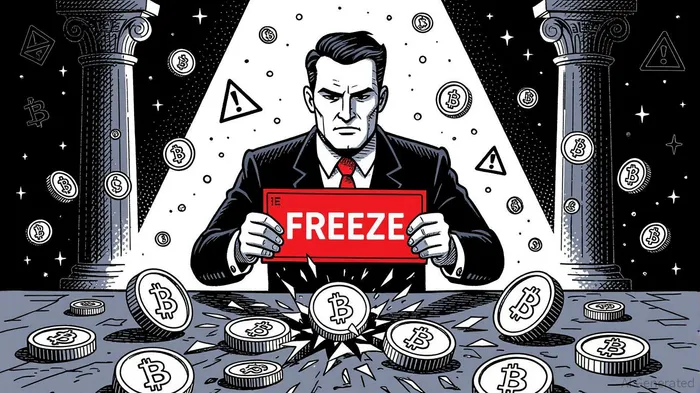
The cryptocurrency industry’s rapid evolution has brought unprecedented innovation, but it has also exposed critical vulnerabilities in compliance frameworks and platform credibility. Recent events, such as the WLFI token freeze incident and critiques from prominent figures like Bruno Skvorc and ZachXBT, underscore the urgent need for robust risk assessment in emerging crypto projects. Meanwhile, entities like Luxe Capital Growth—despite their names—highlight the importance of distinguishing between legitimate ventures and high-risk platforms. This analysis explores these dynamics through a lens of transparency, governance, and regulatory alignment.
The WLFI Token Freeze: Centralization vs. Decentralization
In September 2025, World Liberty Financial (WLFI) froze Justin Sun’s wallet, citing concerns over $9 million in token transfers to exchanges that allegedly suppressed the token’s price [1]. While WLFI defended the action as a measure to protect users from phishing risks, critics argued it exemplified centralized overreach in a space built on decentralization. Blockchain analytics from Nansen and Arkham revealed that Sun’s transfers occurred after WLFI’s price had already declined, suggesting broader market forces—such as shorting and dumping—were at play [1].
The freeze of 595 million WLFI tokens ($107 million) triggered panic among investors, with many questioning whether such unilateral decisions could erode trust in blockchain projects [5]. The U.S. Securities and Exchange Commission (SEC) has since launched an investigation into potential securities law violations, amplifying concerns about regulatory scrutiny [5]. This incident highlights a critical risk: projects that prioritize centralized governance over decentralized principles may face backlash from both users and regulators.
Automated Compliance Tools: A Double-Edged Sword
Blockchain developer Bruno Skvorc and onchain investigator ZachXBT have raised alarms about the limitations of automated compliance systems. Skvorc accused WLFI of unfairly blacklisting his wallet due to indirect links to Tornado Cash and sanctioned entities, despite having invested in the project [1]. He criticized the lack of recourse for affected users, calling it a “mafia-style system” [4]. Similarly, ZachXBT warned that overreliance on compliance tools often leads to false positives, such as flagging addresses for trivial DeFi interactions [3]. These critiques reveal a systemic issue: while compliance is essential, rigid automation without human oversight can undermine user trust and create reputational damage.
Luxe Capital Growth: A Case of Identity and Credibility
The name “Luxe Capital Growth” appears in two distinct contexts, each with divergent risk profiles. On one hand, a forex and crypto trading platform bearing the name has been flagged for offering high leverage (up to 1:500) and opaque trading conditions, raising red flags for potential fraud [5]. On the other, Lux Capital—a venture capital firm with $4 billion in assets under management—invests in early-stage tech and science startups, including AI-driven compliance tools like ConductorAI [2]. The latter’s focus on innovation and strategic partnerships with firms like Hugging Face and Anduril underscores its credibility in navigating high-complexity sectors [3].
This duality illustrates a broader challenge: investors must rigorously vet platforms to avoid conflating similar names. For instance, Lux Capital’s emphasis on AI and deep tech aligns with emerging compliance needs, whereas the forex platform’s lack of transparency signals high risk. The key takeaway is that credibility in crypto compliance hinges on operational transparency, governance structures, and alignment with regulatory expectations.
Risk Assessment Framework for Emerging Projects
To mitigate compliance risks, emerging crypto projects should adopt the following strategies:
1. Decentralized Governance with Human Oversight: Projects must balance automated compliance tools with transparent, community-driven decision-making to avoid accusations of centralization [1].
2. Regulatory Proactivity: Engaging with regulators early—rather than reacting to scrutiny—can build trust and preempt legal challenges, as seen in the SEC’s WLFI investigation [5].
3. Transparency in Compliance Decisions: Providing clear, auditable reasons for actions like wallet freezes, along with appeal mechanisms, can preserve user trust [4].
4. AI-Driven Risk Mitigation: Leveraging AI for compliance, as Lux Capital does, can enhance accuracy while addressing ethical concerns like bias and interpretability [2].
Conclusion
The WLFI incident and critiques from Skvorc and ZachXBT serve as cautionary tales for the crypto industry. They highlight the fragility of trust in projects that prioritize centralized control over decentralization and the risks of overreliance on automated compliance tools. Meanwhile, the Luxe Capital Growth case underscores the importance of due diligence in distinguishing between legitimate ventures and high-risk platforms. For investors, the path forward lies in demanding transparency, supporting projects with robust governance, and staying informed about regulatory trends. In an industry where credibility is currency, the stakes have never been higher.
**Source:[1] Crypto dev claims Trump-linked WLFI "stole" his money, [https://cointelegraph.com/news/developer-trump-wlfi-stealing-tokens][2] Lux Capital [https://teaserclub.com/investors/lux-capital][3] The founder of RMRK said that his address was marked as ..., [https://www.panewslab.com/en/articles/ffcf2538-0905-497e-bdfc-1cd1358cf939][4] WLFI Accused of Blocking Investor Tokens After ..., [https://www.mexc.co/en-IN/news/wlfi-accused-of-blocking-investor-tokens-after-compliance-flags/87787][5] 2.9 billion frozen: TrumpTRUMP-- crypto ally Justin Sun's tokens ..., [https://m.economictimes.com/news/international/global-trends/us-news-107-million-frozen-trump-crypto-ally-justin-suns-tokens-linked-to-suspicious-exchange-activity-check-details/articleshow/123720189.cms]






Comentarios
Aún no hay comentarios