
Navigating Crypto Winter: Strategic Adaptation for South Korean Crypto Exchanges in a Volatile Market
Regulatory Tightrope: Compliance vs. Innovation
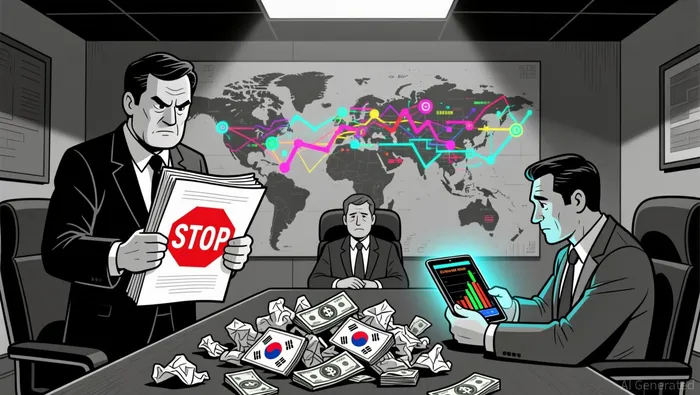
South Korea's regulatory environment has become a double-edged sword. The Financial Services Commission (FSC), Korea Financial Intelligence Unit (KoFIU), and Financial Supervisory Service (FSS) have imposed stringent AML and CTF requirements, including mandatory registration for Virtual Asset Service Providers (VASPs) and the enforcement of the Travel Rule for transactions exceeding KRW 1 million. These measures, while critical for curbing illicit activity, have inadvertently stifled innovation. Exchanges are now restricted from offering institutional-grade services like derivatives and ETFs-tools that global peers such as CoinbaseCOIN-- and Binance use to diversify revenue streams according to market analysis.
The result? A "shadow regulatory environment" where South Korean exchanges lag behind international competitors. For instance, Upbit's third-quarter trading volume reached $286.4 billion, but this figure pales in comparison to diversified income models of global platforms. As one industry executive noted, "Without regulatory reform, South Korea risks becoming a relic in the global digital finance arena."
Market Vulnerabilities: A Retail-Driven Dilemma
The overreliance on retail trading fees has left South Korean exchanges particularly exposed to market volatility. In early November 2025, daily trading volumes on major platforms plummeted to $1.88 billion, the lowest since January 2025. This decline coincided with a broader shift in investor behavior: retail traders, once the lifeblood of the market, are increasingly diverting capital to traditional stock markets, citing heightened compliance costs and perceived risks.
Compounding the issue is the fact that over 98% of exchange revenue still derives from trading fees. While platforms have attempted to offset this by accelerating token listings-adding 391 new tokens in 2025, a 47% year-over-year increase-the strategy has done little to address underlying structural weaknesses.
Diversification Imperatives: A Path Forward
Despite limited concrete examples of diversification strategies, 2025 has seen early signs of adaptation. The most notable development is the reported acquisition talks between Bybit and Korbit, South Korea's oldest exchange. While Bybit denied knowledge of the potential deal, the discussions reflect a broader trend: foreign firms are increasingly acquiring local exchanges to bypass regulatory hurdles and expand into institutional services. Binance's acquisition of Gopax in 2023, after a two-year regulatory process, underscores this pattern.
Regulatory shifts also hint at a potential pivot. South Korea's Financial Services Commission has introduced the Virtual Asset Investor Protection Act, aiming to bolster investor confidence. Meanwhile, political leaders like President Lee Jae-myung have pledged support for spot crypto ETFs and a KRW-backed stablecoin, signaling a gradual opening to institutional-grade infrastructure. These moves, if implemented, could enable exchanges to offer derivatives and custody services, aligning them with global standards.
The Road Ahead: Balancing Compliance and Growth
For South Korean exchanges to thrive in a post-winter landscape, the path forward requires a delicate balance. Regulators must streamline policies to allow for institutional services while maintaining AML/CTF rigor. Exchanges, in turn, must diversify revenue streams beyond retail trading-a task complicated by the absence of a derivatives market and the slow rollout of ETFs.
The stakes are high. As global markets consolidate around platforms with robust institutional ecosystems, South Korea's exchanges risk irrelevance unless they adapt. The coming months will test whether the country can transform its regulatory rigor into a competitive advantage-or if it will remain a cautionary tale of missed opportunities.





Comentarios
Aún no hay comentarios